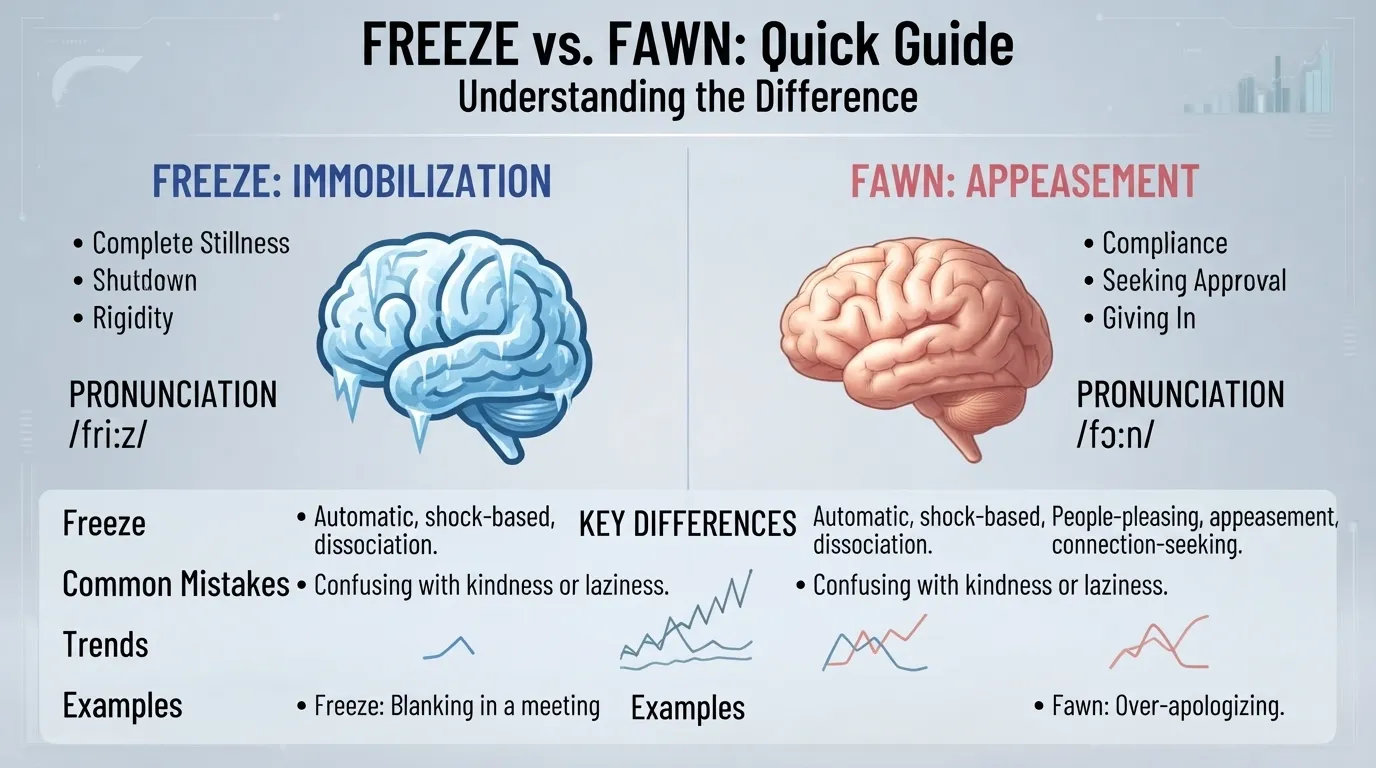
Fawn means trying to please someone, while freeze means becoming unable to move or speak.
Have you ever been in a tense moment and did not know what to do? Maybe someone was angry with you. You may have said sorry right away. You may have agreed with them just to stop the fight. This is a fawn response. Another person may react in a very different way. Almost unable to speak, they stand in silence.Bound by confusion, they feel entirely stuck.Completely at a loss for words, they remain quiet. This is a freeze response.
The words fawn or freeze are often used when people talk about fear, stress, and hard moments. They describe two different reactions. A fawn response means trying to make another person happy or calm. A freeze response means feeling stuck and unable to act.
People search for fawn or freeze because the two responses can look similar. Both can happen during stress. But the actions are not the same. Knowing the difference helps you use each word in the right way.
Pronunciation
| Word | US English | UK English |
|---|---|---|
| Nonresponsive | /ˌnɑːnrɪˈspɑːnsɪv/ | /ˌnɒnrɪˈspɒnsɪv/ |
| Unresponsive | /ˌʌnrɪˈspɑːnsɪv/ | /ˌʌnrɪˈspɒnsɪv/ |
The words are said the same way in US and UK English.
Now let us look at the difference in simple terms.
Difference Between Fawn or Freeze
1. Basic Meaning
Fawn means trying to please someone. It can happen when a person wants to avoid trouble.
Freeze means becoming still or unable to act.
Examples:
- She tried to fawn over her boss.
- He froze when he heard the loud sound.
2. Action vs. No Action
Fawn usually involves action. The person may talk, agree, or say sorry.
Freeze often means that the person cannot act.
Examples:
- He agreed with her to keep her happy.
- She froze and could not answer.
3. Trying to Please
Fawn is often linked to trying to please another person.
The person may agree even when they do not want to.
Examples:
- She said yes because she did not want a fight.
- He kept saying sorry to calm his friend.
Freezing is different.
- He became quiet during the fight.
- She could not say a word.
4. Talking
A person who fawns may talk more.
They may try to explain things or make the other person feel calm.
Examples:
- “I am sorry. You are right,” he said.
- She kept trying to make her friend happy.
A person who freezes may stop talking.
Examples:
- He could not answer the question.
- She became silent when the argument started.
5. Movement
Fawn does not usually mean that a person stops moving.
Freeze can affect movement.
Examples:
- He walked over and tried to calm her.
- She froze when she saw the dog.
6. During an Argument
A person may fawn during an argument by agreeing or saying sorry.
Examples:
- She agreed just to end the fight.
- He said sorry again and again.
A person may freeze during an argument.
Examples:
- He became quiet when they started shouting.
- She could not think of what to say.
7. Main Purpose
Fawn can be a way to avoid more trouble.
The person tries to keep the other person calm.
Examples:
- He agreed to avoid a fight.
- She tried to make her angry friend happy.
Freeze does not involve the same kind of effort.
Examples:
- He froze when he felt scared.
- She froze when everyone looked at her.
8. Feelings
Fawn may come with fear of anger or rejection.
The person may feel that pleasing others is the safest choice.
Examples:
- She said sorry because she feared more anger.
- He agreed because he did not want to be disliked.
Freezing may feel like being stuck.
Examples:
- He wanted to speak but could not.
- She wanted to move but stayed still.
9. What Other People See
A fawn response may look like being very nice or agreeable.
Examples:
- She kept agreeing with him.
- He praised his boss too much.
A freeze response may look like silence or stillness.
Examples:
- He stood still and said nothing.
- She looked scared and could not move.
10. Word Forms
Fawn is a verb.
- She fawned over the famous singer.
Freeze is also a verb.
- I freeze when I get scared.
The last form of freeze is froze.
- I froze when I heard the noise.
The past form of fawn is fawned.
- She fawned over her manager.
Nature and Behaviour of Fawn or Freeze
Fawn
Fawn is about pleasing another person. A person may agree, say sorry, or give praise. They may do this because they want to avoid a fight or make the situation feel safe.
For example, a person may say, “You are right,” even when they do not agree.
Freeze
Freeze is about being unable to act. A person may become quiet or still. They may know what they want to do but still feel unable to do it.
For example, a person may want to run away but cannot move.
Why People Get Confused About Fawn or Freeze
People get confused because both can happen when someone feels stressed or scared.
The person may not act in a normal way. But the two reactions are different.
Fawn = trying to please.
Freeze = becoming unable to act.
Think of it this way:
If someone tries to make an angry person happy, it may fawn.
If someone becomes quiet and cannot respond, it may freeze.
Comparison Table
| Feature | Fawn | Freeze |
| Meaning | Try to please | Become unable to act |
| Main action | Agree or please | Stop or become still |
| Speech | May talk more | May stop talking |
| Movement | Usually continues | May become limited |
| Common feeling | Fear of conflict | Fear or shock |
| Example | Saying sorry to avoid a fight | Being unable to speak |
| Past form | Fawned | Froze |
| US spelling | Fawn | Freeze |
| UK spelling | Fawn | Freeze |
| Main idea | Please | Stop |
The Origin of Fawn or Freeze
Origin of Fawn
The word fawn has more than one meaning.
One meaning is a young deer. Another meaning is to praise or please someone too much.
The verb form has been used in English for a long time.
Origin of Freeze
The word freeze is also very old. Its first main meaning was linked to cold weather and ice.
Later, people began to use it in other ways.
For example, we can say:
- “I froze with fear.”
Here, freeze does not mean turning into ice. It means becoming unable to act.
British vs American English
There is no spelling difference between fawn and freeze in British and American English.
Both forms use the same spelling.
British English
- She froze when she heard the news.
- He tried to fawn over his boss.
American English
- She froze when she heard the news.
- He tried to fawn over his boss.
The basic grammar is also the same.
Which One Should You Use?
Use fawn when someone tries to please another person.
Use freeze when someone becomes unable to move, speak, or act.
This rule works in both US and UK English.
For global English, the same rule is easy to follow:
- Fawn = try to please.
- Freeze = become stuck or still.
Common Mistakes
Mistake 1: Using “Freeze” for Pleasing
❌ She froze to make her boss happy.
✅ She fawned over her boss.
Mistake 2: Using “Fawn” for Being Scared
❌ He fawned when he saw the snake.
✅ He froze when he saw the snake.
Mistake 3: Using “Freezed”
❌ She freezed when she heard the noise.
✅ She froze when she heard the noise.
Mistake 4: Confusing the Two Meanings of Fawn
Fawn can also mean a young deer.
- We saw a fawn in the woods.
This meaning is different from the behavior meaning.
Everyday Usage Examples
In Emails
- “I froze during the meeting and could not answer.”
- “I often fawn when I want to avoid an argument.”
On Social Media
- “I totally froze when everyone looked at me.”
- “Some people fawn when they feel scared.”
In News
- “The witness froze when asked the question.”
- “The report talks about fawn behavior during stress.”
In Formal Writing
- “Some people may freeze during a stressful event.”
- “A person may fawn to avoid conflict.”
Usage Trends
Freeze is much more common in everyday English.
We use it in many ways.
- Freeze food.
- Freeze water.
- Freeze a computer.
- Freeze with fear.
Fawn is less common when it means trying to please someone. It is more likely to appear in writing about behavior, stress, or relationships.
Fawn is also used when talking about a young deer.
Metaphors and Similes
Freeze can have a figurative meaning.
For example:
- “The room froze when the teacher walked in.”
- “I froze under pressure.”
These sentences do not mean that the room or person became ice.
They mean that people became very quiet or unable to act.
Fawn can also describe strong praise.
- “He fawned over the rich guest.”
- “She fawned over her new boss.”
Connotative Meaning
Fawn
Fawn can have a negative meaning.
It may suggest that someone is trying too hard to please another person.
- “He fawned over his boss.”
This can sound critical.
Freeze
Freeze is often neutral.
It can simply describe a sudden reaction.
- “She froze when she heard the noise.”
It can also show fear or stress.
Idioms and Proverbs
There is no common proverb that directly compares fawn and freeze.
But freeze is used in some common phrases.
Freeze Up
Blocking all speech and action, one freezes up under pressure.
- “I froze up during the test.”
Freeze in Fear
This means to become still because of fear.
- “The child froze in fear.”
Fawn is usually used as a normal verb rather than in a common idiom.
Literature and Movies
Words like fawn and freeze can help describe how people act in stories.
Characters may freeze when they face danger. They may also try to please someone who has power over them.
For example, The Scarlet Letter is a historical novel by Nathaniel Hawthorne. It was published in 1850. The story deals with fear, shame, and social pressure.
The Hunchback of Notre Dame is a 1996 American animated musical film. It also deals with fear, power, and social pressure.
Why This Difference Matters
The difference between fawn and freeze matters because the words describe different actions.
Use fawn when a person tries to please someone.
Use freeze when a person becomes unable to act.
This can help English learners write better sentences. It can also help readers understand articles about fear, stress, and behavior.
For example:
- “She fawned to avoid the fight.”
- “She froze during the fight.”
These sentences show two very different reactions.
Usefulness in Daily Life
You may hear freeze often in daily English.
- “My computer froze.”
- “I froze when I saw him.”
- “The water froze.”
You may see fawn less often.
- “He fawned over his boss.”
- “She fawned over the famous singer.”
Situational Preference
Choose fawn when the main action is trying to please another person. This may happen during an argument, a tense talk, or another hard moment. Choose freeze when a person becomes still or cannot respond. For example, someone may fawn by saying sorry again and again. Another person may freeze and say nothing. The best word depends on what the person does. If they try to make someone happy, use fawn. If they become stuck or unable to act, use freeze. This simple rule works well in daily English, school writing, and formal writing.
Possible Questions
What does fawn mean?
Fawn can mean trying to please or praise someone too much.
What does freeze mean?
Freeze can mean becoming still or unable to act because of fear, stress, or surprise.
Are fawn and freeze the same?
No. Fawn is about trying to please. Freeze is about becoming unable to act.
Is fawn a stress response?
The word fawn is used in some discussions about stress and fear. It describes people-pleasing behavior.
Is freeze a stress response?
Yes. Freeze is commonly used to describe becoming still or unable to respond during fear or stress.
What is the past tense of freeze?
The past tense is froze.
- “She froze when she heard the sound.”
Are fawn and freeze different in US and UK English?
No. Both words have the same spelling and basic meaning in US and UK English.
Conclusion
Fawn or freeze describes two different ways people may react to fear, stress, or conflict. Fawn means trying to please another person. Freeze means becoming still or unable to act. The easiest way to remember the difference is to look at the action. A person who fawns may say sorry, agree with someone, or try to make that person happy. A person who freezes may become quiet, still, or unable to speak. Both words are correct in British and American English. Their spelling does not change. However, they should not be used in the same way. Fawn focuses on pleasing behavior. Freeze focuses on being stuck or unable to respond. These words are useful in daily English and in writing about stress and behavior. They can also help you understand books, articles, and online discussions. So, when someone tries to please another person, choose fawn. When someone becomes unable to act, choose freeze. This simple difference will help you use both words with confidence.

Mahnoor Afzal is an educator, researcher, and English language content specialist focused on grammar, vocabulary, word differences, and meanings. I combines research, teaching, and SEO expertise to create clear and reliable English learning content at Lengovia.