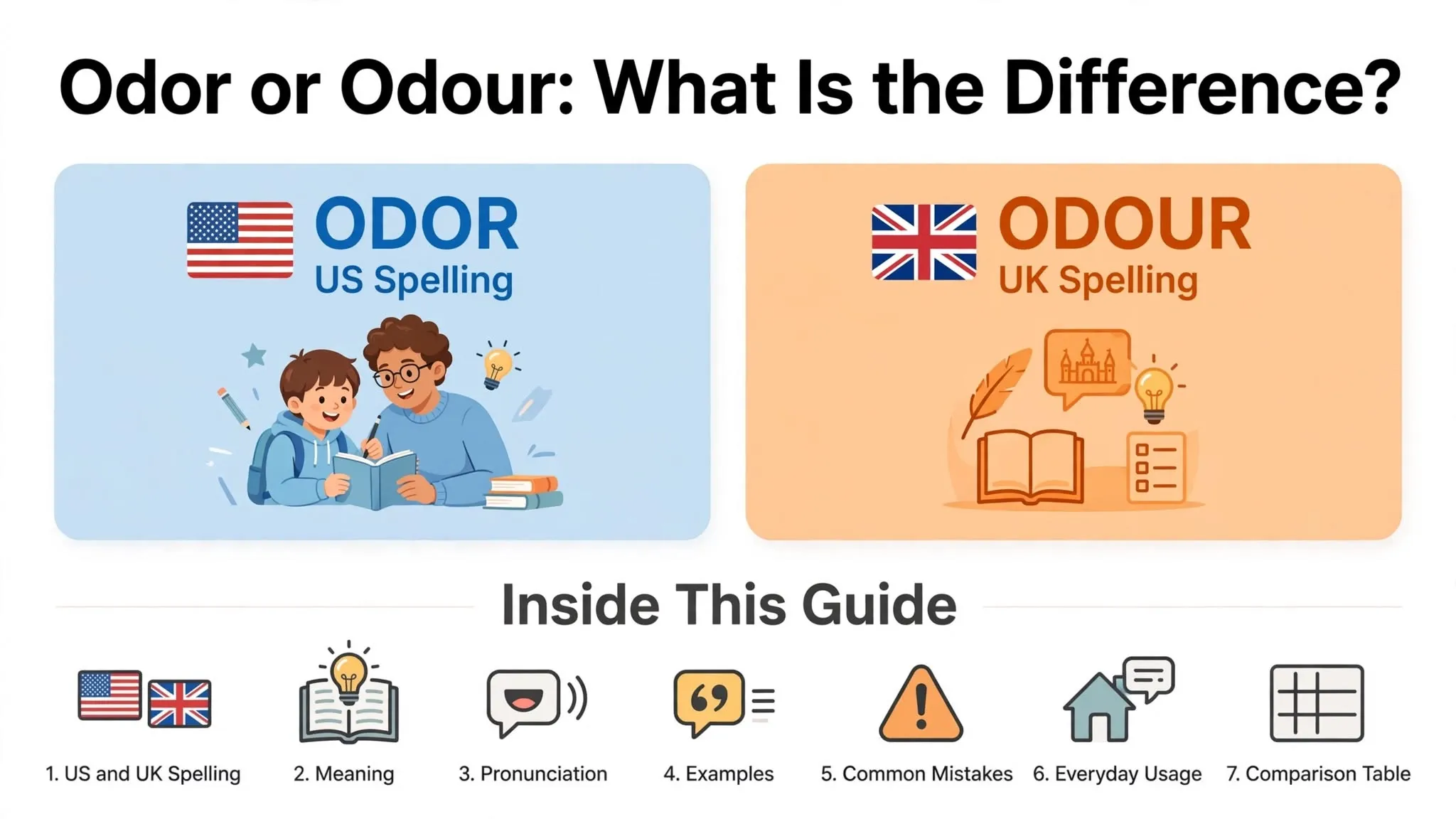
Odor and Odour have the same meaning. Odor is used in American English, while odour is used in British English.
Have you ever written a sentence about a smell and stopped to ask, “Is it odor or odour?” This is a common question for English learners. The two words look different, but their meaning is the same.
Both odor and odour are nouns. They mean a smell or scent. The smell may be good, bad, strong, weak, or strange. The main difference is the spelling style.
American English uses odor. British English uses odour. You can see the same pattern in words such as color/colour and honor/honour.
For example, an American writer may say, “There is a strange odor in the room.” A British writer may write, “There is a strange odour in the room.”
If you are writing for a US audience, use odor. If you are writing for a UK audience, use odour. Knowing this small difference can help you write clear and correct English.
Pronunciation of Odor or Odour
US English: /ˈoʊdər/
UK English: /ˈəʊdə/
The two words are pronounced almost the same. The main difference is their spelling.
Now, let us look at odor or odour in more detail.
Difference Between Odor or Odour
1. Meaning
Both words mean a smell.
- The room had a strange odor.
- The room had a strange odour.
2. American English
Odor is the standard spelling in American English.
- There was a bad odor in the kitchen.
- The dog left a strong odor.
3. British English
Odour is the standard spelling in British English.
- There was a bad odour in the kitchen.
- The dog left a strong odour.
4. Spelling
The main spelling difference is the letter u.
- American English: odor
- British English: odour
The meaning stays the same.
5. Pronunciation
The two words sound almost the same.
- The US form is odor.
- The UK form is odour.
The spelling changes, but the sound has only a small regional difference.
6. Formal Writing
Both forms are correct in formal writing.
- The chemical produced a strong odor. (US)
- The chemical produced a strong odour. (UK)
Your choice should match your English style.
7. Daily Use
People can use both words in everyday English.
- I noticed a strange odor.
- I noticed a strange odour.
Both sentences are correct.
8. Pleasant Smell
The words can describe a pleasant smell too.
- The flowers had a sweet odor.
- The flowers had a sweet odour.
However, words like scent and fragrance are often better for pleasant smells.
9. Unpleasant Smell
The words are often used for bad smells.
- There was a terrible odor from the drain.
- There was a terrible odour from the drain.
The word can make the smell sound strong or noticeable.
10. Same Grammar
Both words are nouns.
They can be used after words such as a, the, strong, bad, strange, sweet, and pleasant.
- A strange odor filled the room.
- A strange odour filled the room.
Nature and Behaviour
Odor and odour describe something that can be smelled.
A smell can come from many things. It can come from food, flowers, animals, chemicals, smoke, or a room.
The word does not always mean a bad smell. Context tells us whether the smell is good or bad.
For example, a sweet odour can be pleasant. A bad odor is usually unpleasant.
Why People Get Confused
People often get confused because the words have different spellings.
They may think that one word is a spelling mistake. That is not true.
Both are correct. The difference comes from American and British English.
American English often removes the u found in some British spellings. British English keeps it.
For example:
- odor / odour
- color / colour
- honor / honour
- favor / favour
Comparison Table
| Feature | Odor | Odour |
| Meaning | A smell | A smell |
| Main use | American English | British English |
| Spelling | Odor | Odour |
| Pronunciation | Almost the same | Almost the same |
| Word type | Noun | Noun |
| Formal use | Yes | Yes |
| Daily use | Yes | Yes |
The Origin of Odor or Odour
The word comes from the Latin word odor, which means “smell” or “scent.” The word entered English many centuries ago.
Over time, English developed different spelling styles. British English kept the spelling odour, while American English commonly uses odor.
The two forms still have the same basic meaning.
British vs American English
The biggest difference is spelling.
American English uses:
The room has a strange odor.
British English uses:
The room has a strange odour.
Which One Should You Use?
Use odor for American English writing.
Use odour for British English writing.
Common Mistakes
One common mistake is thinking that odour is always wrong.
It is not wrong. It is the British spelling.
Another mistake is thinking that odor is always wrong.
It is not wrong either. It is the American spelling.
Incorrect idea:
“Odour is a misspelling of odor.”
Correct idea:
Odor and odour are two standard English spellings.
Everyday Usage Examples
In Emails
US: Please check the strange odor in the office.
UK: Please check the strange odour in the office.
On Social Media
US: What is that strange odor?
UK: What is that strange odour?
In News
US: Workers reported a strong odor near the factory.
UK: Workers reported a strong odour near the factory.
In Formal Writing
US: The test showed a strong odor.
UK: The test showed a strong odour.
Usage Trends
The spelling odor is common in American English. The spelling odour is common in British English.
You may also see odour in other places where British spelling is used.
The choice often depends on the country and the style guide used by a school, company, newspaper, or website.
Metaphors and Similes
Writers can use smells to create clear pictures in the reader’s mind.
For example:
- The odor spread through the house like smoke.
- The odour was as strong as rotten food.
These examples help readers imagine the smell.
Connotative Meaning
The basic meaning of odor and odour is simply “a smell.”
However, the word can sometimes suggest an unpleasant smell when it is used without an adjective.
For a nice smell, writers often use words such as scent or fragrance.
For example:
- The room had a strange odor.
- The flowers had a sweet fragrance.
Idioms and Proverbs
There are no major idioms that depend on the spelling odor or odour.
However, English has expressions about smell. One common example is “smell a rat.”
It means that someone thinks something is wrong or dishonest.
The spelling difference between odor and odour does not change such expressions.
Literature and Movies
Writers often use smells to make scenes feel real. A story may describe the smell of food, flowers, rain, streets, or old buildings.
For example, a writer may describe the odour of a crowded street to help readers imagine the place.
Movies also use smell in dialogue and descriptions. Although viewers cannot smell the scene, words about smell can make a scene feel more real.
Why This Difference Matters
This difference matters when you write for a specific audience.
Using the right spelling can make your writing fit the English style used by your readers.
If you write for Americans, odor is the usual choice.
If you write for British readers, odour is the usual choice.
Usefulness in Daily Life
You may see odor or odour in many places. These include books, websites, product descriptions, school work, news, and work documents.
Knowing both forms also helps you read English from different countries without thinking that one spelling is a mistake.
Situational Preference
Your choice depends on your audience. Use odor when your content follows American English. Use odour when your content follows British English. For example, a US school book may use odor, while a UK newspaper may use odour. Both forms are correct. If you are writing an article for a website, check its spelling style first. Then use the same style throughout the article. This makes your writing look clear and consistent.
Possible Questions
Is odor or odour correct?
Both are correct. Odor is American English, and odour is British English.
What does odor mean?
Odor means a smell. It can be pleasant or unpleasant.
What does odour mean?
Odour also means a smell. It has the same meaning as odor.
Which is American, odor or odour?
Odor is the standard American spelling.
Which is British, odor or odour?
Odour is the standard British spelling.
Is odour wrong in American English?
Odour is not a meaningless or incorrect word, but odor is the usual American spelling.
Should I use odor or odour?
Use odor for American English and odour for British English.
Conclusion
Odor or odour is a simple spelling difference between American and British English. Both words have the same meaning. They both mean a smell. The main difference is the letter u. American English uses odor, while British English uses odour.Both forms can describe good, bad, strong, weak, or strange smells. They can be used in daily speech, formal writing, emails, news, and websites. If you are writing for a US audience, choose odor. If you are writing for a UK audience, choose odour.If you are writing for a global audience, choose one style and use it consistently. Once you understand this difference, choosing between odor or odour becomes easy.The important thing is not to think that one form is always right and the other is always wrong. Both are correct in the English variety where they are normally used.

Mahnoor Afzal is an educator, researcher, and English language content specialist focused on grammar, vocabulary, word differences, and meanings. I combines research, teaching, and SEO expertise to create clear and reliable English learning content at Lengovia.