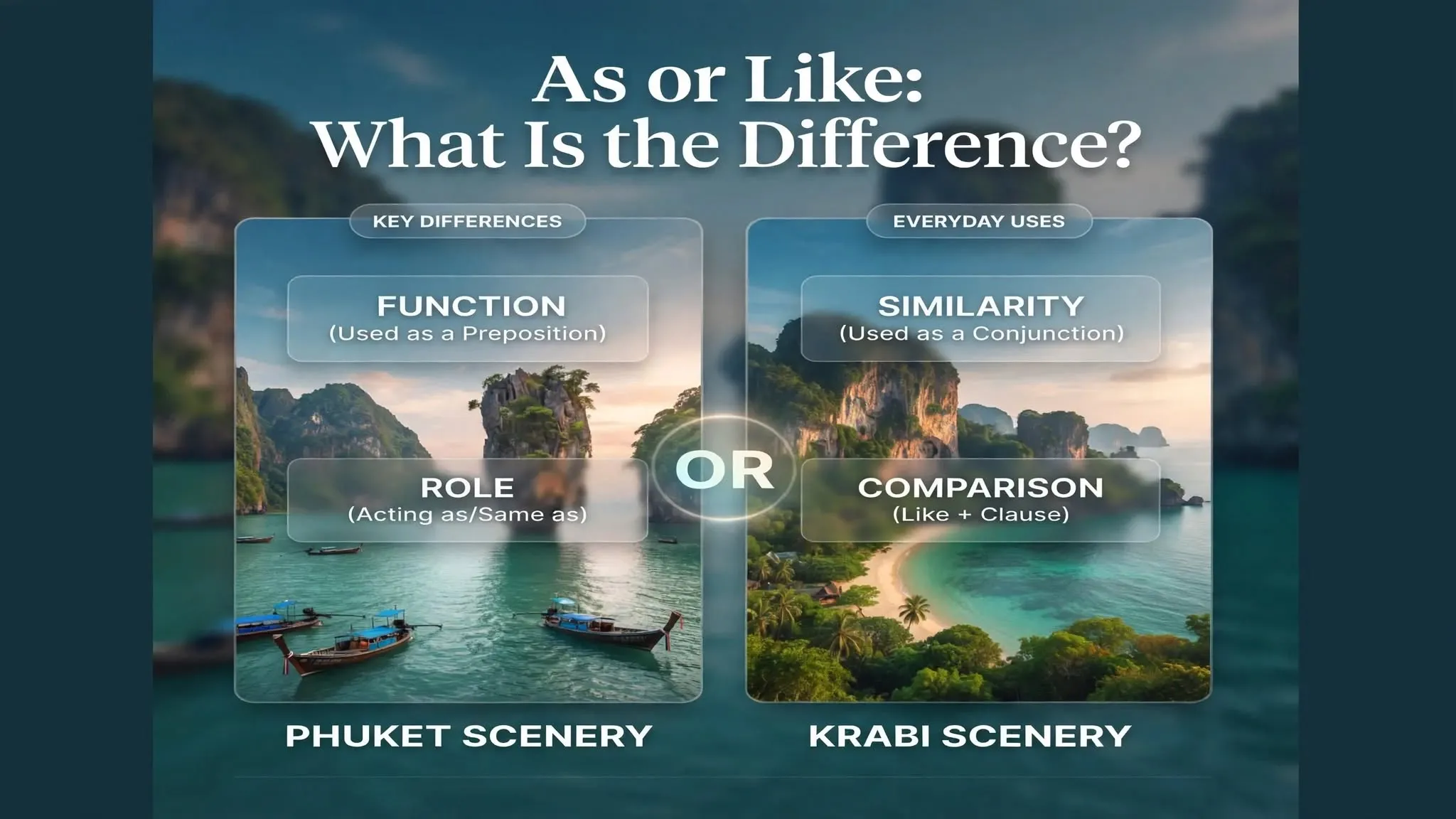
Use as to talk about a role, way, or action. Use like to say that two things are similar.
Have you ever stopped while writing a sentence and wondered, “Should I use as or like?” You are not alone. These two small words can cause a lot of confusion. For example, we say, “She works as a teacher,” but we say, “She sings like a bird.” Both sentences sound simple, but as and like do different jobs.
In simple English, as often tells us about a job, role, or way something happens. On the other hand, like often shows that one person or thing is similar to another. Because the words can look alike in some sentences, people often use the wrong one. So, learning as or like can make your English clearer.
In this guide, we will look at as or like with simple rules and examples. We will also look at common mistakes, daily use, British and American English, and easy ways to remember the difference.
Pronunciation of As and Like
As
- US: /æz/
- UK: /æz/
Like
- US: /laɪk/
- UK: /laɪk/
Now, let us look at the main difference between these two words.
Difference Between As and Like
1. As talks about a role or job
We often use as when a person has a job, role, or purpose.
Examples:
- She works as a teacher.
- He works as a driver.
Here, the person really is a teacher or driver.
2. Like shows similarity
We use like when one person or thing is similar to another.
Examples:
- She sings like a bird.
- He runs like a deer.
The person is not really a bird or a deer. The sentence only compares them.
3. As can mean “in the way that”
We can use as to talk about the way something is done.
Examples:
- Do as I say.
- Do it as your teacher showed you.
In these sentences, as means “in the way that.”
4. Like can compare two things
Like is often used before a noun or pronoun to make a comparison.
Examples:
- Your eyes look like stars.
- He eats like a horse.
These sentences show similarity.
5. As can introduce a clause
A clause has a subject and a verb. We can use as before a clause.
Examples:
- Do it as I told you.
- As she expected, the test was easy.
Here, as connects ideas.
6. Like is often followed by a noun
In simple comparisons, like is usually followed by a noun or pronoun.
Examples:
- She looks like her mother.
- This tastes like honey.
The words after like name the thing being compared.
7. As can show a real position
As can show that someone is acting in a real role.
Examples:
- He served as a leader.
- She worked as a nurse.
The role is real.
8. Like can show an imagined comparison
Like can also compare something that is not really the same.
Examples:
- He sleeps like a baby.
- The clouds look like cotton.
He is not a baby, and clouds are not cotton. The words only show similarity.
9. As can mean “because” in some sentences
Sometimes as gives a reason.
Examples:
- As it was raining, we stayed home.
- As I was tired, I went to bed.
Here, as has a meaning close to “because.”
10. Like can be used for simple comparison
When you want to say that two things look, sound, feel, or act in a similar way, like is often the right choice.
Examples:
- It looks like rain.
- She sounds like her sister.
So, in short, as often talks about a role or way, while like often talks about similarity.
You may also read https://lengovia.com/mopped-or-moped/
Nature and Behaviour of As and Like
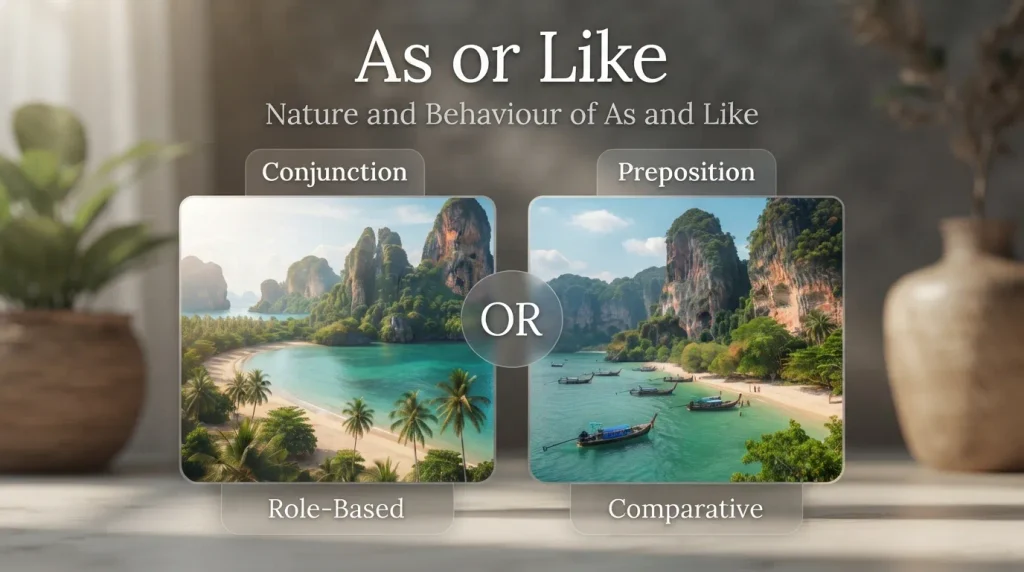
The word as has many jobs. It can talk about a role, a way, a reason, or time. Therefore, you may see as in many kinds of sentences.
For example:
- I work as a writer.
- Do as I say.
- As it was late, we left.
The word like is often used for comparison.
For example:
- She looks like her sister.
- He runs like a rabbit.
- It feels like silk.
However, like can have other uses too. For example, it can be a verb meaning to enjoy something.
- I like tea.
- They like this movie.
Therefore, you should look at the whole sentence before choosing as or like.
Why Do People Get Confused About As and Like?
People often get confused because both words can be used in comparisons.
For example:
- She sings like a professional.
- She works as a professional singer.
The first sentence compares her singing to that of a professional. The second sentence tells us about her real role.
Also, in everyday speech, some people use like where traditional grammar would use as. Because of this, learners may hear different forms in real conversations.
However, for clear and formal writing, it is useful to learn the standard difference.
Comparison Table
| As | Like |
| Often shows a role | Often shows similarity |
| Can mean “in the way that” | Often means “similar to” |
| Can introduce a clause | Often comes before a noun |
| Can give a reason | Common in comparisons |
| She works as a teacher. | She sings like a bird. |
| Do as I say. | He looks like his father. |
Therefore, remember this simple rule:
As = role, way, or clause.
Like = similarity or comparison.
The Origin of As and Like
Both as and like are very old English words.
The word as comes from an old form that was used to show a way, manner, or similarity. Over time, it gained many uses in English.
The word like also has a long history. It comes from an old word connected with the idea of being similar.
Today, both words are common in everyday English. However, their uses are not always the same.
British vs American English
The basic difference between as or like is the same in British and American English.
For example:
- She works as a teacher.
- She looks like her mother.
Both British and American speakers use these forms.
However, there can be differences in casual speech. In informal American English, like is sometimes used in places where formal grammar may use as.
For example, people may say:
- It looks like he is tired.
In more formal writing, some style guides prefer:
- It looks as if he is tired.
Both forms can be heard in modern English, but the best choice can depend on the sentence and level of formality.
Which One Should You Use?
Use as when you mean a real role, way, or relationship between clauses.
Examples:
- She works as a doctor.
- Do as I told you.
Use like when you mean “similar to.”
Examples:
- She looks like a doctor.
- He eats like a king.
The first example says she really has the job. The second only says she looks similar to a doctor.
Therefore, ask yourself:
Is this a real role or way? Use as.
Am I only showing similarity? Use like.
Common Mistakes
Mistake 1: Using like for a real job
❌ She works like a teacher.
✅ She works as a teacher.
If teaching is her real job, use as.
Mistake 2: Using as for a simple comparison
❌ He runs as a rabbit.
✅ He runs like a rabbit.
He is not a rabbit. You are only making a comparison.
Mistake 3: Confusing “as” with “like” before a clause
❌ Do like I told you.
In informal speech, this may be heard. However, in careful standard writing:
✅ Do as I told you.
Mistake 4: Forgetting that like has other meanings
Like can also be a verb.
- I like apples.
- She likes music.
So, not every use of like is a comparison.
Everyday Usage Examples
You can see as or like in many daily situations.
In Emails
- I am writing as your teacher.
- Please do as we discussed.
For Social Media
- She dances like a star.
- This place looks like a dream.
In News
- He served as a leader for many years.
- The event looked like a major success.
For Formal Writing
- She worked as a research assistant.
- The machine works like a human hand.
In Daily Speech
- You look like your brother.
- Do as I say.
Therefore, both words are very useful in daily English.
Usage Trends
Today, like is very common in everyday English. People often use it in casual comparisons.
For example:
- It looks like rain.
- He talks like his father.
Also, many speakers use like in casual speech before a full clause.
However, as remains common in formal writing and in set phrases. Therefore, knowing both forms is helpful.
In short, modern English uses both words often, but the exact choice depends on meaning and sentence structure.
Metaphors and Similes
Like is very common in similes. A simile compares two things.
For example:
- Her face shines like the sun.
- He is strong like a lion.
These sentences do not say that the person is really the sun or a lion. They only make a picture in the reader’s mind.
As can also appear in comparisons, especially in patterns such as:
- as brave as a lion
- as cold as ice
- as light as a feather
Therefore, both words can help us make clear and interesting comparisons.
Connotative Meaning
As and like do not usually create the same feeling.
As can sound more direct or formal when it shows a role.
- She works as a manager.
Like can make a sentence feel more visual because it creates a comparison.
- She moves like a dancer.
So, the meaning and feeling depend on how the word is used.
Idioms and Common Phrases
There are many common phrases with as.
- as soon as
- as well as
- as long as
- as if
- as usual
Examples:
- Call me as soon as you arrive.
- She sings as well as her sister.
There are also many common phrases with like.
- like this
- like that
- looks like
- sounds like
- feels like
Examples:
- Do it like this.
- It looks like rain.
Learning these common phrases can make your English sound more natural.
Literature and Movies
Writers often use like to create clear comparisons.
For example, a writer may describe a person as moving like the wind. This helps readers picture the action.
The word as is also common in stories. It can connect actions or show time.
For example:
- As the sun went down, they went home.
Therefore, both words are useful in books, stories, films, and other forms of writing.
Why This Difference Matters
The difference between as or like may look small. However, it can change the meaning of a sentence.
Compare:
- She works as a teacher.
- She looks like a teacher.
The first sentence tells us her real job. The second sentence only gives an impression.
Usefulness in Daily Life
You do not need a hard rule to use as or like correctly.
First, think about the meaning.
If you mean a real role, use as.
- He works as a chef.
Next, if you mean “similar to,” use like.
- He cooks like a chef.
Then, check the rest of the sentence. If as introduces a full clause, it may be the better choice.
For example:
- Do as I told you.
With practice, this choice becomes easier.
Situational Preference
Use as when you talk about a real job, role, way, or clause. For example, “She works as a nurse.” Use like when you compare two people or things. For example, “She looks like her sister.” However, real English can be flexible, especially in casual speech. Therefore, listen to the whole sentence. In formal writing, choose the form that clearly shows your meaning. If you mean “similar to,” like is usually simple and clear. If you mean “in the role of” or “in the way that,” as is usually the better choice.
Possible Questions
1. What is the main difference between as and like?
As often shows a role, way, or clause. Like usually shows similarity.
2. Is “She works as a teacher” correct?
Yes. It means teaching is her real job.
3. Is “She sings like a bird” correct?
Yes. It compares her singing to the sound or style of a bird.
4. Can like be a verb?
Yes. For example, “I like coffee.”
5. Can as mean because?
Yes. In some sentences, as can give a reason.
Example: “As it was late, we went home.”
6. Which word is used for comparison?
Like is often used for simple comparisons.
Example: “He runs like a horse.”
7. Is “Do as I say” correct?
Yes. As means “in the way that” in this sentence.
Conclusion
The words as or like are small, but they have different jobs. In simple terms, use as for a real role, a way, or a clause. Use like when you want to show that two things are similar. For example, “She works as a teacher” tells us about her real job. However, “She sings like a bird” only makes a comparison. Also, as can give a reason, while like can be a verb that means to enjoy something. Therefore, always look at the meaning of the sentence before you choose the word. If you are talking about a real role, as is often the right choice. If you are saying that something is similar to something else, like is often the better choice. Finally, remember the easy rule: as = role or way; like = similarity. With a little practice, choosing between as or like will become much easier.

Mahnoor Afzal is an educator, researcher, and English language content specialist focused on grammar, vocabulary, word differences, and meanings. I combines research, teaching, and SEO expertise to create clear and reliable English learning content at Lengovia.







1 thought on “As or Like: What Is the Difference?”