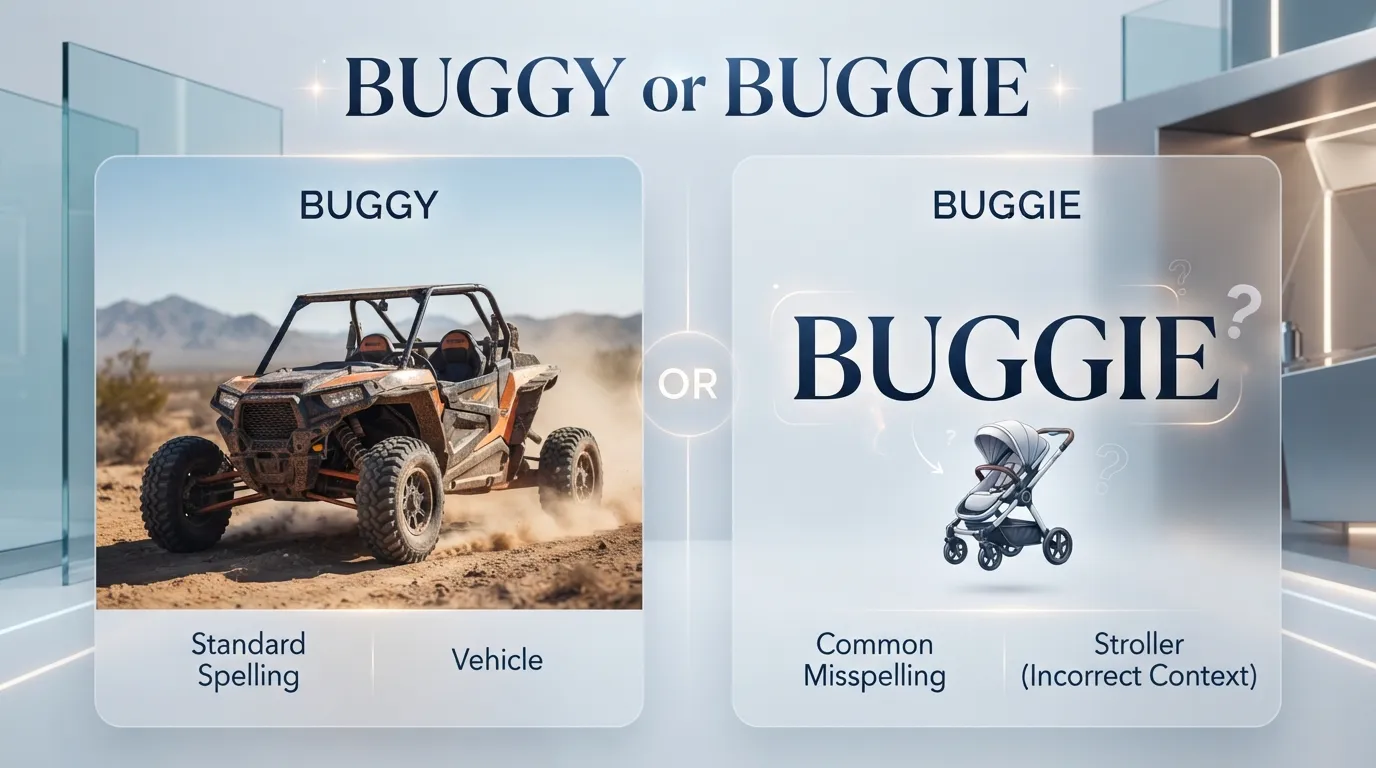
When you write in English, some words look almost the same but have different uses. Buggy or buggie is one example. Both spellings appear in English, but buggy is the standard spelling in most common uses. People often use it to talk about a small cart, a baby carriage, or something full of bugs.
The word buggie appears in some names and informal uses. However, it is not the usual spelling for everyday writing. If you are writing an email, a school assignment, or a blog post, buggy is normally the right choice.
Imagine you are writing about a small cart at a beach or a vehicle used on a farm. You may wonder whether to write buggy or buggie. In most cases, you should choose buggy. Learning this difference helps you spell words correctly and make your writing clear.
Use buggy for the standard word. Use buggie only when a name, brand, or specific source uses that spelling.
US and UK Pronunciation
- Buggy: /ˈbʌɡi/ in both US and UK English.
- Buggie: Usually pronounced the same way when used as a spelling variant or name.
Both sound like “BUG-ee.”
Difference Between Buggy and Buggie
1. Standard Spelling
Buggy is the standard spelling in general English. Buggie is less common.
- The child sat in a buggy.
- We drove a beach buggy.
2. Everyday Use
People use buggy in normal writing and speech. They rarely use buggie as a general word.
- She pushed the buggy down the street.
- The buggy moved over the sand.
3. Meaning
Buggy can mean a small cart or a light vehicle. It can also mean full of bugs or insects.
- The farmer used a horse and buggy.
- The old room was buggy in summer.
4. Baby Carriage
In British English, people often use buggy for a small pushchair for a baby.
- The baby slept in the buggy.
- Dad folded the buggy before putting it in the car.
5. Small Vehicle
A buggy can also mean a light vehicle used on sand or rough ground.
- They rented a dune buggy.
- The buggy drove across the beach.
6. Informal Names
Some people or businesses may use Buggie as a name or nickname. In that case, keep the spelling used by that person or business.
- Buggie was the name of her toy.
- The shop used Buggie in its brand name.
7. Formal Writing
Use buggy in schoolwork, reports, and most articles when you mean the common word.
- The buggy has four small wheels.
- The baby is sitting in a buggy.
8. Spelling in Sentences
Choosing the usual spelling makes your sentence easier to understand.
- Correct: The buggy is outside.
- Uncommon: The buggie is outside.
9. British English
In British English, buggy often means a baby pushchair. The spelling buggie is not the usual choice for this meaning.
- She took the baby out in a buggy.
- The buggy fits in the boot of the car.
10. Best Word to Choose
Choose buggy unless you are copying a special name or a source that clearly uses buggie.
- I bought a new buggy.
- The sign says “Buggie,” so we kept that spelling.
You may also read https://lengovia.com/sudafed-or-dayquil/
Nature and Behaviour
The word buggy has more than one meaning. Its meaning depends on the sentence.
It may refer to a small vehicle or a baby carriage. It can also describe a place with many bugs. In computer use, buggy means a program or device that does not work as it should.
The spelling buggie is uncommon in general writing. It may appear as a name or a special spelling.
Why Do People Get Confused?
People may confuse these words because they sound the same. The ending also looks similar. However, English does not always use the same spelling for words with the same sound.
The safest choice is to use buggy for the common word. Check the spelling when you see Buggie in a name or brand.
Comparison Table
| Feature | Buggy | Buggie |
| Standard spelling | Yes | Usually no |
| Pronunciation | BUG-ee | Usually BUG-ee |
| Baby carriage | Common | Uncommon |
| Small vehicle | Common | Uncommon |
| Formal writing | Preferred | Avoid unless it is a name |
| General use | Widely used | Limited use |
Origin of the Word
The word buggy has been used for a small, light carriage. Over time, people also began using it for other small vehicles, such as dune buggies.
The word bug is also used for insects and for errors in computer programs. This is why buggy can describe something full of bugs or a program with problems.
Buggie is a less common spelling. It may appear in names or informal writing.
British vs American English
Both British and American English use the spelling buggy, but the meaning may depend on the situation.
In British English, buggy often means a baby pushchair. In American English, people may use stroller more often for a baby carriage. Americans also use buggy for some small carts and vehicles.
Buggie is not the usual spelling in either variety.
Which One Should You Use?
Use buggy in most situations. It is the standard spelling and works in both British and American English.
Use buggie only if you need to keep the exact spelling of a name, nickname, brand, or title.
Common Mistakes
- Incorrect for normal use: The buggie is in the garden.
- Correct: The buggy is in the garden.
- Incorrect for normal use: We rented a buggie at the beach.
- Correct: We rented a buggy at the beach.
- Incorrect assumption: Buggy and buggie are always equal.
- Correct: Buggy is the standard spelling; buggie is uncommon.
Everyday Usage Examples
In Emails
“Please bring the baby’s buggy to the car.”
On Social Media
“We had fun driving a dune buggy on the beach!”
In News
“The new buggy can travel over rough ground.”
In Schoolwork
“The farmer used a horse and buggy.”
Usage Trends
Buggy is the more common spelling in everyday English. You may see it in books, websites, product descriptions, and conversations.
Buggie appears less often and is more likely to be used as a special name or informal spelling. For clear writing, choose buggy unless you have a reason to use the other form.
Metaphors and Similes
The word buggy can also describe something that does not work well, especially a computer program.
- “The app is buggy” means the app has errors.
- “The game is as buggy as an old computer” means the game has many problems.
These examples use buggy, not buggie.
Connotative Meaning
The meaning of buggy depends on the context.
When it refers to a baby carriage, it is a neutral word. It describes software, it suggests that something is faulty or unreliable. When it refers to a small vehicle, it may suggest fun, travel, or outdoor activity.
Buggie does not have a widely accepted separate meaning in standard English.
Idioms and Common Expressions
There is no widely used English idiom that depends on the spelling buggie. However, these common expressions use buggy:
- Dune buggy: A light vehicle made for sandy ground.
- Buggy software: Software that has errors.
- Horse and buggy: A horse-drawn carriage.
Literature and Movies

The word buggy appears in stories about older times, farms, and travel. A horse and buggy may show how people travelled before cars became common.
Dune buggies also appear in films and adventure stories. In both cases, buggy is the usual spelling.
Why Does This Difference Matter?
Correct spelling helps readers understand your meaning. If you use buggie in a normal sentence, readers may think it is a mistake.
Using buggy also helps your writing look clear and professional. This is useful in schoolwork, blogs, emails, and other forms of writing.
Usefulness in Daily Life
You may need the word when talking about a baby carriage, a small vehicle, or software problems. In each case, buggy is the usual spelling.
For example, you can say, “The buggy is in the car,” or “The new app is buggy.” You should use Buggie only when that spelling belongs to a name or title.
Situational Preference
The best spelling depends on what you want to say. If you mean a baby carriage, a small cart, a dune vehicle, or software with errors, use buggy. It is the standard spelling and is understood in both British and American English.
If you see Buggie written as a person’s nickname, a business name, or a product title, keep that spelling when referring to it. Do not use buggie just because it sounds the same as buggy. For everyday English, buggy is the safer and more widely accepted choice.
Multiple-Choice Questions
1. Which is the standard spelling?
A. Buggie B. Buggy C. Buggey D. Buggi
2. Which sentence is correct for everyday writing?
A. The buggie is outside. B. The buggy is outsid. C. The bugy is outside. D. The buggey is outside.
3. What can a buggy mean? A. A small vehicle B. A type of fruit C. A school subject D. A kind of flower
4. What does “buggy software” mean? A. Software with errors B. Babies software C. Software about flowers D. Software with no problems
5. When should you use “Buggie”? A. In every sentence B. For all small vehicles C. When it is the exact spelling of a name or title D. Instead of every use of “buggy”
Answers: 1-B, 2-B, 3-A, 4-A, 5-C.
Possible Questions
1. Is buggy or buggie correct?
Buggy is the standard spelling for common uses.
2. Is buggie a real word?
It appears in some names and informal uses, but it is not the usual spelling of the common word.
3. How do you pronounce buggy?
It is pronounced “BUG-ee.”
4. Does buggy mean a baby carriage?
Yes. In British English, buggy often means a small pushchair for a baby.
5. Can buggy mean a computer problem?
Yes. “Buggy software” means software that has errors or does not work well.
6. Is buggy British or American English?
It is used in both. The exact meaning may vary by context.
Conclusion
The choice between buggy or buggie is simple in most cases. Buggy is the standard spelling in everyday English. It can mean a baby carriage, a small cart, a light vehicle, or something that has bugs or errors. It is also used to describe computer programs that do not work properly.Buggie is much less common. You may see it as a nickname, brand name, or special spelling, but it is not the usual form for general writing. Therefore, use buggy in school assignments, emails, articles, and most everyday sentences. If you are writing about a specific name or title that uses Buggie, keep its original spelling. Learning this small difference helps you write clearly and avoid common spelling mistakes.

Mahnoor Afzal is an educator, researcher, and English language content specialist focused on grammar, vocabulary, word differences, and meanings. I combines research, teaching, and SEO expertise to create clear and reliable English learning content at Lengovia.












1 thought on “Buggy or Buggie: Meaning, Differences, and Correct Usage”