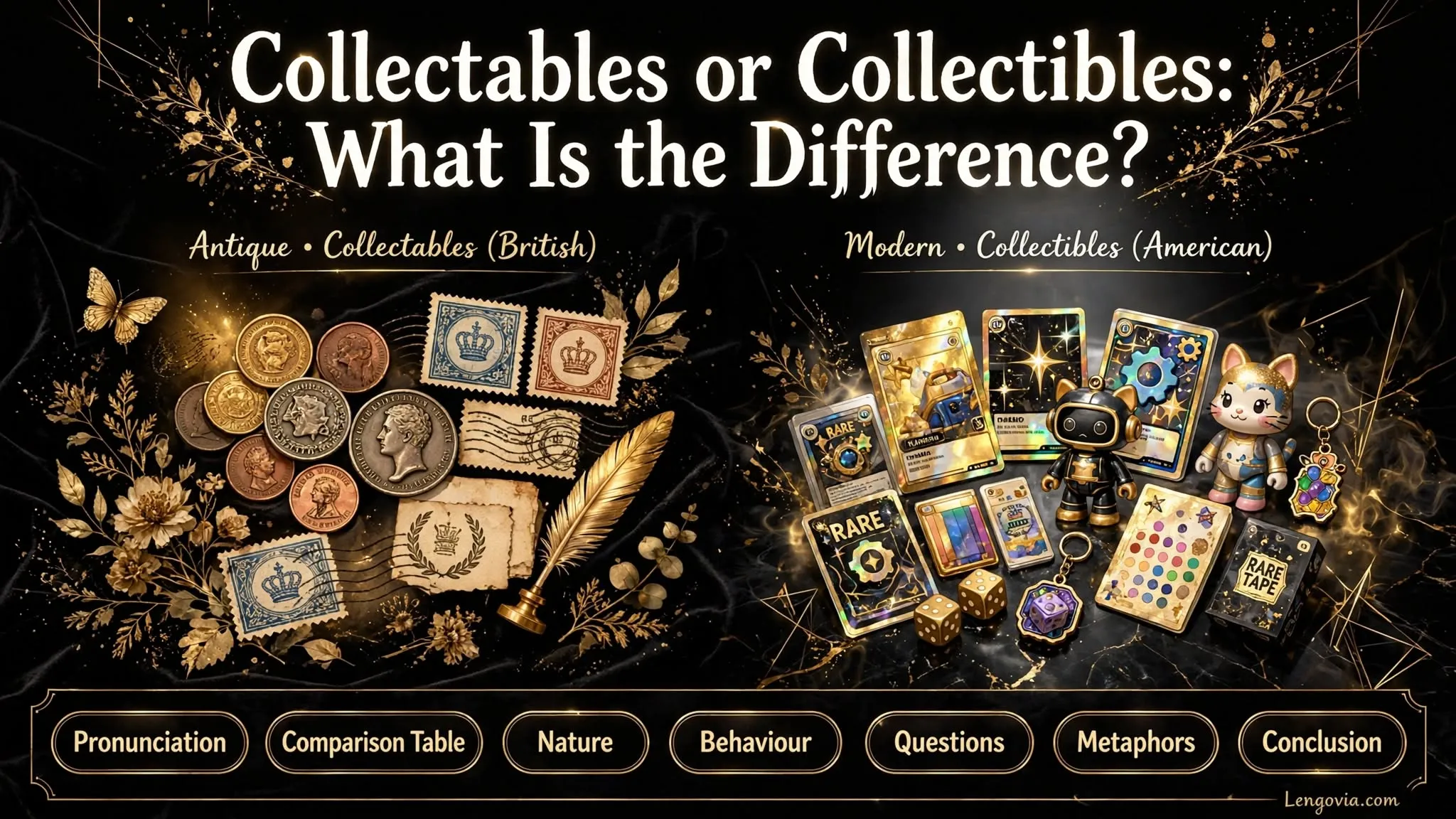
Collectables and collectibles both mean things people collect. Collectibles are more common in American English.
Do you like to keep special things? Maybe you have old coins, toys, cards, stamps, or books. Some people love to collect things. They may keep them in a box. People may put them on a shelf. They may show them to friends.
When we talk about things that people collect, we may see two words: collectables or collectibles.
These words can be hard to tell apart. They look almost the same. They also sound almost the same. Both words can talk about things that people collect.
The main difference is the spelling. There is also a small difference in how often each word is used.
Collectables is the correct word. Collectibles is also a correct word. Collectibles are more common in American English. Collectables are often used in British English.
For example, old coins can be called collectables. They can also be called collectibles. The same is true for toys, cards, stamps, books, and other special things.
People often search for collectables or collectibles because they do not know which word to use. They may see both forms on websites and in shops.
Pronunciation of Collectables and Collectibles
Both words sound almost the same.
- Collectables: kuh-LEK-tuh-bulz
- Collectibles: kuh-LEK-tuh-bulz
The main difference is the spelling.
You do not need to say the two words in a very different way.
Difference Between Collectables and Collectibles
1. Meaning
Both words mean things that people collect.
A person may collect things for fun. They may also collect things because they are old, rare, or special.
For example:
These coins are collectibles.
You can also say:
These coins are collectables.
Both sentences have the same basic meaning.
2. Spelling
The main difference is the spelling.
Collectables are -able.
Collectibles have -ible.
Look at the two words:
- Collectable
- Collectible
They are very close. This is why people often mix them up.
3. American English
Collectibles are more common in American English.
You may see it in American shops, websites, ads, and books.
For example:
The shop sells sports collectibles.
You may also see:
Movie collectibles are popular.
4. British English
Collectables are often used in British English.
For example:
The shop sells old collectables.
You may also see:
She has many rare collectables.
But collectibles are also used and understood in British English.
5. Coins
Coins are common items for collectors.
Some people collect coins from other countries. Some people collect very old coins.
For example:
My uncle collects old coins.
You can say:
His coins are valuable collectibles.
You can also say:
His coins are valuable collectables.
6. Toys
Toys can also be collectibles.
Some people keep toys from childhood. Others buy new toys to add to a collection.
For example:
She collects old toys.
You can say:
These toys are popular collectibles.
Or:
These toys are popular collectables.
7. Cards
Cards are also popular items to collect.
People may collect sports cards, game cards, or special cards.
For example:
He collects football cards.
You can say:
These cards are rare collectibles.
Or:
These cards are rare collectables.
8. Books
Some people collect books.
They may collect old books or books by a writer they like.
For example:
She collects old books.
You can say:
These books are special collectibles.
A book can be special because it is old, rare, or important to the owner.
9. Value
Some collectibles can be worth a lot of money.
But a collectible does not have to be expensive.
People may keep things because they like them.
For example:
This card is worth a lot of money.
But another person may have a toy that is not worth much money.
That toy can still be a collectible.
10. One Item or Many Items
Use collectable or collectible for one item.
Use collectables or collectibles for more than one item.
For example:
This is a collectible.
For more than one:
These are collectibles.
You can also say:
This is a collectible.
And:
These are collectables.
Nature and Behaviour of Collectables and Collectibles
Collectables
Collectables are things that people like to keep.
They can be:
- Old
- New
- Rare
- Small
- Big
- Special
- Valuable
People may keep them in boxes. They may put them on shelves. They may also show them to other people.
For many people, collecting is a hobby.
Collectibles
Collectibles have the same basic meaning.
People collect them because they like them. They may also collect them because the items are rare or special.
One person may collect toy cars. Another person may collect coins. Someone else may collect sports cards.
Each person can have a different reason for collecting.
Why Do People Get Confused?
People get confused because the two words are very close.
They:
- They look almost the same.
- It sounds almost the same.
- Have almost the same meaning.
- Come from the word collect.
The spelling is the main difference.
An easy way to remember the common use is:
Collectables → often used in British English
Collectibles → more common in American English
But this is not a strict rule. You can see both words in different places.
Comparison Table
| Point | Collectables | Collectibles |
| Meaning | Things people collect | Things people collect |
| Spelling | -ables | -ibles |
| US English | Less common | More common |
| UK English | Often used | Also used |
| Sound | Almost the same | Almost the same |
| One item | Collectable | Collectible |
| Many items | Collectables | Collectibles |
| Person | Collector | Collector |
The Origin of Collectables and Collectibles
Both words come from the word collect.
Collect means to bring things together.
For example:
I collect stamps.
This means that I keep stamps as a group.
The words collectable and collectible came from this idea.
They can describe something that people may collect.
Both forms have been used in English for many years.
Today, people use these words for many types of items.
These may include:
- Coins
- Stamps
- Toys
- Cards
- Books
- Art
- Games
- Sports items
British vs American English
The biggest difference is common use.
American English
American English usually uses collectible.
Example:
He collects baseball collectibles.
Another example:
I bought some movie collectibles.
British English
British English often uses collectables.
Example:
She bought some old collectables.
Another example:
The shop sells rare collectables.
Both forms can be understood in both types of English.
Which One Should You Use?
Think about your readers.
When you are writing for American readers, use collectibles.
If you are writing for British readers, use collectables.
If you are writing for people from many countries, collectibles are also a clear choice.
For example:
Our shop sells sports collectibles.
This is easy for most English readers to understand.
Common Mistakes
Mistake 1
Some people think collectibles are wrong.
It is not wrong.
Collectables is the correct word.
Mistake 2
Some people think collectibles are wrong.
It is not wrong.
Collectibles are also correct.
Mistake 3
Do not use the plural form for one item.
Wrong:
This is a collectible.
Correct:
This is a collectible.
Mistake 4
Do not use the singular form for many items.
Wrong:
I have many collectibles.
Correct:
I have many collectibles.
Mistake 5
Do not confuse collector and collectible.
A collector is a person.
A collectible is a thing.
For example:
Ali is a collector.
This card is collectible.
Everyday Usage Examples
At Home
I have many old collectibles.
My father collects old coins.
In a Shop
We sell toys and collectibles.
Look at these rare collectables.
In an Email
I am looking for old sports collectibles.
Do you sell movie collectables?
On Social Media
Look at my new collectibles!
I found a rare collectible today.
In News
The show had many rare collectibles.
The event showed old collectables.
In School
My hobby is collecting stamps.
These stamps are part of my collection.
In a Blog
Many people enjoy collecting sports collectibles.
Usage Trends
Collectibles are very common today.
You may see it on:
- Shopping websites
- Toy websites
- Sports websites
- Game websites
- Social media
- Hobby pages
- Online shops
It is also common when people talk about movies, sports, toys, and games.
Collectables are also used.
You may see it more often in British English.
The word you see can depend on the country and the website.
Both forms are still used today.
Metaphors and Similes
The words collectables and collectibles are normally used in a direct way.
They do not have many common metaphors.
But people can use simple comparisons when they talk about a collection.
For example:
His room was like a small museum.
This means he had many special things.
Another example:
Her collection was like a treasure box.
This means her collection was very special to her.
These are creative examples. They are not the direct meaning of the words.
Connotative Meaning
The word collectibles may make people think of many things.
It may suggest:
- Fun
- Hobbies
- Toys
- Games
- Memories
- History
- Rare items
- Special items
For a child, collectibles may mean toys or cards.
For an adult, collectibles may mean coins, books, art, or sports items.
Collectables can give the same ideas.
The feeling can change from person to person.
Idioms and Proverbs
There is no common idiom that means exactly collectables or collectibles.
But some common sayings can fit the idea of collecting.
One Man’s Trash Is Another Man’s Treasure
This means that one person may not want something, but another person may think it is special.
For example:
I do not want this old toy, but one man’s trash is another man’s treasure.
This idea fits collecting very well.
A collector may see a special item where another person sees an old thing.
Keep Something for a Rainy Day
This means to save something for later.
For example:
He keeps his old cards for a rainy day.
This saying is not about collecting, but it can relate to keeping things.
Literature and Movies
Collecting is seen in many stories.
Books and movies may show people who collect special things.
They may collect:
- Coins
- Books
- Toys
- Cards
- Art
- Old objects
Movies can also make some items popular.
For example, a popular movie may have toys, figures, cards, or posters. Fans may buy these items and keep them as collectibles.
Books about history may also show old objects.
A story about a child may show a collection of toys.
These stories can show why people like to keep special things.
Why This Difference Matters
Knowing the difference between collectables or collectibles can help you choose the right word.
This is useful when you write:
- Blog posts
- Articles
- Product pages
- Emails
- Social media posts
- School work
- Shop descriptions
If your readers are mainly American, collectibles is usually a good choice.
If your readers are mainly British, collectables may be a better choice.
The meaning is almost the same.
The main difference is the spelling and common use.
Usefulness in Daily Life
You may see these words when shopping online.
You may also see them in:
- Toy shops
- Sports shops
- Comic shops
- Hobby groups
- Online stores
- Auction pages
- Social media
For example, a website may have a section called:
Sports Collectibles
Another shop may use:
Antique Collectables
You may also hear people use these words when talking about hobbies.
For example:
I collect old cards.
These cards are my favorite collectibles.
Knowing these words can help you understand what you read.
Situational Preference
Use collectibles when you write for American readers. It is also a common choice for websites with readers from many countries. Use collectables when you write in British English or follow British style. Both words are correct. Both can mean things that people collect. The main difference is the spelling and common use. If you know your readers, choose the form they use most often. If you do not know your readers, collectibles are a simple and common choice.
Possible Questions
1. Are collectables and collectibles the same?
Yes. Both words can mean things that people collect.
2. Is collectables correct?
Yes. Collectables is a correct English word.
3. Are collectibles correct?
Yes. Collectibles is also a correct English word.
4. Which word is more common in American English?
Collectibles are more common in American English.
5. Which word is common in British English?
Collectables are often used in British English.
6. Are collectibles always expensive?
No. Some collectibles are cheap. Some are expensive.
7. What is a collector?
A collector is a person who collects things.
A collectible is a thing that people collect.
Conclusion
Both collectables and collectibles are fully correct and recognized terms for any items gathered by passionate fans and hobbyists. Even though they carry the exact same meaning, picking the right spelling comes down to knowing your target regional audience. If you are writing for an American or global audience, sticking with collectibles ensures a modern and widely accepted style. On the other hand, choosing collectables works perfectly when crafting content tailored specifically for British readers. Ultimately, keeping your usage consistent throughout your writing will maintain a clean, professional, and clear tone for your audience.

Mahnoor Afzal is an educator, researcher, and English language content specialist focused on grammar, vocabulary, word differences, and meanings. I combines research, teaching, and SEO expertise to create clear and reliable English learning content at Lengovia.










1 thought on “Collectables or Collectibles: What Is the Difference?”