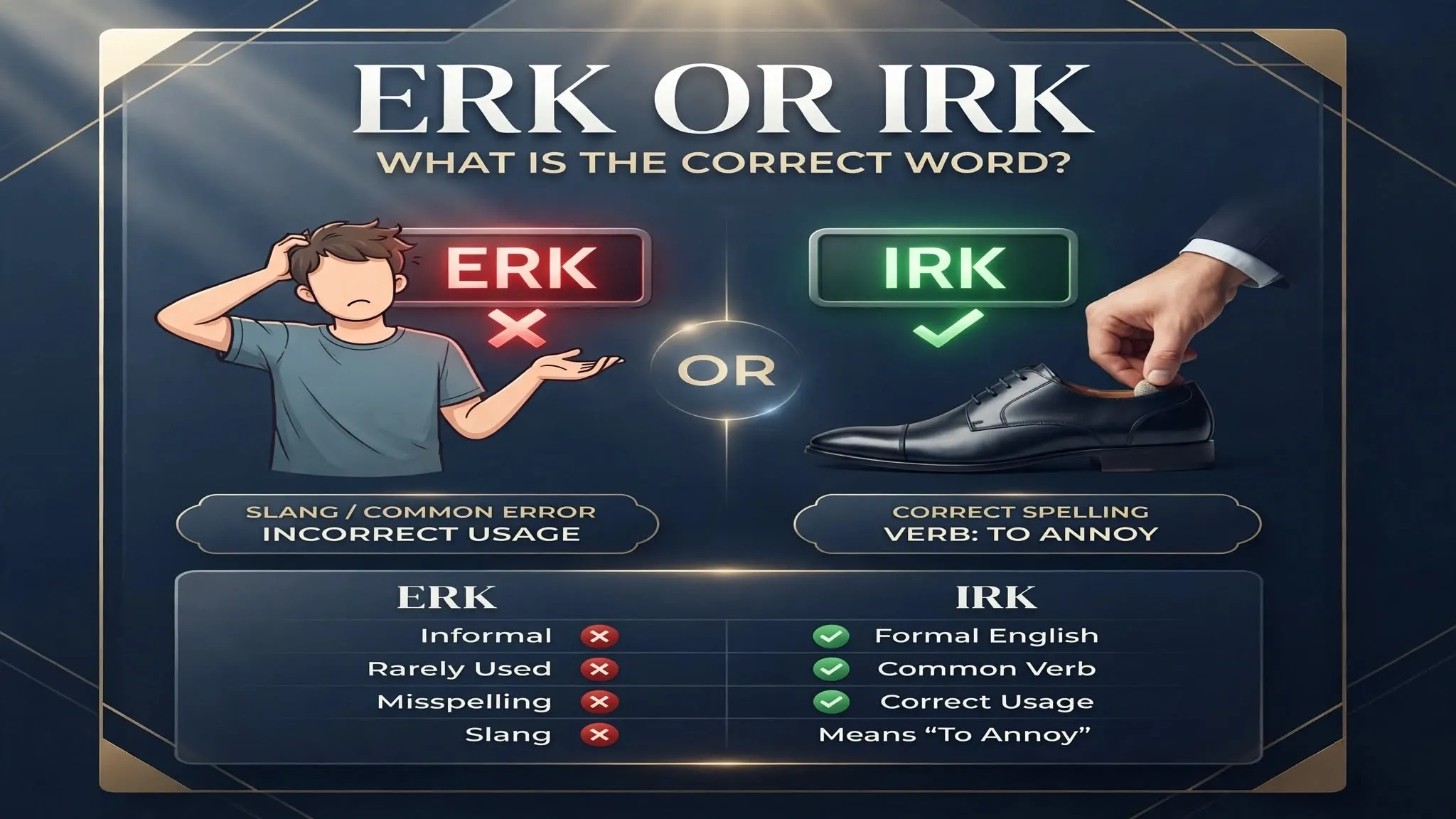
Irk is the correct word when you mean “to annoy” or “to bother.” Erk is not the standard spelling for this meaning.
Have you ever wanted to write a sentence like, “This noise really ___ me”? You may stop and wonder if the word is erk or irk. They sound almost the same, so this can be confusing. However, the correct word for “annoy” is irk. For example, you can say, “His rude words irk me.” The word irk is a verb. It means to annoy or bother someone. Cambridge Dictionary also defines irk as “to annoy someone.”
The spelling erk is not the standard spelling for this meaning. So, if you want to say that something bothers you, use irk. In this article, we will look at erk or irk in simple words. We will also see their meanings, pronunciation, use, common mistakes, and examples. Therefore, you can use the right word with confidence.
Pronunciation of Erk or Irk
The correct word is irk.
- Irk — US: /ɝːk/
- Irk — UK: /ɜːk/
The sound is close to “urk.” Cambridge gives /ɝːk/ for American English and /ɜːk/ for British English.
Erk is not the standard spelling of this verb.
Now, let us look at the difference between erk or irk.
Difference Between Erk or Irk
1. Irk is the correct word
Irk is the standard English word. It means to annoy or bother someone.
Examples:
- Loud music irks me.
- His rude words irk her.
2. Erk is not correct for “annoy”
Erk should not be used when you want to say “annoy.”
Incorrect:
- His noise erks me.
Correct:
- His noise irks me.
So, remember that irk is the spelling you need.
3. Irk is a verb
Irk is used as a verb. A verb tells us about an action or state.
For example:
- The noise irks me.
- The delay irked him.
Oxford also lists irk as a verb meaning “to annoy somebody.”
4. Irked is the past form
When something annoyed someone in the past, use irked.
Examples:
- The long wait irked me.
- Her answer irked him.
So, irk → irked.
5. Irking is the -ing form
You can also use irking.
Examples:
- The loud sound is irking me.
- His behavior is irking his teacher.
Therefore, the word changes like other verbs.
6. Irk can describe a person or thing
A person, action, sound, or situation can irk someone.
Examples:
- His jokes irk me.
- The slow internet irks me.
The thing that causes the feeling is the subject.
7. Irk means more than simple dislike
Irk means to annoy or bother someone. It does not simply mean that you do not like something.
Example:
- The noise irks me.
This means the noise bothers you.
8. Irk is often used in formal English
Irk is marked as a formal verb by Cambridge.
In everyday speech, people often use simpler words such as annoy, bother, or irritate.
For example:
- The noise annoys me.
- The noise bothers me.
- The noise irks me.
9. Irk has related forms
You may see these forms:
- irk — present form
- irks — he/she/it form
- irked — past form
- irking — -ing form
Examples:
- This sound irks me.
- That sound irked me.
- The sound is irking me.
10. Erk and irk are not equal spellings
Some people may write erk because the sound can be confusing. However, for the meaning “to annoy,” the standard word is irk.
Remember:
Irk = annoy or bother.
You may also read https://lengovia.com/reoccurring-or-recurring/
Nature and Behaviour of Erk or Irk
The two spellings do not have the same standard use.
Irk is a real English verb. It describes the feeling caused by something annoying. It is often used with a person as the object.
For example:
- The noise irks me.
- His habit irks his sister.
- The delay irked us.
On the other hand, erk is not the standard spelling for this meaning. Therefore, you should not use it in normal English writing when you mean “annoy.”
Why People Get Confused About Erk or Irk
People can confuse these words because irk has a short spelling and an unusual sound.
Also, when people hear the word, they may not know whether the first vowel sound should be written with e or i. As a result, some may write erk.
However, the correct spelling is easy to remember:
Irk = annoy
For example:
- His loud voice irks me.
Comparison Table
| Word | Correct? | Meaning | Example |
| Irk | ✅ Yes | To annoy or bother | The noise irks me. |
| Erk | ❌ Not for this meaning | Not the standard spelling of “irk” | Do not use it for “annoy.” |
Therefore, when you mean “annoy,” always choose irk.
The Origin of Irk
The word irk is an old English word. Oxford says it comes from Middle English and may be related to the Old Norse word yrkja. Its earlier sense was connected with being annoyed or disgusted.
Over time, irk became a verb meaning “to annoy.”
So, irk has a long history in English. The spelling has stayed as irk.
British vs American English
There is no British spelling and American spelling difference here.
Both British and American English use irk.
| English | Correct spelling |
| British English | irk |
| American English | irk |
The pronunciation is slightly different in dictionary guides, but the spelling is the same. Cambridge lists /ɜːk/ for UK English and /ɝːk/ for US English.
Examples:
British English:
- The noise really irks me.
American English:
- The noise really irks me.
So, you do not need to change irk based on the type of English you use.
Which One Should You Use?
Use irk when you mean annoy or bother.
Correct:
- Your loud music irks me.
- His rude behavior irked her.
- The long wait is irking us.
Do not use erk for this meaning.
In short, the answer is simple:
Irk is correct. Erk is not the standard spelling for “annoy.”
Common Mistakes
Here are some common mistakes with erk or irk.
Mistake 1: Using erk
❌ The noise erks me.
✅ The noise irks me.
Mistake 2: Spelling irked as irked with e
❌ The delay erks me.
✅ The delay irks me.
Mistake 3: Using irk when you mean “like”
Irk does not mean “dislike.”
It means to annoy or bother.
❌ I irk this movie.
✅ This movie is not my favorite.
Mistake 4: Forgetting the final k
The word is spelled:
I-R-K
Not E-R-K when you mean “annoy.”
Everyday Usage Examples
You may see irk in many kinds of writing.
In emails
- The delay in the reply really irked me.
On social media
- It really irks me when people are late.
For news writing
- The decision irked many local residents.
In formal writing
- The repeated errors irked the manager.
In daily English
- That noise irks me.
However, because irk is a formal word, annoy and bother may sound more natural in simple everyday speech. Cambridge labels irk as formal.
Usage Trends

The word irk is still used in modern English. Dictionaries list it as a current verb. Cambridge gives modern examples such as “Her comments really irked me.”
However, annoy and bother are more common choices in simple daily speech.
For example:
- Simple: That noise bothers me.
- Simple: That noise annoys me.
- More formal: That noise irks me.
Therefore, choose the word that fits your sentence and audience.
Metaphors and Similes
Irk is not usually used as a metaphor by itself. Still, it can be part of sentences that describe strong annoyance.
For example:
- His loud voice irked me like a buzzing fly.
- The delay irked her like a long wait in a slow line.
These examples compare an annoying thing with another annoying experience.
Connotative Meaning
The word irk has a negative meaning.
It shows that something bothers or annoys a person.
For example:
His rude tone irks me.
This tells us that his tone causes annoyance.
The word does not normally show love, joy, or approval. Instead, it shows displeasure.
Idioms and Common Phrases
There is no common idiom based only on irk that you need to learn first. However, these common phrases are useful:
- It irks me.
- It really irks me.
- That really irked him.
- Her behavior irks me.
- The delay is irking us.
You can also use simple words with the same basic idea:
- annoy me
- bother me
- irritate me
For example:
- It irks me.
- It annoys me.
- It bothers me.
These sentences have a similar basic meaning.
Literature and Movies
The verb irk has been used in English writing for a long time. Oxford traces it to Middle English and gives its earlier sense as being annoyed or disgusted.
Because irk is a formal or literary word, it can appear in books and formal writing. It can also appear in modern news and online writing.
For example:
- The writer was irked by the criticism.
- The character was irked by the unfair rule.
You do not need to use erk in such writing. The correct word remains irk.
Why This Difference Matters
Spelling matters because one small letter can change whether a word is correct.
If you write erk when you mean “annoy,” readers may think you made a spelling mistake. However, if you write irk, your meaning is clear.
For example:
❌ His behavior erks me.
✅ His behavior irks me.
Therefore, learning the correct spelling can make your English clearer.
Usefulness in Daily Life
You may need irk when you write emails, school work, blog posts, stories, or formal messages.
It is especially useful when you want a word that means annoy.
For example:
- The noise irks me.
- His answer irked her.
- The delay really irks us.
Still, if you are speaking with a friend, annoy or bother may be easier.
So, learn irk, but also know its simpler alternatives.
Situational Preference
Use irk when you want to say that something annoys or bothers someone. It works in formal writing and can also be used in normal sentences. For example, “The noise irks me” is correct. However, in very simple daily speech, “The noise bothers me” may sound more natural. On the other hand, erk should not be used as the spelling of irk. Therefore, when you mean “annoy,” choose irk in both British and American English.
Possible Questions
1. Is it erk or irk?
Irk is correct when you mean “to annoy or bother.”
2. What does irk mean?
Irk means to annoy or bother someone.
3. Is erk a correct word?
Erk is not the standard spelling of the verb meaning “to annoy.” Use irk instead.
4. Is irk used in American English?
Yes. Irk is used in American English. Cambridge gives the American pronunciation /ɝːk/.
5. Is irk used in British English?
Yes. Irk is also used in British English. The British pronunciation listed by Cambridge is /ɜːk/.
6. What is the past tense of irk?
The past tense is irked.
Example:
- His rude words irked me.
7. What is a simple synonym for irk?
Simple synonyms include annoy, bother, and irritate. Cambridge lists these as related words for the meaning “to annoy someone.”
Conclusion
The correct word is irk not erk, when you want to say “annoy” or “bother.” Irk is a verb used to describe something that makes a person feel annoyed. For example, you can say, “The loud noise irks me.” You can also use its other forms, such as irked and irking. The word is used in both British and American English. However, it is more formal than simple words such as annoy and bother. Cambridge marks irk as a formal verb, while Oxford also describes it as formal or literary. The main point is easy to remember: irk = annoy. If you are writing a sentence about something that bothers you, use irk. Do not write erk for this meaning. So, if you are choosing between erk or irk, the correct choice is: Irk or erk → Irk ✅

Mahnoor Afzal is an educator, researcher, and English language content specialist focused on grammar, vocabulary, word differences, and meanings. I combines research, teaching, and SEO expertise to create clear and reliable English learning content at Lengovia.











1 thought on “Erk or Irk: What Is the Correct Word?”