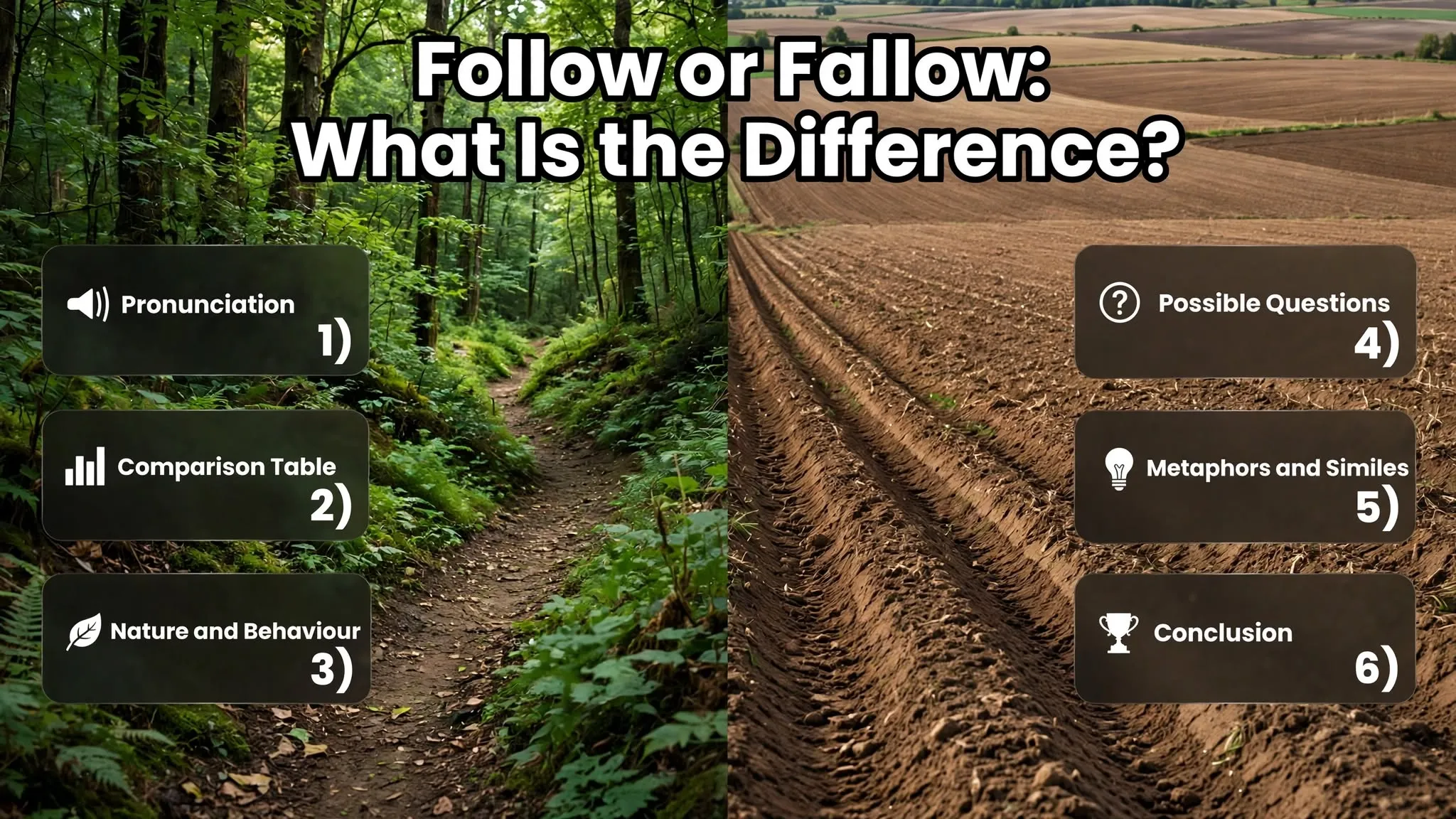
Follow means to go after someone or do what they say. Fallow means land that is left unused for a time.
Have you ever seen the words follow and fallow and thought they looked almost the same? You are not alone. These two words sound alike, but they do not mean the same thing. For example, you may follow your teacher in class. A farmer may leave a field fallow for a year.
The word follow is very common in daily English. We use it when we talk about people, rules, ideas, directions, and social media. The word fallow is less common. It is mostly used when we talk about farms and fields.
Pronunciation of Follow and Fallow
Both words have almost the same sound.
- Follow: /ˈfɑːloʊ/ in US English
- Fallow: /ˈfæloʊ/ in US English
In many accents, the two words can sound very close.
The spelling and meaning help you choose the right word.
Difference Between Follow and Fallow
1. Basic Meaning
Follow means to go after someone or something. It can also mean to obey or use directions.
Example 1:
Please follow me.
Example 2:
Follow the rules.
Fallow means land that is not used for growing crops for some time.
Example 1:
The farmer left the field fallow.
Example 2:
The land stayed fallow for one year.
2. Spelling
The words have different spellings.
- Follow → F-O-L-L-O-W
- Fallow → F-A-L-L-O-W
The first word has o after the “f.”
The second word has a after the “f.”
3. Use of Follow
We use follow in many daily situations.
You can follow a person.
Example:
The child followed his mother.
You can also follow advice.
Example:
She followed my advice.
4. Use of Fallow
We mostly use fallow for land or fields.
Example:
The farmer kept the field fallow.
Example:
The field was fallow during the winter.
5. Follow Can Mean “Go After”
One common meaning of follow is to go behind someone.
Example:
The dog followed the boy.
Example:
I followed my friend home.
6. Follow Can Mean “Obey”
Follow can also mean to do what a rule, order, or person says.
Example:
Please follow the instructions.
Example:
We must follow the law.
7. Fallow Describes Land
Fallow is often used as an adjective.
It tells us that land is not being used for crops.
Example:
The farmer has a fallow field.
Example:
The land was left fallow.
8. Follow Is Very Common
You see follow in daily English.
You may hear:
- Follow me.
- Follow the road.
- Follow the rules.
- Follow the steps.
- Follow the news.
- Follow me on social media.
9. Fallow Is Less Common
Fallow is not used as often as follow.
It is common in farming and land-related writing.
Example:
The farmer left the soil fallow.
10. They Have Different Meanings
This is the main point.
Follow is about going after, obeying, or keeping up with something.
Fallow is about land that is not being used for crops.
So, these words cannot normally replace each other.
Nature and Behaviour of Follow and Fallow
Follow
Follow is an active word. It often shows an action.
You can follow:
- a person
- a road
- a rule
- advice
- a plan
- instructions
- a team
- a social media account
Example:
Follow the signs.
Fallow
Fallow is mainly linked to land.
A field may be left unused for some time. This can help the land rest before it is used again.
Example:
The farmer left the field fallow.
Why Do People Get Confused About Follow and Fallow?
People often confuse these words because they look and sound very similar.
Both start with fall-.
They also have the same ending:
-low
But their meanings are very different.
A simple trick can help:
Follow = go after
Fallow = empty farm land
Remember this short line:
You follow a person. You leave a field fallow.
Comparison Table
| Word | Meaning | Common Use | Example |
| Follow | Go after or obey | People, rules, directions | Follow me. |
| Fallow | Land left unused | Farms and fields | The field is fallow. |
Similarity
Both words:
- look similar
- sound similar
- are English words
- have two syllables
Main Difference
Their meanings are not the same.
Follow is mostly about an action.
Fallow is mostly about unused farm land.
The Origin of Follow and Fallow
The words follow and fallow come from old English words. They developed over a long time and kept different meanings.
Follow has a long history linked to the idea of going after someone or something.
Fallow has a history linked to land and farming.
Their similar sound can make them confusing today, but their meanings remain different.
British vs American English
The words follow and fallow are used in both British and American English.
There is no major spelling difference between the two forms.
British English:
- Follow the road.
- The field is fallow.
American English:
- Follow the road.
- The field is fallow.
The main difference is not British vs American spelling. The key difference is meaning.
Which One Should You Use?
Use follow when you mean:
- go after someone
- obey a rule
- use directions
- keep up with something
- watch or support someone online
Example:
Follow these steps.
Use fallow when you mean land that is not being used for crops.
Example:
The farmer left the land fallow.
For most daily English, you will use follow much more often.
Common Mistakes
Mistake 1
❌ Fallow me.
✅ Follow me.
You mean “come after me,” so use follow.
Mistake 2
❌ The farmer left the field follow.
✅ The farmer left the field fallow.
You are talking about unused land, so use fallow.
Mistake 3
❌ Please fallow the instructions.
✅ Please follow the instructions.
Instructions are something you obey, so use follow.
Mistake 4
❌ This is a follow field.
✅ This is a fallow field.
A field that is not being used for crops is fallow.
Everyday Usage Examples
In Emails
Follow the steps in the email.
Please follow the instructions below.
On Social Media
Please follow our page.
I follow many news pages.
In News
People follow the latest news.
Farmers may leave some land fallow.
In Formal Writing
Please follow the rules.
The farmer kept the land fallow.
Usage Trends
Follow is a very common English word. It is used in speech, books, news, school work, emails, and online posts.
Social media has also made follow even more common. People follow friends, singers, actors, teams, brands, and news pages.
Fallow is much less common. You are more likely to see it in farming, gardening, land, and agriculture.
Metaphors and Similes
Follow is often used in a wider way.
For example:
Follow your dreams.
This does not mean walking behind your dreams. It means trying to reach them.
Another example is:
Follow your heart.
This means to trust your feelings when making a choice.
Fallow is mostly used in its real farming sense. It can sometimes describe something that has been left unused.
Connotative Meaning
Follow is usually neutral. Its meaning depends on the sentence.
Positive:
Follow your dreams.
Neutral:
Follow the road.
Negative:
He always follows others.
Fallow is also mostly neutral.
Example:
The farmer left the field fallow.
It simply tells us that the land is not being used for crops.
Idioms and Common Phrases
There are many common phrases with follow.
Follow the rules
Example:
All students must follow the rules.
Follow the crowd
This means to do what many other people do.
Example:
Do not always follow the crowd.
Follow your heart
This means to trust your feelings.
Example:
She decided to follow her heart.
Follow in someone’s footsteps
This means to do something similar to another person.
Example:
He wants to follow in his father’s footsteps.
There are fewer common idioms with fallow because it is mainly a farming word.
Literature and Movies
The word follow appears often in stories and books because characters may follow people, clues, paths, or ideas.
For example, adventure stories often have a character who follows a map or a trail.
The word fallow is more common in writing about farms, nature, and rural life.
In movies and books about farming, a writer may use fallow to describe land that is resting.
This shows why context is important. The topic of the sentence can help you choose the right word.
Why This Difference Matters
Using the right word makes your sentence clear.
If you write fallow when you mean follow, the reader may not understand you.
Compare:
❌ Fallow me.
✅ Follow me.
The first sentence is wrong because you are asking someone to come with you.
Now compare:
❌ The farmer left the field follow.
✅ The farmer left the field fallow.
The second sentence is correct because the field is not being used for crops.
Usefulness in Daily Life
You will use follow much more often than fallow.
You may need follow when:
- reading instructions
- talking to a teacher
- giving directions
- using a website
- using social media
- talking about rules
- talking about plans
We may need fallow when:
- reading about farming
- talking about crops
- writing about fields
- studying agriculture
- reading about soil
Knowing these two words can help you avoid simple spelling mistakes.
Situational Preference
Use follow in almost every normal daily situation when you mean “go after,” “obey,” or “keep up with.” For example, you can follow a friend, follow a road, or follow a rule. Use fallow only when you talk about land that is left unused for a time. If you are unsure, look at the subject of the sentence. A Resting field or farmland uses “fallow,” whereas a person, rule, road, plan, or instruction takes “follow.”.Referring to resting farmland calls for “fallow,” but referring to a person, rule, road, plan, or instruction calls for “follow.”
Possible Questions
1. Is “follow” a correct word?
Yes. Follow is a very common English word.
2. Is “fallow” a correct word?
Yes. Fallow is also a correct English word.
3. What does follow mean?
Follow means to go after someone or something. It can also mean to obey or use directions.
4. What does fallow mean?
Fallow means land that is left unused for a time.
5. Are follow and fallow homophones?
They are very similar in sound, but pronunciation can vary by accent. Their meanings are different.
6. Can I say “fallow me”?
No. If you want someone to come after you, say “Follow me.”
7. Which word is more common?
Follow is much more common in everyday English. Fallow is mainly used for land and farming.
Conclusion
Follow or fallow can be confusing because the words look and sound very similar. But their meanings are easy to learn. Follow means to go after someone or something. It can also mean to obey rules, use directions, or keep up with a person or page. Fallow is mainly used for land. A field is fallow when it is left unused for a time. Remember this simple rule: Follow a person, but leave a field fallow. You can follow your teacher, follow a road, follow instructions, or follow someone online. A farmer can leave a field fallow. Both words are correct. The right choice depends on what you mean. Once you learn the simple difference, you can use follow and fallow with confidence in your writing and speech.

Mahnoor Afzal is an educator, researcher, and English language content specialist focused on grammar, vocabulary, word differences, and meanings. I combines research, teaching, and SEO expertise to create clear and reliable English learning content at Lengovia.












2 thoughts on “Follow or Fallow: What Is the Difference?”