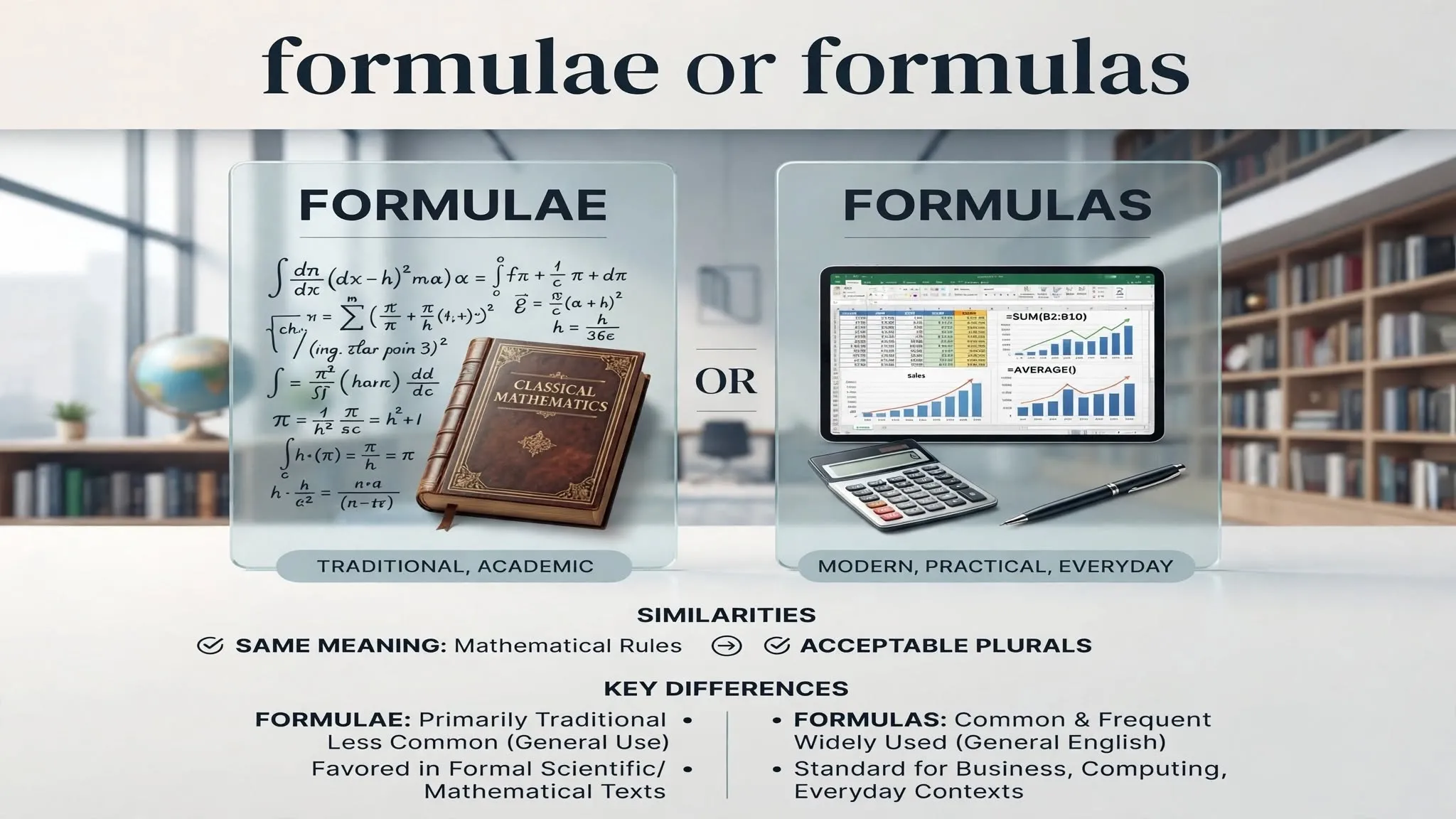
Formulae and formulas are both correct plural forms of formula. Formulae is more traditional, while formulas is very common today.
Have you ever seen the words formulae and formulas and wondered which one is correct? You may see both words in math books, science books, school work, and online articles. This can make you think that one of them is wrong. But both are correct.
A formula is a set of letters, numbers, or signs that shows a rule or helps us find an answer. For example, E = mc² is a famous formula. When we talk about more than one formula, we can use formulae or formulas.
Formulae is the older plural form. It is still used, especially in British English and some formal or academic writing. Formulas is also correct and is very common in American English and in everyday English.
Pronunciation of Formulae and Formulas
The words are pronounced in different ways.
- Formulae: FOR-myoo-lee
- Formulas: FOR-myuh-luhz
The pronunciation may change a little by accent.
Both words mean more than one formula.
You May also readhttps://lengovia.com/follow-or-fallow/
Difference Between Formulae and Formulas
1. Both Are Plural Words
Both formulae and formulas mean more than one formula.
Example:
- The book has many formulae.
- The book has many formulas.
Both sentences are correct.
2. Formulae Is an Older Form
Formulae comes from the older Latin plural form.
It is still used in English today.
Example:
The teacher gave us three formulae.
3. Formulas Is a Modern Form
Formulas is the regular English plural.
It is very common in modern English.
Example:
The teacher gave us three formulas.
4. Both Are Used in Math
You can use either word when talking about math.
Example:
We learned five formulae today.
We learned five formulas today.
Both are correct.
5. Both Are Used in Science
Science books may use either form.
Example:
The students used different formulae.
The students used different formulas.
6. Formulae Is Common in Formal Writing
Some academic and formal texts use formulae.
Example:
The paper explains several mathematical formulae.
But formulas is also correct.
7. Formulas Is Very Common Today
Many people use formulas in everyday English.
Example:
I need to learn these formulas for my test.
This sounds natural and clear.
8. Formulae and Formulas Have the Same Meaning
There is no big difference in meaning.
Formulae = more than one formula
Formulas = more than one formula
9. The Choice Can Depend on Style
A school, book, or website may prefer one form.
Some writers like formulae.
Others prefer formulas.
The important thing is to use the style your audience expects.
10. Formula Is Singular
Remember that formula is singular.
Example:
This is one formula.
For more than one, use:
formulae or formulas
Example:
These are two formulas.
Nature and Behaviour of Formulae and Formulas

Both words are nouns.
They are used when we talk about two or more formulas.
A formula can help us:
- solve a math problem
- find an answer
- explain a science rule
- calculate numbers
- understand a process
For example:
Area = length × width
This is a formula.
If you have many of them, you can call them formulae or formulas.
Why Do People Get Confused About Formulae and Formulas?
The main reason is that formula comes from Latin.
In older English, many Latin words kept their old plural forms.
So:
formula → formulae
But English also allows words to take the normal -s ending.
So:
formula → formulas
Both forms became accepted.
This is why you can see both words today.
Comparison Table
| Point | Formulae | Formulas |
| Singular | Formula | Formula |
| Plural | Formulae | Formulas |
| Meaning | More than one formula | More than one formula |
| Style | Traditional | Modern/common |
| Common in | Academic and British writing | Everyday and American English |
| Correct? | Yes | Yes |
| Example | These formulae are useful. | These formulas are useful. |
The Origin of Formulae and Formulas
The word formula comes from Latin.
The Latin word formula meant a form, rule, or set form of words.
The older plural became formulae.
Over time, English speakers also started using the regular plural formulas.
Today, both forms are used.
The choice often depends on the writer and the type of English being used.
British vs American English
Both formulae and formulas can be found in British and American English.
However, formulae is often seen in traditional British or academic writing.
Formulas is very common in American English and modern general writing.
British-style example
Students must learn these formulae.
American-style example
Students must learn these formulas.
But it is important to remember that the difference is not a strict rule.
American writers can use formulae, and British writers can use formulas.
Which One Should You Use?
Use formulae if you want a more traditional or academic style.
Use formulas if you want a simple and common modern style.
Using for everyday writing, formulas is often the easier choice.
For academic writing, check your school, teacher, journal, or style guide.
For example:
Simple:
I learned ten formulas.
Traditional:
I learned ten formulae.
Both are correct.
Common Mistakes
Mistake 1
❌ I learned many formula.
✅ I learned many formulas.
or
✅ I learned many formulae.
You need a plural form when talking about more than one.
Mistake 2
❌ One formulas
✅ One formula
Use formula for one.
Mistake 3
❌ Two formula
✅ Two formulas
or
✅ Two formulae
Mistake 4
Thinking that formulae is wrong.
❌ Formulae is wrong.
✅ Formulae is correct.
Mistake 5
Thinking that formulas is wrong.
❌ Formulas is wrong.
✅ Formulas is correct.
Everyday Usage Examples
In School
I need to learn these formulas for my math test.
The teacher wrote three formulae on the board.
In Math
These formulas help us solve the problem.
We used different formulae in the lesson.
In Science
The book gives many science formulas.
The students studied chemical formulae.
In Work
The spreadsheet uses several formulas.
The team checked the formulae in the report.
Online
You can find useful math formulas online.
Some academic websites use formulae.
Usage Trends
Formulas is very common in modern English.
It is easy to understand and follows the normal English plural pattern.
Formulae is also correct. It is often seen in math, science, academic writing, and traditional texts.
You may see formulae more often in some British-style or academic writing.
You may see formulas more often in everyday and American English.
There is no need to think that one word is always right and the other is always wrong.
Metaphors and Similes
The word formula can also have a wider meaning.
It can mean a simple plan that works well.
For example:
Kindness is his formula for success.
This does not mean a math formula. It means a way of doing something.
We can also use the plural:
These are the formulas for success.
Here, formulas means methods or plans.
Connotative Meaning
Both formulae and formulas are mostly neutral words.
They often sound:
- clear
- academic
- scientific
- technical
For example:
The book contains many mathematical formulas.
This sounds like school or science writing.
When formula means a plan, it can have a positive meaning:
Hard work is her formula for success.
It can also have a negative meaning in some cases:
The movie follows the same old formula.
Here, formula means a repeated way of doing something.
Idioms and Common Phrases
The word formula is used in some common phrases.
Formula for Success
This means a way to become successful.
Example:
Hard work is a formula for success.
Winning Formula
This means a plan that works well.
Example:
The team found a winning formula.
Secret Formula
This means a special method or recipe.
Example:
The company has a secret formula.
In plural form, we can use formulas or formulae, depending on the context.
Literature and Movies

The word formula is also used in books and movies.
A writer may talk about a story formula. This means a common way of making a story.
For example, some stories have a simple formula:
problem → struggle → solution
In movie writing, people may also say that a film uses the same formula as another film.
Here, formula does not mean a math rule. It means a common plan or pattern.
Why This Difference Matters
Knowing formulae or formulas can help you write better English.
You may see formulae in a math book or academic paper.
You may see formulas in a school lesson, website, or everyday text.
If you know that both are correct, you will not be confused when you see either form.
It is also useful to know the singular form:
One formula
Two formulas
or
Two formulae
Usefulness in Daily Life
You may see formulas in many places.
For example:
- math books
- science books
- school tests
- spreadsheets
- websites
- work reports
- cooking
- business
A recipe can even be called a formula in some contexts.
In daily English, formulas is often simple and easy to use.
If you are reading an academic text, you may also see formulae.
Situational Preference
Use formulae when you want a traditional form or when your school, teacher, or style guide prefers it. Use formulas when you want a simple and common modern form. Both words mean more than one formula. In everyday English, formulas is often easier for most readers. In academic or scientific writing, formulae may appear more often. The most important thing is to follow the style used in your writing. If your teacher asks for British or traditional English, formulae may be preferred. If your text uses modern American English, formulas is a natural choice.
Possible Questions
1. Is “formulae” correct?
Yes. Formulae is a correct plural of formula.
2. Is “formulas” correct?
Yes. Formulas is also a correct plural of formula.
3. What is the plural of formula?
Both formulae and formulas are correct plurals.
4. Which is more common?
Formulas is very common in modern everyday English. Formulae is also common in some academic and traditional writing.
5. Is formulae British English?
It is often associated with traditional British and academic usage, but it can be used in other forms of English too.
6. Are formulas American English?
Formulas are very common in American English, but British writers can use it too.
7. What is the singular form of formulae?
The singular is formula.
Conclusion
Both formulae or formulas serve as entirely valid plural forms of the noun “formula,” meaning two or more. Formulae represents the classical, traditional spelling that frequently appears in formal science, higher mathematics, and traditional British publications. On the other hand, formulas follows standard English pluralization rules, making it the preferred option for modern business writing, general media, and standard American English. No matter which spelling option you select, the core meaning of your sentence stays exactly the same. Simply check your school, journal, or workplace style guidelines before deciding; if no strict rule applies, opting for formulas provides a clean, natural, and accessible experience for the majority of modern readers.

Mahnoor Afzal is an educator, researcher, and English language content specialist focused on grammar, vocabulary, word differences, and meanings. I combines research, teaching, and SEO expertise to create clear and reliable English learning content at Lengovia.