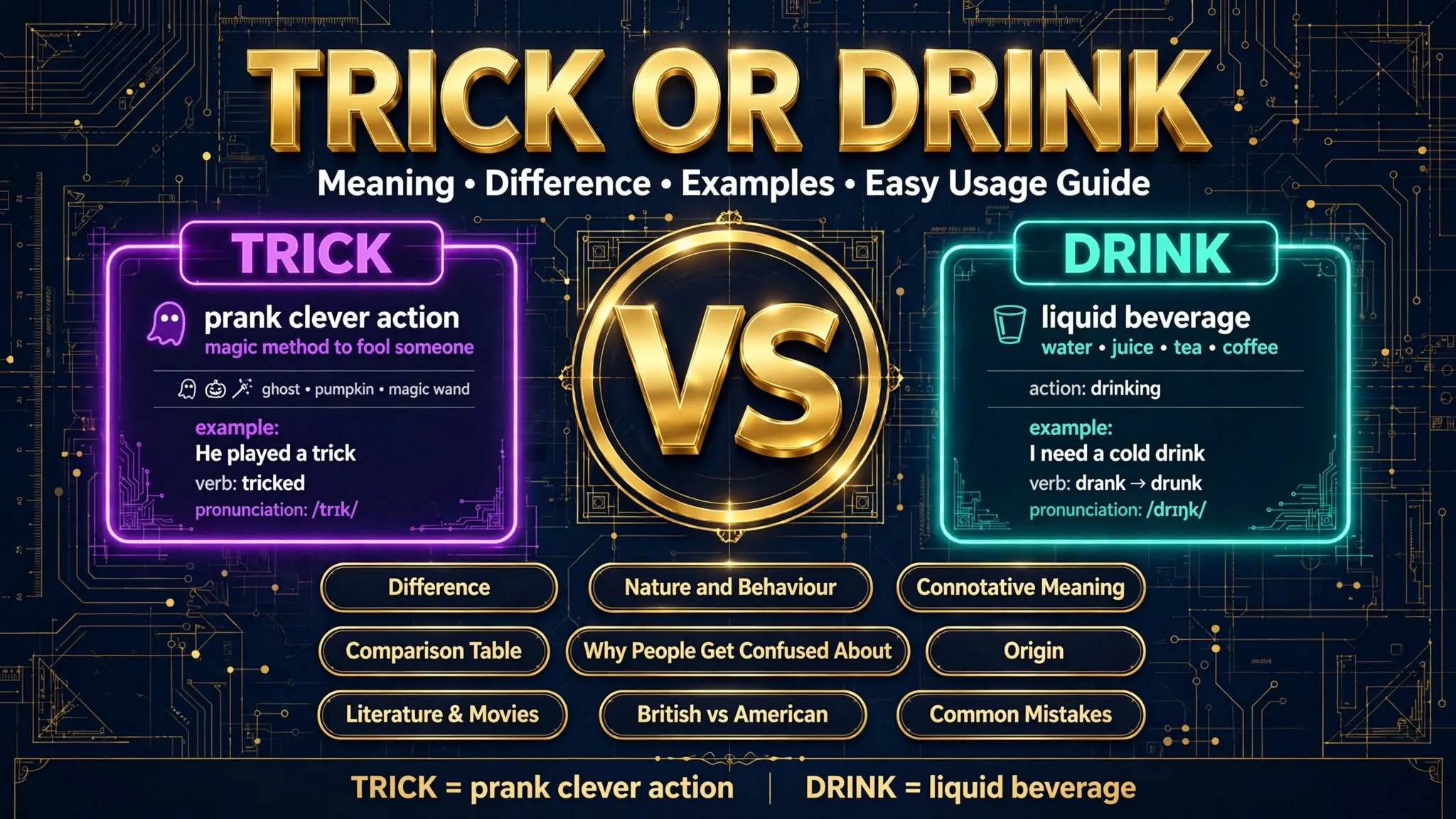
Trick means a prank, clever action, or way to fool someone, while drink means a liquid or the act of drinking.
Have you ever seen trick or drink and wondered what it means? The two words are very different. A trick can be a joke, prank, clever method, or action used to fool someone. A drink is usually a liquid such as water, juice, tea, or coffee. It can also mean the action of drinking.
The phrase trick or drink can be used as a playful phrase. It follows the pattern of the well-known phrase trick or treat. In some party games, it can mean choosing between doing a trick or taking a drink. The meaning depends on the situation.
So, trick or drink is not a choice between two spellings of the same word. They have different meanings and different uses. Knowing the difference will help you use each word correctly in everyday English.
Pronunciation of Trick or Drink
Trick
- US: /trɪk/
- UK: /trɪk/
Drink
- US: /drɪŋk/
- UK: /drɪŋk/
The words have different first sounds. Trick begins with /tr/, while drink begins with /dr/.
Let’s look at the difference in simple English.
Difference Between Trick or Drink
1. Their Meanings Are Different
Trick usually means a clever action, prank, or way to fool someone. Drink usually means a liquid that you consume.
- He played a trick on his brother.
- I need a cold drink.
The first sentence is about an action. The second is about a beverage.
2. Trick Can Mean a Prank
A trick can be something funny or surprising that you do to another person.
- She played a trick on her friend.
- The children planned a trick for their teacher.
A trick can be harmless fun, but it can also be used to deceive someone.
3. Drink Can Mean a Beverage
A drink can be water, milk, tea, coffee, juice, or another beverage.
- Would you like a drink?
- She ordered a cold drink.
Here, drink is a noun.
4. Trick Can Mean a Clever Method
Trick does not always mean a prank. It can also mean a useful way of doing something.
- This is a useful trick for cleaning.
- He knows a trick for remembering names.
Here, trick means a clever method or technique.
5. Drink Can Be a Verb
Drink can also describe the action of taking liquid.
- Please drink some water.
- He likes to drink tea in the morning.
So, drink can be both a noun and a verb.
6. Trick Can Be a Verb
Trick can also be a verb. It means to fool or deceive someone.
- He tried to trick me.
- She tricked her brother.
As a verb, trick can describe an action done to another person.
7. Their Past Forms Are Different
The past form of trick is tricked. The past form of drink is drank.
- He tricked me yesterday.
- She drank some water.
Do not use drinked as the past form of drink.
8. Trick Can Be Used for Magic
A trick can be a skillful action used to entertain people. Magic shows often have tricks.
- The magician showed a card trick.
- The boy learned a new magic trick.
This use is about entertainment, not deception.
9. Drink Has Many Everyday Uses
Drink is a very common word in daily English.
- I need a drink after my walk.
- What would you like to drink?
It can refer to a beverage or the act of consuming one.
10. Trick or Drink Is a Playful Phrase
Trick or drink can be used as a fun phrase at parties or social events. It is based on the pattern of trick or treat. The exact rules or meaning can change depending on the game or event.
- The friends played trick or drink at the party.
- Everyone had to choose trick or drink.
Nature and Behaviour of Trick or Drink
Nature of Trick
Trick is connected with actions, jokes, magic, methods, and deception. It can have either a positive or negative meaning.
A magic trick can entertain people. A dishonest trick can fool someone.
The magician performed a great trick.
He used a trick to fool his friend.
Nature of Drink
Drink is connected with liquids and the action of drinking.
Common drinks include:
- water
- tea
- coffee
- juice
- milk
I had a drink after dinner.
Why People Get Confused About Trick or Drink
People may confuse trick and drink because the words look and sound somewhat similar. They also appear together in the playful phrase trick or drink.
Another reason is the familiar Halloween phrase trick or treat. People may see trick or drink and wonder if it is a mistake.
It is not a spelling mistake when it is used as a playful phrase. However, it is not the standard Halloween expression. Trick or treat is the traditional phrase.
Comparison Table
| Feature | Trick | Drink |
| Main meaning | Prank, clever action, or method | Liquid or act of drinking |
| Part of speech | Noun and verb | Noun and verb |
| Common use | Joke, magic, method | Water, tea, juice |
| Past form | Tricked | Drank |
| Past participle | Tricked | Drunk |
| -ing form | Tricking | Drinking |
| Example | He played a trick. | I had a drink. |
| Common phrase | Trick or treat | Have a drink |
The Origin of Trick or Drink
The word trick has a long history in English. It entered English through French and later developed several meanings. These include deception, playful actions, clever methods, and entertaining acts.
The word drink has an older Germanic history. It has long been connected with taking liquid into the body.
The phrase trick or drink is much newer. It is a playful variation built around the familiar pattern of trick or treat.
British vs American English
There is no major British-American spelling difference between trick and drink.
British English
He played a trick on me.
I need a drink.
American English
He played a trick on me.
I need a drink.
The spelling stays the same in both forms of English.
The phrase trick or drink can also be understood in both varieties, but its use depends on the situation.
Which One Should You Use?
Use trick when you mean a prank, clever action, magic act, or method.
That was a clever trick.
Use drink when you mean a beverage or the act of drinking.
I would like a drink.
Use trick or drink when you mean the playful phrase.
If you are talking about Halloween, use trick or treat, not trick or drink.
Common Mistakes
Mistake 1: Using Drink for a Prank
❌ He played a drink on me.
✅ He played a trick on me.
Mistake 2: Using Trick for a Beverage
❌ Can I have a trick?
✅ Can I have a drink?
Mistake 3: Confusing Trick or Drink With Trick or Treat
❌ Children say “trick or drink” when asking for Halloween candy.
✅ Children traditionally say “trick or treat.”
Mistake 4: Using Drinked
❌ She drinked the water.
✅ She drank the water.
Mistake 5: Using Trick as a Drink
❌ I ordered a trick at the restaurant.
✅ I ordered a drink at the restaurant.
Everyday Usage Examples
In Emails
I learned a useful trick for organizing my work.
Please have a drink before you leave.
On Social Media
My brother played a funny trick on me.
This is my favorite summer drink.
In News
The company used a new trick to attract customers.
The new drink became popular with customers.
In Formal Writing
The magician used a simple trick during the show.
The study examined people’s drinking habits.
Usage Trends
Trick and drink are both common English words. They appear in everyday speech, books, news, entertainment, and online content.
Trick is often used when people discuss jokes, magic, clever methods, or deception.
Drink is common when people talk about beverages and drinking.
The phrase trick or drink has a much narrower use. It is mainly a playful expression. It should not replace the traditional Halloween phrase trick or treat.
Metaphors and Similes
Trick can be used in a figurative way.
Memory can play tricks on you.
This means that your memory can make you think about something incorrectly.
Another example is:
The light played a trick on my eyes.
Here, trick does not mean a planned joke. It means that something appeared different from reality.
Drink can also be used figuratively.
She drank in the beautiful view.
Here, drank in means to enjoy or take in something deeply.
Connotative Meaning
Trick can have different feelings.
A magic trick can have a positive meaning:
That was an amazing trick.
A dishonest trick can have a negative meaning:
He used a dirty trick.
Drink is usually neutral.
I need a drink.
The meaning can change when the word appears in a special phrase or situation.
Idioms and Proverbs
The word trick appears in many common expressions.
Do the Trick
This means something works or solves a problem.
This small tool should do the trick.
Every Trick in the Book
This means using every possible method.
She tried every trick in the book to finish the job.
Tricks of the Trade
This means useful skills or methods used in a job.
The chef taught me some tricks of the trade.
Teach an Old Dog New Tricks
This saying means that changing old habits can be difficult.
My father likes his old computer, so you cannot teach an old dog new tricks.
Drink also appears in common phrases such as:
Let’s have a drink.
He drank in the beautiful view.
Literature and Movies
Trick is common in stories about magic, mystery, adventure, and crime. A good movie example is The Prestige, a mystery drama released in 2006. The story focuses on two rival magicians. Tricks, secrets, and performances are important parts of the story.
Drink is also common in literature and movies because drinking is part of daily life. It can appear in stories about family, friendship, travel, work, and social events.
Why This Difference Matters
Knowing the difference between trick or drink helps you choose the right word.
Use trick for a prank, clever action, magic act, or method.
Apply “drink” whenever you refer to a beverage itself or the act of consuming it.
Apply “trick or drink” exclusively in situations where the playful phrase directly fits the mood.
Small word differences can change the meaning of a sentence. Using the correct word makes your English clearer.
Usefulness in Daily Life
Applying the word “trick” works well when discussing clever tips, practical jokes, illusions, or special skills.
- jokes
- magic
- clever methods
- games
- surprises
- deception
You can use drink when talking about:
- water
- tea
- coffee
- juice
- milk
- beverages
You may see trick or drink in party games, social media posts, or themed events.
Situational Preference
Choose trick when you mean a prank, clever action, magic act, or useful method. Choose drink when you mean a beverage or the act of drinking. These words are not interchangeable. If you see trick or drink, check the context because it may be a playful phrase used for a party or game. If you are talking about Halloween and asking for candy, use trick or treat. In normal writing, use the word that matches your exact meaning. This simple rule will help you avoid confusion.
Possible Questions
Is “trick or drink” correct?
Yes. Trick or drink can be used as a playful phrase. Its exact meaning depends on the context.
Is “trick or drink” the same as “trick or treat”?
No. Trick or treat is the traditional Halloween phrase. Trick or drink is a playful variation.
What does trick mean?
Trick can mean a prank, clever action, magic act, method, or attempt to fool someone.
What does drink mean?
Drink can mean a liquid that you consume. It can also mean the action of consuming a liquid.
Can trick be a verb?
Yes.
He tried to trick me.
Can drink be a verb?
Yes.
Please drink some water.
Which is correct: trick or drink?
Both words are correct, but they have different meanings. Use trick for a prank or clever action and drink for a beverage or drinking.
Conclusion
Trick or drink contains two simple but different English words. Trick can mean a prank, clever action, magic act, method, or attempt to fool someone. Drink usually means a liquid that people consume, but it can also describe the action of drinking. The two words are not interchangeable. If someone plays a joke on you, they play a trick. If someone offers you water or juice, they offer you a drink. The phrase trick or drink is different. It is a playful expression based on the pattern of trick or treat. It may be used in some party games or social events. The exact meaning can change with the rules of the event. The easiest rule is simple: trick = prank, clever action, or method; drink = beverage or drinking. When you understand this difference, choosing the right word becomes easy.

Mahnoor Afzal is an educator, researcher, and English language content specialist focused on grammar, vocabulary, word differences, and meanings. I combines research, teaching, and SEO expertise to create clear and reliable English learning content at Lengovia.