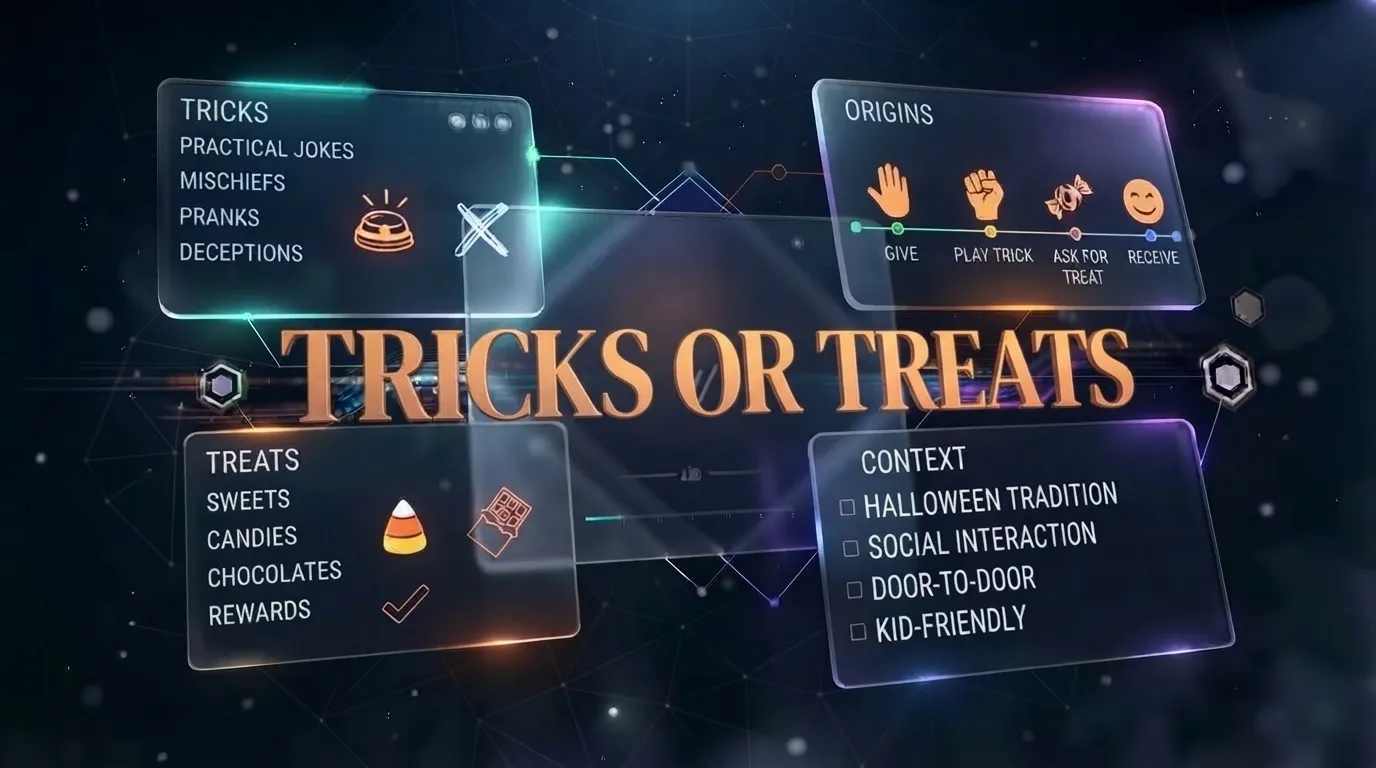
Trick or treat is the standard modern Halloween phrase. Tricks or treats is an older form that is not common today.
Imagine children wearing costumes and walking from house to house on Halloween. They knock on doors and say, “Trick or treat!” People often give them candy, sweets, or small gifts.
But why do some people write tricks or treats? This can confuse English learners. Both trick and treat are correct English words. The difference is in how they are used in the Halloween phrase.
A trick can mean a prank or a clever act. A treat is something nice or enjoyable, such as candy. So, the phrase has a playful meaning. It asks for a treat and suggests a trick if no treat is given.
Historical records show that tricks or treats was used as an early form of the Halloween phrase. The modern form, trick or treat, became the usual form.
This guide explains Tricks or Treats, its meaning, history, grammar, examples, and correct modern use.
Pronunciation
- Trick: US /trɪk/ | UK /trɪk/
- Treat: US /triːt/ | UK /triːt/
Let us now look at the difference in simple words.
Difference Between Tricks or Treats
1. Modern and old use
Trick or treat is the normal modern phrase.
Tricks or treats is an older form.
Examples:
- The children shouted, “Trick or treat!”
- The old text used “tricks or treats.”
2. Singular and plural
Trick or treat uses singular words.
Tricks or treats uses plural words.
Examples:
- The child said, “Trick or treat!”
- The story used the words “tricks or treats.”
3. Common usage
Trick or treat is common today.
Tricks or treats is rare today.
Examples:
- We heard “trick or treat” at the door.
- I found “tricks or treats” in an old story.
4. Halloween greeting
Children normally say trick or treat when they visit homes.
They do not normally say tricks or treats today.
Examples:
- “Trick or treat!” the children shouted.
- “Tricks or treats!” sounds old-fashioned today.
5. Meaning of trick
Trick can mean a prank or clever action.
Tricks means more than one prank or action.
Examples:
- Jack played a trick on his friend.
- The magician showed many tricks.
6. Meaning of treat
Treat can mean one nice thing or reward.
Treats means more than one.
Examples:
- The child received a treat.
- The children received many treats.
7. Fixed phrase
Trick or treat is a fixed Halloween expression.
Changing both words to plural makes it an older variant.
Examples:
- “Trick or treat?” is the usual form.
- “Tricks or treats?” is an older form.
8. Modern writing
Use trick or treat in modern writing.
Use tricks or treats mainly for old or historical context.
Examples:
- The school held a trick-or-treat event.
- The book described old “tricks or treats” customs.
9. Meaning in Halloween
Trick or treat is linked to asking for candy or other treats.
Tricks or treats carries the same basic idea but sounds old today.
Examples:
- Children went out for trick or treat.
- An old story talked about tricks or treats.
10. Activity name
Trick-or-treating is the name of the Halloween activity.
Tricks or treats is not normally used as the activity name today.
Examples:
- We went trick-or-treating last night.
- The children came home after trick-or-treating.
Nature and Behaviour of Tricks and Treats
A trick can be fun, clever, or sometimes harmful. A joke played on a friend can be a trick. A magician can also perform a trick.
A treat has a positive meaning. It can be candy, cake, a gift, or another nice thing.
In the Halloween phrase, the words create a playful choice. Children ask for a treat while making a light joke about a trick.
Why People Get Confused About Tricks or Treats
People may see tricks or treats in old books, films, or websites. They may think it is the normal phrase.
The confusion also comes from the fact that tricks and treats are both correct plural words. But a fixed phrase does not always follow normal word patterns.
The easy rule is:
For modern English, use “trick or treat.”
Comparison Table
| Point | Trick or Treat | Tricks or Treats |
| Form | Singular | Plural |
| Modern use | Common | Rare |
| Halloween phrase | Standard | Older form |
| Meaning | Halloween request | Older Halloween request |
| Style | Modern | Dated |
| Common today | Yes | No |
| History | Modern standard | Early variant |
| Children use it today | Yes | Rarely |
| Writing | Natural | Historical |
| Activity | Trick-or-treating | Older wording |
The Origin of Tricks or Treats
Halloween has very old roots. Some Halloween customs are linked to old Celtic and European traditions. People wore costumes and went from place to place for food, gifts, or fun.
The modern trick-or-treat tradition developed much later. Historical records show early versions of the phrase in Canada. One early record from 1917 used “tricks or treats.” Other versions also appeared before “trick or treat” became the usual form.
The practice became much more common in North America during the 20th century. It later became a well-known Halloween tradition.
British vs American English
There is no major British-American spelling difference between trick or treat and tricks or treats.
Both forms can be understood in both varieties of English. However, trick or treat is the normal modern phrase.
There can be a small word difference for the candy:
- American English: candy
- British English: sweets
Examples:
- The children collected candy.
- The children collected sweets.
Which One Should You Use?
For modern English, use trick or treat.
Use tricks or treats when:
- talking about old usage,
- discussing language history,
- quoting an old source,
- or talking about older media.
Common Mistakes
❌ Tricks or treats!
✅ Trick or treat!
❌ Treat or trick!
✅ Trick or treat!
❌ Trick and treat!
✅ Trick or treat!
❌ We went tricks or treats.
✅ We went trick-or-treating.
Everyday Usage Examples
In an Email
“We will have a trick-or-treat event for the children.”
On Social Media
“Happy Halloween! Trick or treat!”
In News Writing
“Children went trick-or-treating on Halloween night.”
In Formal Writing
“Trick-or-treating is a popular Halloween activity.”
Usage Trends
Today, trick or treat is the usual form. Tricks or treats is mainly seen in older or historical material.
The older form was still used in the 1966 television special It’s the Great Pumpkin, Charlie Brown. This shows that the plural form remained in popular culture for some time.
Metaphors and Similes
The words trick and treat also appear in other useful expressions.
A trick of the light means a strange effect caused by light.
- The shadow was a trick of the light.
A treat for the eyes means something very beautiful.
- The colorful garden was a treat for the eyes.
Treat yourself means to give yourself something nice.
- I bought a new book to treat myself.
Connotative Meaning
Trick can have a playful or negative feeling. It may suggest a prank, lie, or clever action.
Treat usually has a positive feeling. It suggests pleasure, kindness, food, or a reward.
In trick or treat, the two words create a fun Halloween feeling.
Idioms and Proverbs
There is no common proverb based on tricks or treats, but both words appear in useful expressions.
Play a trick on someone
- Sam played a trick on his brother.
Treat yourself
- I went out to treat myself.
A special treat
- The cake was a special treat for the children.
Literature and Movies
Halloween and trick-or-treating appear often in children’s stories, poems, cartoons, and films.
A famous example is It’s the Great Pumpkin, Charlie Brown, a 1966 American animated television special based on Charles M. Schulz’s Peanuts. The older phrase “tricks or treats” appears in the special.
Another well-known example is Disney’s Trick or Treat, a 1952 American animated short featuring Donald Duck and his nephews.
Why This Difference Matters
Knowing this difference helps you use natural English.
If you write trick or treat, most readers will see it as the normal Halloween phrase.
If you write tricks or treats, readers may understand it, but it can sound old-fashioned.
This small difference is useful for students, teachers, writers, and bloggers.
Usefulness in Daily Life
This difference is helpful when you write about Halloween. It can help you choose the right phrase in school work, blog posts, emails, and social media.
It also helps when you read older books or watch older films. If you see tricks or treats, you will know that it is an older form of the phrase.
Situational Preference
Use trick or treat when you talk about modern Halloween. It is the phrase children normally use when they visit homes for candy or other treats. Use tricks or treats only when you are talking about older language or quoting an old source. If you are writing a school assignment, website article, email, or social media post, trick or treat is the safer modern choice. Also remember that trick-or-treating is the name of the activity. This simple rule can help you write clear and natural English.
Possible Questions
Is “tricks or treats” correct?
It is an older form of the Halloween phrase. It is not the usual modern form.
Is it “trick or treat” or “tricks or treats”?
Trick or treat is the standard modern phrase.
What does trick mean?
A trick can be a prank, clever action, or act meant to surprise someone.
What does treat mean?
A treat is something nice or enjoyable, such as candy, food, or a small gift.
Do British people say “trick or treat”?
Yes. Trick or treat is also used in British English.
What is trick-or-treating?
It is the Halloween activity in which children visit homes and ask for treats.
Why is “tricks or treats” sometimes used?
It was used as an early variant of the Halloween phrase and can still appear in older material.
Conclusion
Tricks or Treats and trick or treat have the same basic Halloween idea, but they are not used in the same way today. Trick or treat is the standard modern phrase. Children use it when they visit homes on Halloween and ask for candy, sweets, or other treats. Tricks or treats is an older form. Historical records show that it was used in the early history of the phrase. It can still be found in old books, historical writing, and older films or television shows. The word trick can mean a prank or clever act. The word treat means something nice or enjoyable. Together, they make a fun Halloween expression. So, if you are writing modern English, remember the simple rule: use “trick or treat.” Use “tricks or treats” only when the older form fits your context.

Mahnoor Afzal is an educator, researcher, and English language content specialist focused on grammar, vocabulary, word differences, and meanings. I combines research, teaching, and SEO expertise to create clear and reliable English learning content at Lengovia.






1 thought on “Tricks or Treats: Meaning, Difference, History, and Correct Usage”