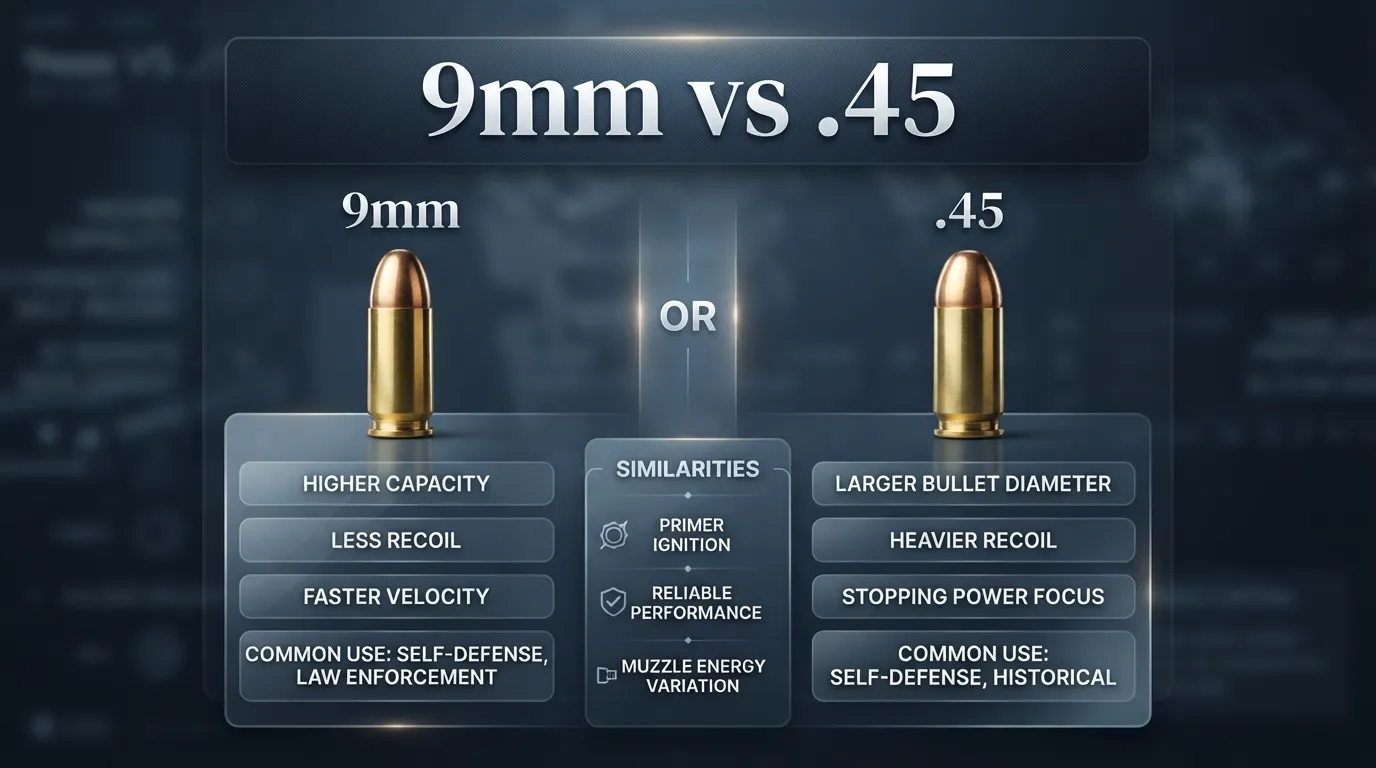
9mm and .45 are two types of ammunition used in firearms. The numbers refer to the approximate diameter of the bullet, measured in millimeters or inches.
9mm means about 9 millimeters in diameter. It is commonly used in handguns and is often called 9mm Luger or 9×19mm.
.45 often means .45 ACP, a handgun cartridge with a bullet about 0.45 inches wide. The exact meaning depends on the full cartridge name, as other .45-caliber cartridges also exist.
The main difference is size. A 9mm bullet is narrower than a .45 ACP bullet. The cartridges also differ in design and performance.
These terms are not interchangeable. A firearm must use the exact cartridge type it was designed for. Always check the firearm’s markings and its manual.
9mm or .45: Pronunciation
- 9mm: “Nine millimeter.”
- .45: “Point forty-five” or “forty-five caliber,” depending on the context.
In the United States, people often say “nine mil” for 9mm. The term “forty-five” often refers to .45 ACP.
Difference Between 9mm and .45
1. Size
A 9mm bullet is about 9 millimeters wide. A .45 ACP bullet is about 11.43 millimeters wide.
Examples:
- A 9mm bullet is narrower.
- A .45 ACP bullet is wider.
2. Measurement
The term 9mm uses the metric system. The term .45 uses inches to describe its caliber.
Examples:
- 9mm refers to about 9 millimeters.
- .45 ACP refers to a bullet about 0.45 inches wide.
3. Cartridge Name
9mm often means 9×19mm Parabellum, also called 9mm Luger.
.45 often means .45 ACP, which stands for Automatic Colt Pistol.
Examples:
- A box may say 9mm Luger.
- A box may say .45 ACP.
4. Bullet Width
The bullet used in 9mm ammunition is narrower than the bullet used in .45 ACP ammunition.
Examples:
- A 9mm bullet has a smaller diameter.
- A .45 ACP bullet has a larger diameter.
5. Cartridge Design
The two cartridges have different sizes and designs. They are made for firearms built for their specific cartridge type.
Examples:
- A firearm marked for 9mm needs the correct 9mm ammunition.
- A firearm marked for .45 ACP needs the correct .45 ACP ammunition.
6. Recoil
Recoil is the backward movement felt when a firearm is fired. It can vary with the firearm, ammunition, and other factors.
Examples:
- Different 9mm loads can produce different recoil.
- Different .45 ACP loads can also produce different recoil.
7. Ammunition Options
Both 9mm and .45 ACP ammunition come in different types. The exact options depend on the cartridge and local laws.
Examples:
- 9mm ammunition is sold in different load types.
- .45 ACP ammunition is also sold in different load types.
8. Firearm Compatibility
A firearm is designed for a specific cartridge. The caliber and cartridge name must match the firearm’s markings and manual.
Examples:
- A 9mm firearm is not automatically suitable for .45 ACP.
- A .45 ACP firearm is not automatically suitable for 9mm.
9. Cost and Availability
Prices and availability vary by location, brand, and time. Neither type is always cheaper everywhere.
Examples:
- The price of 9mm ammunition can vary between shops.
- The price of .45 ACP ammunition can also vary.
10. Main Difference
The clearest difference is bullet diameter and cartridge design. Other features depend on the exact ammunition and firearm.
Examples:
- 9mm is the narrower option by bullet diameter.
- .45 ACP has the wider bullet diameter.
You can also explore:https://lengovia.com/alluding-or-eluding/
Nature and Behaviour
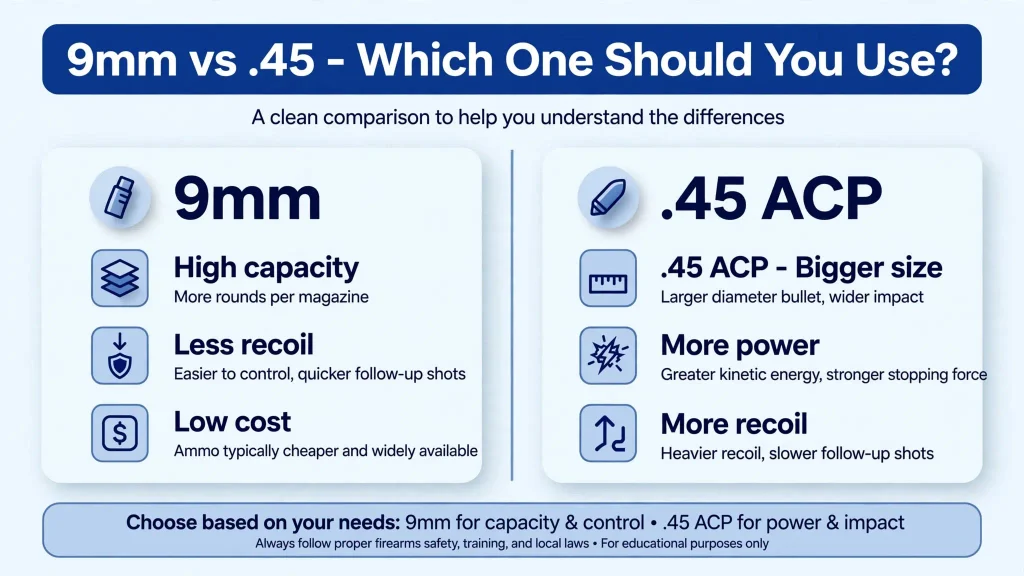
The terms 9mm and .45 describe ammunition types. They do not name two specific firearms.
9mm ammunition is commonly used in handguns. .45 ACP is also a handgun cartridge. Both have a long history of use in firearms.
Their performance can change with the firearm and the exact ammunition. Bullet size alone does not explain every difference.
Why Do People Get Confused?
People may compare 9mm and .45 because both are common handgun cartridges. They may also think the numbers describe the same kind of measurement.
The key difference is that 9mm uses millimeters, while .45 uses a caliber measurement in inches. Also, “.45” can refer to more than one cartridge, so the full name matters.
9mm vs .45: Comparison Table
| Feature | 9mm | .45 ACP |
| Full name often used | 9mm Luger | .45 Automatic Colt Pistol |
| Bullet diameter | About 9mm | About 11.43mm |
| Measurement | Millimeters | Inches |
| Bullet width | Narrower | Wider |
| Cartridge design | Different from .45 ACP | Different from 9mm |
| Common use | Handguns | Handguns |
| Recoil | Depends on the load and firearm | Depends on the load and firearm |
| Price | Varies | Varies |
| Compatibility | Requires a matching firearm | Requires a matching firearm |
| Main difference | Smaller bullet diameter | Larger bullet diameter |
Origin of 9mm and .45
The 9mm Luger cartridge was developed in the early 1900s and became widely used around the world.
The .45 ACP cartridge was designed by John Browning in the early 1900s. It became known for its use in the M1911 pistol.
Both cartridges have been used for many years, and both remain known in the world of firearms.
British vs American English
The terms 9mm and .45 are used in both British and American English. The main difference is not spelling but measurement style.
- 9mm: Uses millimeters.
- .45: Uses a caliber measurement in inches.
The exact cartridge name is important in both countries.
Which One Should You Use?
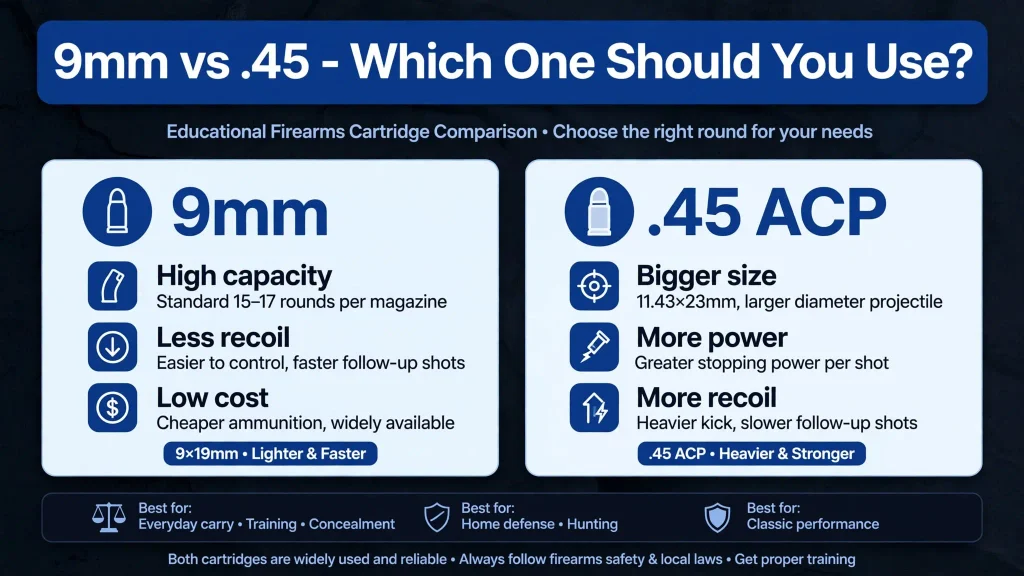
Use 9mm when referring to a 9mm cartridge, such as 9mm Luger.
Use .45 ACP when referring to the .45 Automatic Colt Pistol cartridge.
Do not use the terms as if they mean the same ammunition. Always follow the firearm’s markings and manual, and follow local laws.
Common Mistakes
– Mistake: 9mm and .45 are the same size.
Correct: .45 ACP has a wider bullet diameter.
– Mistake: Every .45 cartridge is .45 ACP.
Correct: Several different cartridges use a .45-caliber name.
– Mistake: Any handgun can use both types.
Correct: Firearms must use the ammunition they are designed for.
– Mistake: Bullet diameter tells you everything about performance.
Correct: Many factors affect performance.
Everyday Usage
These terms may appear in news stories, product labels, books, and discussions about firearms.
Examples:
- “The report mentioned a 9mm cartridge.”
- “The firearm was marked for .45 ACP.”
Usage Trends
Both 9mm and .45 ACP remain familiar terms in firearm discussions. The 9mm cartridge is widely used internationally, while .45 ACP is also well known, especially in the United States.
Prices, availability, and common uses can vary by region. A general comparison should not replace the details printed on a specific ammunition package.
Metaphors and Similes
These terms are technical names, so they do not have common metaphors of their own.
You can think of them as two different sizes of a product. They may serve similar broad purposes, but their details are not the same.
This comparison is only a simple way to understand why the names should not be mixed up.
Connotative Meaning
The terms 9mm and .45 may bring to mind handguns, ammunition, or firearm history.
Their meanings are technical rather than emotional. The exact context determines what a person means when they use either term.
Idioms and Proverbs
There are no common English idioms that specifically mean 9mm or .45. However, these phrases can relate to technical terms:
- Know the facts: Understand the correct details.
- Get the details right: Make sure information is accurate.
- Read the fine print: Check the small details before making a choice.
These phrases remind readers to check the exact cartridge name instead of guessing.
Literature and Movies
The terms 9mm and .45 appear in some crime stories, action films, and books about firearms. They may be used to describe ammunition mentioned in a scene.
However, a film may not always show technical details correctly. For accurate information, the full cartridge name and reliable reference material are more useful than a movie scene.
Why Does This Difference Matter?
Knowing the difference between 9mm and .45 helps readers understand firearm-related writing and labels.
The bullet diameters differ, and the cartridges are not interchangeable. Confusing their names can lead to serious safety risks.
The safest rule is simple: always check the exact cartridge marking and the firearm’s manual.
Usefulness in Daily Life
This difference can help people read news reports, understand technical terms, and follow discussions about firearms.
It is also useful to know that a number alone may not give the full cartridge name. For example, .45 ACP is more specific than simply saying .45.
Clear names help prevent mistakes and improve understanding.
Situational Preference
Use 9mm when the cartridge is 9mm Luger or another clearly identified 9mm type. Use .45 ACP when the cartridge is the .45 Automatic Colt Pistol type. If you see only “.45,” check the full name because other cartridges may use that caliber. Never guess which ammunition fits a firearm. Check its markings and manual, and follow all safety rules and local laws.
Fill in the Blanks
Complete each sentence with 9mm or .45 ACP.
- ______ uses millimeters in its name.
- ______ has a bullet diameter of about 11.43mm.
- ______ is also called 9mm Luger.
- The full name of ______ includes Automatic Colt Pistol.
- Both types require a firearm made for the correct cartridge: ______ and ______.
Multiple-Choice Questions
1. What does 9mm refer to?
A. A cartridge size B. A type of website C. A car model D. A tool
Answer: A. A cartridge size
2. What does .45 ACP stand for?
A. Automatic Colt Pistol B. American Car Part C. Automatic Control Plan D. Air Check Point
Answer: A. Automatic Colt Pistol
3. Which bullet has the wider diameter?
A. 9mm B. .45 ACP C. Both are always equal D. Neither
Answer: B. .45 ACP
4. Can every firearm use both cartridges?
A. Yes B. No C. Only new firearms can D. Only old firearms can
Answer: B. No
5. What should you check before identifying ammunition for a firearm?
A. Its color only B. Its price only C. The firearm markings and manual D. A movie scene
Answer: C. The firearm markings and manual
Possible Questions
1. What is the main difference between 9mm and .45?
The main difference is bullet diameter and cartridge design. A .45 ACP bullet is wider than a 9mm bullet.
2. Is .45 the same as .45 ACP?
Not always. Several cartridges use a .45-caliber name, so the full cartridge name matters.
3. Are 9mm and .45 ACP interchangeable?
No. A firearm must use the exact type of ammunition it was designed for.
4. Which cartridge is cheaper?
Prices vary by location, brand, and time. Neither is always cheaper in every market.
5. Do 9mm and .45 have the same recoil?
No single answer applies to every firearm and load. Recoil depends on several factors, including the firearm and ammunition.
6. Are these terms used in British and American English?
Yes. Both terms are used in firearm-related writing in the UK and the US.
7. Why is the full cartridge name important?
The full name helps identify the exact cartridge and prevents confusion between different types.
Conclusion
9mm or .45 are names used for different ammunition types. 9mm often refers to 9mm Luger, while .45 often refers to .45 ACP in handgun discussions. The .45 ACP bullet has a wider diameter, and the cartridge designs differ. The numbers alone do not explain every feature. The full cartridge name is important because other .45-caliber cartridges exist. Always check the firearm’s markings and manual, and never assume that different cartridges can be used in the same firearm.

Mahnoor Afzal is an educator, researcher, and English language content specialist focused on grammar, vocabulary, word differences, and meanings. I combines research, teaching, and SEO expertise to create clear and reliable English learning content at Lengovia.











1 thought on “9mm or .45: What Is the Difference?”