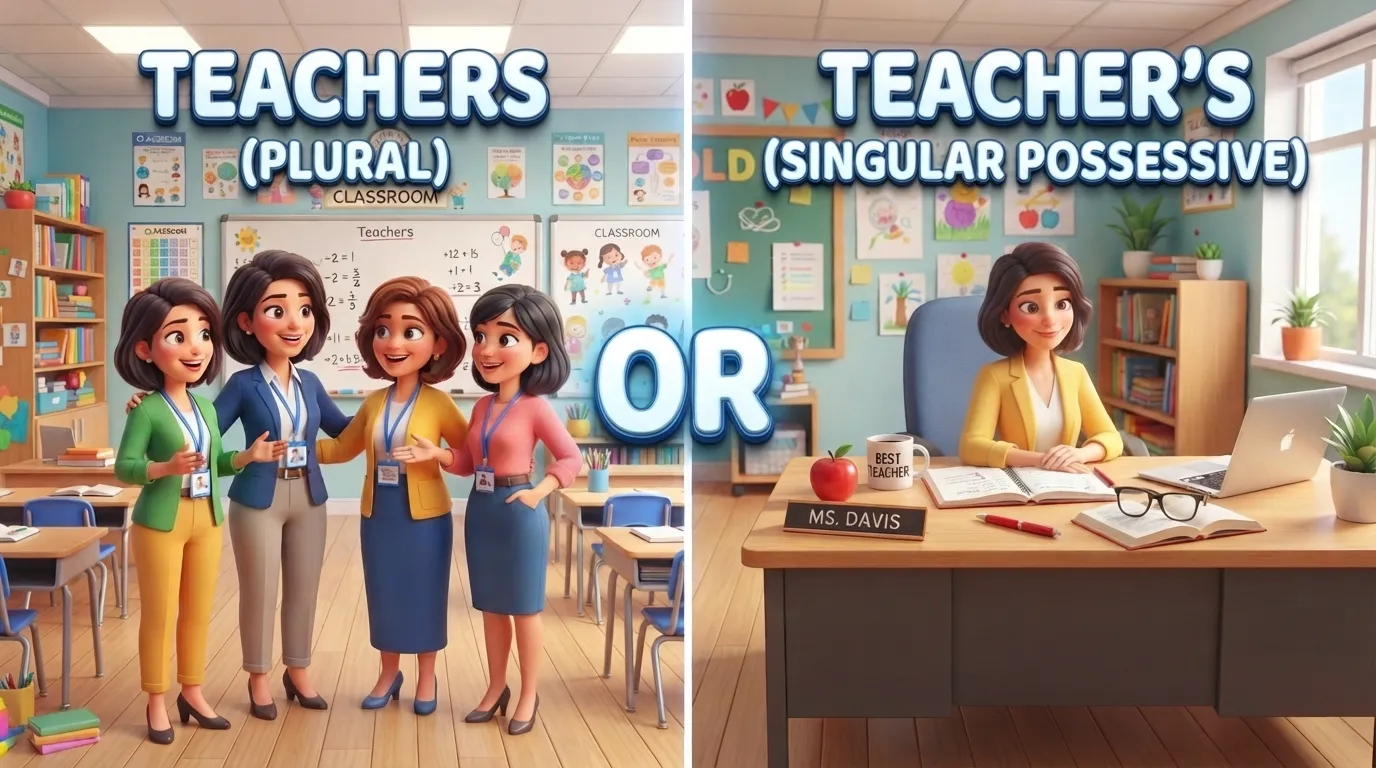
Teachers and teacher’s look almost the same, but they have different meanings. The main difference is the apostrophe (’).
Teachers means more than one teacher. Teacher’s shows that something belongs to one teacher.
For example, “The teachers are in the room” means that many teachers are there. “The teacher’s book is on the desk” means the book belongs to one teacher.
These words can confuse students because they sound the same when spoken. However, their spelling and use are different. Learning this simple rule can help you write better English at school, at work, and in daily life.
US and UK Pronunciation
- Teachers: /ˈtiːtʃərz/
- Teacher’s: /ˈtiːtʃərz/
Both words usually sound the same in American and British English. The difference appears in writing.
Difference Between Teachers and Teacher’s
1. Basic Meaning
Teachers means two or more people who teach.
Example: The teachers are very kind.
Teacher’s shows that something belongs to one teacher.
Example: The teacher’s bag is blue.
2. Number of People
We use teachers when we talk about more than one teacher.
Example: Three teachers came to school.
We use teacher’s when we talk about one teacher and something that belongs to them.
Example: The teacher’s desk is clean.
3. Use of the Apostrophe
Teachers has no apostrophe.
Example: The teachers are busy.
Teacher’s has an apostrophe before the s.
Example: The teacher’s pen is missing.
4. Talking About Books
Use teachers when you mean many teachers.
Example: The teachers have new books.
Use teacher’s when one teacher owns a book.
Example: This is the teacher’s book.
5. Talking About Classrooms
Teachers refers to more than one teacher.
Example: The teachers are in their classrooms.
Teacher’s shows that a classroom or item belongs to one teacher.
Example: The teacher’s classroom is large.
6. Talking About Ideas
Use teachers to talk about teachers as a group.
Example: Teachers share ideas.
Use teacher’s to show that an idea belongs to one teacher.
Example: The teacher’s idea helped us.
7. Use in Sentences
Teachers is a plural noun.
Example: The teachers help the children.
Teacher’s is a possessive form.
Example: The teacher’s advice was helpful.
8. Talking About Work
Example with teachers: The teachers work hard every day.
Example with teacher’s: The teacher’s work is important.
The first sentence talks about many teachers. The second talks about the work of one teacher.
9. Talking About Supplies
Example with teachers: The teachers need more supplies.
Example with teacher’s: The teacher’s pencils are on the table.
10. Common Grammar Rule
Use teachers when you mean more than one teacher.
Use teacher’s when something belongs to one teacher.
Remember: the apostrophe changes the meaning.
You can also explore :https://lengovia.com/come-or-cum/
Nature and Behaviour
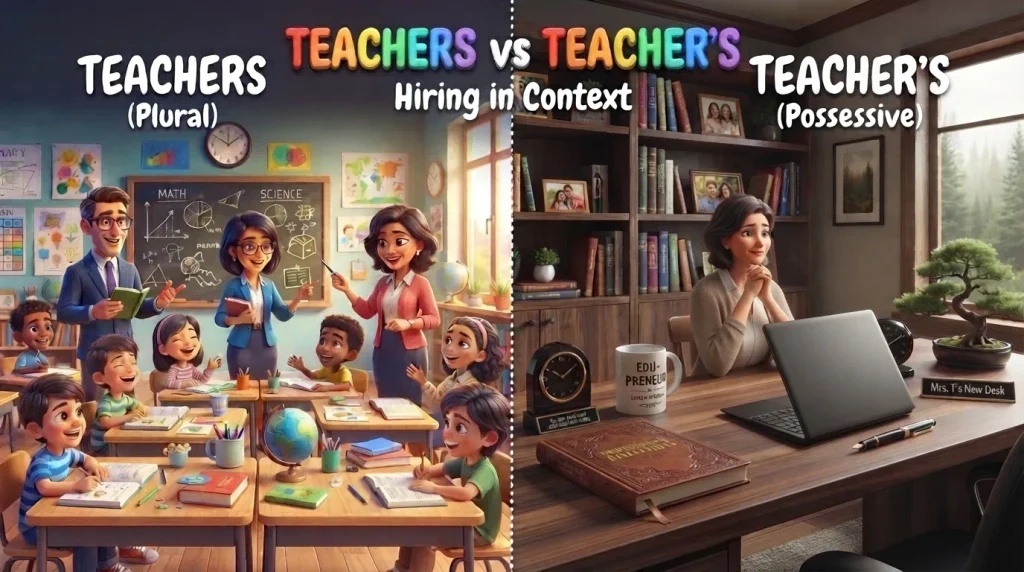
The main difference is number and ownership.
- Teachers: More than one teacher.
- Teacher’s: Something belongs to one teacher.
Examples:
- The teachers are talking.
- The teacher’s phone is ringing.
Both forms are correct when used in the right way.
Why Do People Get Confused?
People often confuse these words because they sound alike. The apostrophe is small, so it is easy to miss when writing.
Remember that teachers means many teachers, while teacher’s means something belongs to one teacher.
Comparison Table
| Teachers | Teacher’s |
| Means more than one teacher | Shows ownership by one teacher |
| No apostrophe | Has an apostrophe |
| Teachers are friendly. | The teacher’s bag is red. |
| Teachers have books. | The teacher’s book is new. |
| Teachers help students. | The teacher’s advice helped me. |
Origin
The word teacher comes from the verb teach. A teacher is a person who helps others learn.
The ending -s can make a noun plural, so teachers means more than one teacher. An apostrophe with s can show ownership, so teacher’s means something belongs to one teacher.
British vs American English
British and American English use teachers and teacher’s in the same way.
Examples:
- British English: The teachers are in the staff room.
- American English: The teachers are in the staff room.
Both forms follow the same grammar rules.
Which One Should You Use?
Choose the word based on your meaning.
Use teachers when you mean two or more teachers.
Example: The teachers are ready for the meeting.
Use teacher’s when you mean something belongs to one teacher.
Example: The teacher’s chair is near the window.
If you mean something belongs to more than one teacher, use teachers’.
Example: The teachers’ room is open.
Common Mistakes
Avoid these mistakes:
- Incorrect: The teacher’s are here.
- Correct: The teachers are here.
- Incorrect: The teachers book is new.
- Correct: The teacher’s book is new.
- Incorrect: The teacher’s are kind.
- Correct: The teachers are kind.
- Incorrect: The teachers’s room is clean.
- Correct: The teachers’ room is clean.
Everyday Usage
These words appear in schoolwork, emails, and daily conversations.
At school: The teachers are in a meeting.
In a sentence: The teacher’s name is on the board.
In an email: The teachers are ready for the event.
For a note: Please return the teacher’s keys.
Using the correct form makes your writing clear and natural.
Usage Trends
Both forms are common in written English. Teachers often appears when people talk about schools, lessons, and education. Teacher’s often appears before a noun to show ownership, such as teacher’s desk or teacher’s book.
The correct choice depends on the sentence.
Metaphors and Similes
The word teachers can describe a group of people who help others learn.
Example: Good teachers are like guides on a journey.
Teacher’s can show that an idea or lesson belongs to one teacher.
Example: The teacher’s words were a light in a dark room.
Connotative Meaning
Teachers can bring to mind learning, care, and teamwork because it refers to a group of people who teach.
Teacher’s often points to something linked to one teacher, such as their advice, book, or classroom.
The exact meaning depends on the sentence.
Idioms and Proverbs
The word teacher appears in sayings about learning.
- Experience is the best teacher: We can learn from what happens to us.
- A good teacher can change a life: A caring teacher can help someone grow.
These sayings use teacher in a broad way. The possessive form teacher’s is used when showing ownership, such as “the teacher’s advice.”
Literature and Movies
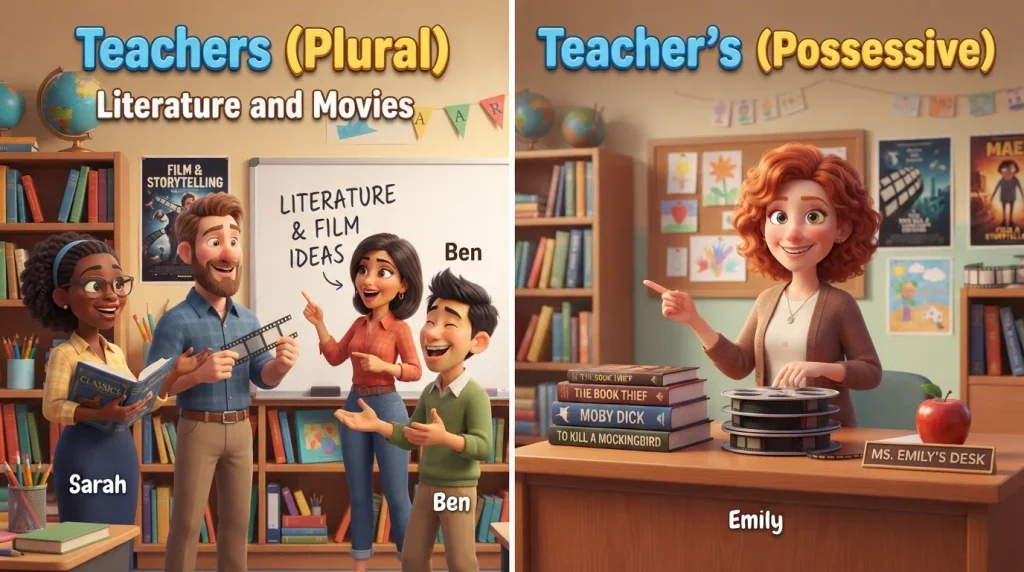
Teachers often appear in books and films as people who guide students.
For example, Matilda (1988), a children’s book by Roald Dahl, features Miss Honey, a kind teacher. The film Matilda (1996), made in the United States, also shows her caring role.
You could write:
- The teachers help the children.
- The teacher’s advice changes Matilda’s life.
The first sentence talks about several teachers. The second shows ownership of the advice by one teacher.
Why Does This Difference Matter?
Using the correct form helps readers understand your meaning. If you write “the teachers’ room,” you mean a room used by or belonging to several teachers. If you write “the teacher’s room,” you mean a room linked to one teacher.
A small apostrophe can change the meaning of a sentence. That is why it is important to check it when writing.
Usefulness in Daily Life
You may use these words in homework, school notices, emails, and messages.
For example, “The teachers are busy” talks about several people. “The teacher’s phone is on the desk” tells us who owns the phone.
Once you learn this rule, it becomes easier to choose the correct word.
Situational Preference
Use teachers when you talk about more than one teacher. For example, “The teachers are planning a school event.” Use teacher’s when something belongs to one teacher. For example, “The teacher’s bag is under the desk.” If something belongs to several teachers, use teachers’, as in “The teachers’ office is open.” Always think about whether you mean a group, one person’s belongings, or something linked to several people.
Fill in the Blanks
Choose teachers, teacher’s, or teachers’.
- The _____ are in the classroom.
- The _____ book is on the desk. (one teacher)
- The _____ room is clean. (many teachers)
- Our _____ help us learn.
- The _____ pen is blue. (one teacher)
Answers: 1. teachers, 2. teacher’s, 3. teachers’, 4. teachers, 5. teacher’s
Quiz Questions
1. Which word means more than one teacher? A) Teacher’s B) Teachers C) Teacher D) Teachers’s
Answer: B) Teachers
2. Which form shows ownership by one teacher? A) Teachers B) Teacher C) Teacher’s D) Teachers’
Answer: C) Teacher’s
3. Choose the correct sentence. A) The teachers are kind. B) The teacher’s are kind. C) The teachers’s are kind. D) The teacher are kind.
Answer: A) The teachers are kind.
4. Which form shows something belongs to several teachers? A) Teacher’s B) Teachers C) Teachers’ D) Teacher
Answer: C) Teachers’
5. Choose the correct phrase for a book owned by one teacher. A) Teachers book B) Teacher’s book C) Teachers’s book D) Teacher book
Answer: B) Teacher’s book
Possible Questions
1. What is the difference between teachers and teacher’s?
Teachers means more than one teacher. Teacher’s shows that something belongs to one teacher.
2. Does teachers need an apostrophe?
No. Use teachers without an apostrophe when you mean more than one teacher.
3. When do I use teacher’s?
Use teacher’s to show ownership by one teacher, as in “the teacher’s desk.”
4. What does teachers’ mean?
Teachers’ shows ownership by more than one teacher, as in “the teachers’ room.”
5. Do British and American English use these forms differently?
No. Both use the same rules.
6. How can I remember the difference?
No apostrophe means more than one teacher. An apostrophe before s shows ownership by one teacher. An apostrophe after s shows ownership by several teachers.
Conclusion
Teachers or teacher’s sound alike, but they have different meanings. Use teachers when you mean more than one teacher. Use teacher’s when something belongs to one teacher. If something belongs to several teachers, use teachers’. For example, “The teachers are happy” talks about a group. “The teacher’s bag is red” shows that one teacher owns the bag. “The teachers’ room is large” refers to a room linked to several teachers. The easiest way to remember the difference is to check the number of teachers and look at the apostrophe. With a little practice, you can use all three forms correctly in schoolwork, emails, and everyday writing.

Mahnoor Afzal is an educator, researcher, and English language content specialist focused on grammar, vocabulary, word differences, and meanings. I combines research, teaching, and SEO expertise to create clear and reliable English learning content at Lengovia.











1 thought on “Teachers or Teacher’s: Learn the Difference in Easy English”