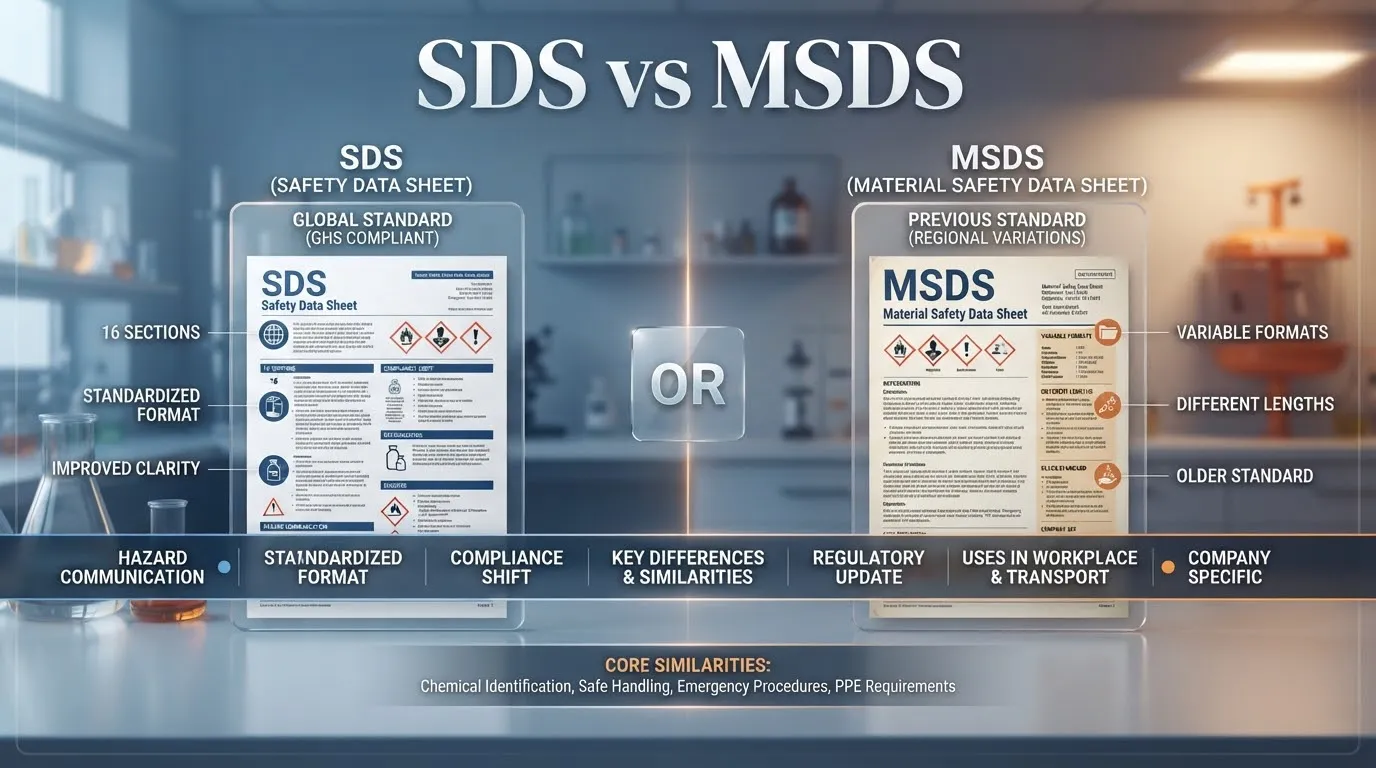
SDS or MSDS are terms used for papers that explain the dangers of chemicals and how to use them safely. Both help people learn about chemical risks. However, SDS is the newer term, while MSDS is the older term. These papers help workers, students, and other people stay safe around chemicals.
For example, a worker may read an SDS before using a cleaning product. In the past, the worker may have used an MSDS for the same purpose. Today, many safety rules use SDS instead of MSDS.
Understanding SDS or MSDS is useful when you work with chemicals at home, school, or work. Both terms relate to chemical safety, but they do not mean that every document has the same format.
Pronunciation of SDS and MSDS
- SDS: Say each letter: “S-D-S.”
- MSDS: Say each letter: “M-S-D-S.”
Difference Between SDS and MSDS
1. Full Form
- SDS: Safety Data Sheet.
- MSDS: Material Safety Data Sheet.
Example: The new chemical came with an SDS.
Example: The old chemical file contained an MSDS.
2. Age
- SDS: The newer term.
- MSDS: The older term.
Example: The company now uses SDS documents.
Example: An older file may still say MSDS.
3. Main Purpose
Both documents explain chemical dangers and safe use.
Example: An SDS explains how to handle a chemical.
Example: An MSDS also gives safety details.
4. Format
- SDS: Uses a standard 16-section format under the Globally Harmonized System (GHS).
- MSDS: Older versions may have different formats.
Example: The SDS has 16 sections.
Example: An old MSDS may use another layout.
5. Safety Details
Both may include information about risks, storage, and first aid.
Example: An SDS explains what to do after a spill.
Example: An MSDS may give first-aid steps too.
6. Workplace Use
- SDS: Commonly used in current workplace safety systems.
- MSDS: May appear in older records.
Example: A worker checks the SDS before use.
Example: The manager keeps an old MSDS for reference.
7. Chemical Hazards
Both can explain the dangers of a chemical.
Example: An SDS warns about harmful fumes.
Example: An MSDS may warn about skin contact.
8. Emergency Help
Both may give steps for dealing with accidents.
Example: An SDS explains what to do after exposure.
Example: An MSDS may explain how to handle a spill.
9. Current Rules
- SDS: The standard term used in many modern chemical safety systems.
- MSDS: An older term that may still be used informally.
Example: The company asks workers to check the SDS.
Example: A worker calls an old document an MSDS.
10. Which One Is Better?
An up-to-date SDS is generally the right document to check today. The document must match the chemical and supplier.
Example: Read the current SDS for a cleaning liquid.
Example: Do not rely only on an old MSDS if a newer SDS is available.
Nature and Behaviour
SDS and MSDS are not chemicals. They are safety documents.
An SDS gives clear details about a chemical’s risks and safe use. It usually follows a set format with 16 sections. These sections cover things such as hazards, first aid, storage, and emergency steps.
An MSDS serves a similar purpose. However, older MSDS documents may not follow the same format. Always check that the document is current and matches the product you are using.
You can also explore :https://lengovia.com/9mm-or-45/
Why Do People Get Confused?
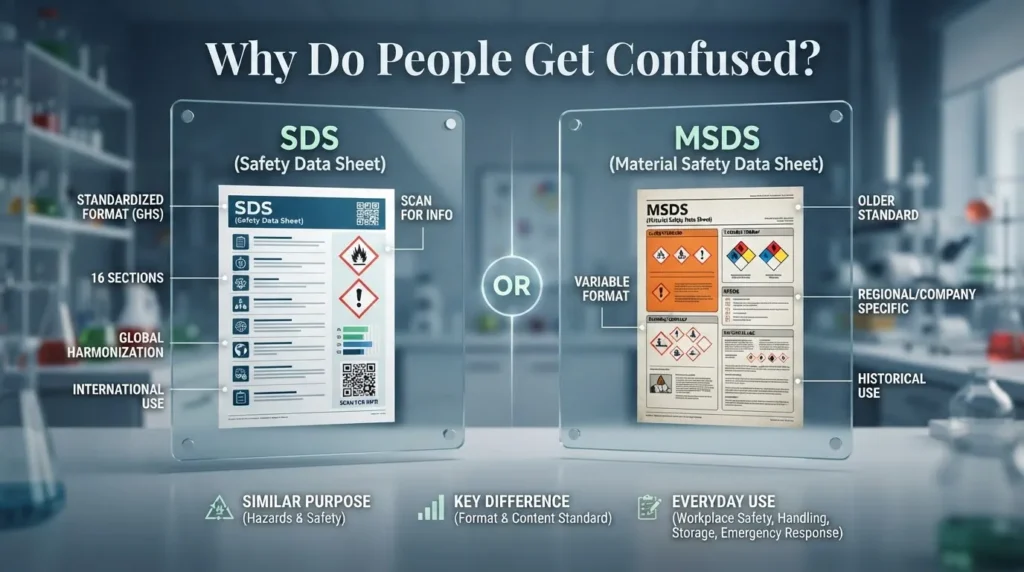
People get confused because SDS and MSDS have similar names and purposes. Both give information about chemical safety.
The main difference is that SDS is the newer term. MSDS is the older name. Some people still say MSDS because they learned that term years ago.
Comparison Table
| Feature | SDS | MSDS |
| Full form | Safety Data Sheet | Material Safety Data Sheet |
| Use | Modern term | Older term |
| Format | Standard 16-section format | Older formats may vary |
| Purpose | Chemical safety | Chemical safety |
| Hazards | Explains risks | Explains risks |
| First aid | May include steps | May include steps |
| Current use | Widely used today | May appear in old files |
| Best choice | Current document | Check its date and details |
Origin of SDS and MSDS
MSDS stands for Material Safety Data Sheet. This name was used for documents that explained the risks of materials and chemicals.
Later, the Globally Harmonized System of Classification and Labelling of Chemicals (GHS) helped create a more consistent way to share chemical safety information. The name Safety Data Sheet (SDS) is used in this system.
The newer format makes it easier for people in different places to find key safety details.
British vs. American English
SDS and MSDS are used in both British and American English. The terms do not change simply because someone uses British or American spelling.
However, chemical safety rules may differ by country. Always follow the rules that apply to your workplace.
Which One Should You Use?
Use SDS when talking about a current Safety Data Sheet. It is the standard term used in many modern safety systems.
You may still see MSDS on older papers, labels, or workplace files. If you find one, check whether it is still current. Use the latest document provided for the exact chemical or product.
Common Mistakes
| Wrong Statement (❌) | Correct Statement (✅) |
| SDS means Safety Material Document. | SDS means Safety Data Sheet. |
| MSDS and SDS always have the same format. | Older MSDS documents may use different formats. |
| An old MSDS is always up to date. | Check the date and product details to ensure it’s up to date. |
| SDS is the name of a chemical. | SDS is a document about chemical safety. |
| You can use any SDS for any chemical. | Use the document that matches the exact product. |
Everyday Usage
You may see SDS or MSDS in factories, schools, labs, cleaning services, and other workplaces.
A worker may read an SDS before using a strong cleaner. A teacher may check an SDS before a science experiment. A safety manager may keep older MSDS files for records.
These documents help people understand risks and choose safe ways to handle, store, and move chemicals.
Usage Trends
SDS is now the common term in many current chemical safety systems. MSDS remains familiar because it was used for many years.
Older documents may still be stored in offices and workplaces. Even so, workers should check whether a newer SDS is available.
Metaphors and Similes
SDS and MSDS are not usually used in metaphors. However, you can explain their purpose with simple comparisons.
- An SDS is like a safety guide for a chemical.
- An MSDS is like an older safety guide.
- Both are like a map that helps people avoid danger.
These comparisons make the purpose of the documents easier to understand.
Connotative Meaning
SDS and MSDS both suggest safety, care, and warning.
The term SDS often sounds more modern because it is used in current safety systems. MSDS may remind people of older documents. Neither term means that a chemical is safe by itself. You must read the details to understand its risks.
Idioms and Proverbs
There are no common idioms or proverbs based directly on SDS or MSDS. Still, safety sayings can help explain why these documents matter.
- Better safe than sorry: Read the safety information before using a chemical.
- Look before you leap: Check the risks before starting a task.
- Prevention is better than cure: Follow safety steps to help avoid accidents.
Literature and Movies
SDS and MSDS are technical terms, so they do not often appear as main topics in books or movies.
However, chemical safety documents may appear in stories about science labs, factories, hospitals, or workplace accidents. In these settings, a character may read an SDS to learn how to handle a dangerous substance.
Such examples show how safety information can help people make better choices.
Why Does This Difference Matter?
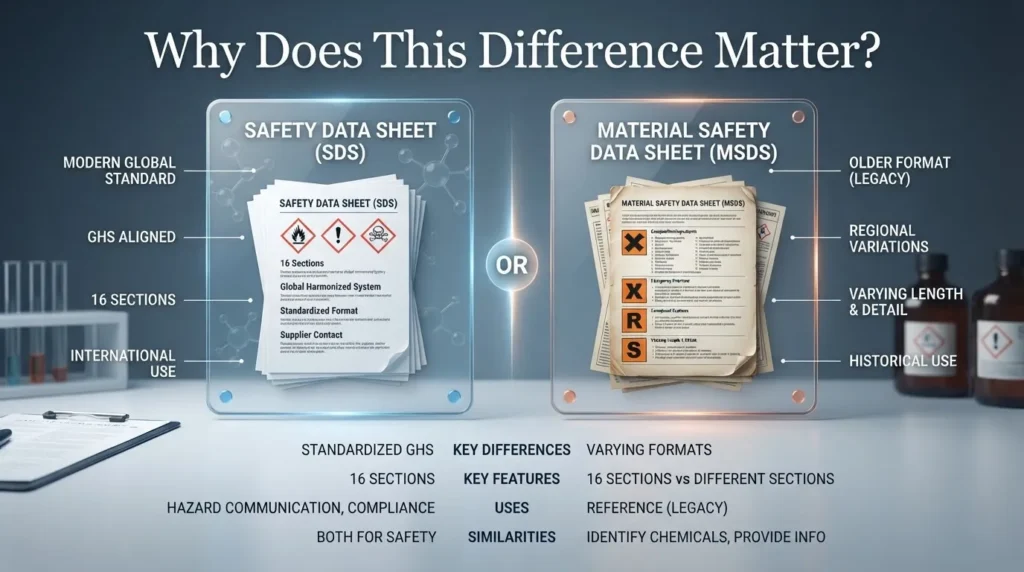
Knowing the difference between SDS and MSDS helps people find the right safety information.
A current SDS can explain the hazards of a chemical, how to store it, what protective equipment to use, and what to do in an emergency. An older MSDS may still be useful for reference, but it should not replace a current document when one is available.
Using the right document can help reduce mistakes and support safer work.
Usefulness in Daily Life
You may not need to read an SDS every day. However, it can be useful when you handle cleaning products, paints, oils, or other chemicals at work.
Read the document before use. Follow its safety steps, wear the recommended protection, and store the product as directed. If you do not understand a warning, ask a trained person for help.
Situational Preference
Use SDS in modern reports, workplace training, and current chemical safety instructions. It is the preferred term in many systems today.
Use MSDS when talking about an older document or when the original record uses that name. If you are given an MSDS, check its date and confirm that it matches the chemical. When possible, get the latest SDS from the supplier. This simple step helps you use clear and current safety information.
Fill in the Blanks
Complete each sentence with SDS or MSDS.
- The full form of _____ is Safety Data Sheet.
- _____ is the older term.
- A current _____ often follows a 16-section format.
- Both documents give information about chemical _____.
- Always check that the document matches the _____ you are using.
Answers: 1. SDS, 2. MSDS, 3. SDS, 4. safety, 5. chemical
Multiple-Choice Questions
1. What does SDS stand for? A) Safety Data Sheet B) Safe Daily System C) Standard Drug Sheet D) Safety Design System
2. Which term is older? A) SDS B) MSDS C) Both are new D) Neither
3. What is the main purpose of an SDS? A) Sell chemicals B) Name a company C) Explain chemical safety D) Set prices
4. How many sections are in the standard SDS format? A) 5 B) 10 C) 12 D) 16
5. What should you do before using a chemical? A) Ignore warnings B) Read its current SDS C) Guess the risks D) Use any document
Answers: 1. A — Safety Data Sheet; 2. B — MSDS; 3. C — Explain chemical safety; 4. D — 16; 5. B — Read its current SDS.
Possible Questions
1. What is the main difference between SDS and MSDS?
SDS is the newer term, while MSDS is the older term. Both relate to chemical safety information.
2. Does SDS mean Safety Data Sheet?
Yes. SDS stands for Safety Data Sheet.
3. Does MSDS mean Material Safety Data Sheet?
Yes. MSDS stands for Material Safety Data Sheet.
4. Is SDS better than MSDS?
A current SDS is generally preferred in modern safety systems. Always use the document that matches the exact chemical.
5. Does every SDS have 16 sections?
The standard GHS-format SDS has 16 sections. Local rules may affect how these documents are prepared and used.
6. Can I still use an MSDS?
An MSDS may help as an older reference. However, check its date and look for a current SDS.
7. Where can I find an SDS?
You can often get one from the product maker or supplier. Make sure it matches the product you have.
Conclusion
SDS or MSDS both refer to documents that explain chemical safety. SDS means Safety Data Sheet and is the newer term. MSDS means Material Safety Data Sheet and is the older term. The main difference is that older MSDS documents may use different formats, while a standard SDS uses 16 sections. When working with chemicals, check the current SDS for the exact product. Read its warnings, follow its instructions, and ask for help if anything is unclear. Knowing the difference between SDS or MSDS can help you make safer choices at work, school, or home.

Mahnoor Afzal is an educator, researcher, and English language content specialist focused on grammar, vocabulary, word differences, and meanings. I combines research, teaching, and SEO expertise to create clear and reliable English learning content at Lengovia.