
The words come and cum look almost the same. They also sound the same in English. But they have very different meanings.
Come is a common English word. It means to move toward a person or place. We use it in daily talk, emails, and many other situations.
Cum is a word with an adult meaning. It can refer to semen or be used as a slang word for ejaculation. It can also have a different meaning in formal writing, where it joins two roles or uses in one thing.
This is why it is important to know the difference between come and cum. One is a normal word for daily use. The other is often linked to adult topics.
US and UK Pronunciation
Both words are usually pronounced the same way.
- Come: /kʌm/
- Cum: /kʌm/
The main difference is their meaning and use, not their sound.
Difference Between Come and Cum
1. Meaning
Come means to move toward someone or somewhere.
Cum is often used as an adult slang word for semen or ejaculation.
Examples:
- Please come to my house.
- The word “cum” may appear in adult writing.
2. Daily Use
Come is used every day. People use it with friends, family, and at work.
Cum is not suitable for most daily or formal conversations because of its adult meaning.
Examples:
- Come and sit with us.
- He saw the word “cum” in an adult text.
3. Grammar
Come is a verb. Its forms include come, comes, came, and coming.
Cum can be a noun or a verb in adult slang. In formal writing, it can also join two roles or uses.
Examples:
- They come here every day.
- The term “teacher-cum-writer” means a person who is both a teacher and a writer.
4. Formal Writing
Come is suitable for formal and informal writing.
Cum can appear in some formal compound terms, but its adult meaning may cause confusion.
Examples:
- Please come to the meeting.
- The phrase “office-cum-store” describes a place used as both an office and a store.
5. Meaning in Context
The meaning of come depends on the sentence.
Cum also depends on context, but many readers may first think of its adult meaning.
Examples:
- Come here, please.
- The term “studio-cum-bedroom” describes a room used for both purposes.
6. Spelling
The two words differ by one letter: come has an o, while cum has a u.
Examples:
- I will come soon.
- The word “cum” has a different meaning.
7. Common Phrases
Come appears in many common English phrases, such as “come back,” “come in,” and “come along.”
Cum is less common in everyday phrases and often appears in adult slang or compound terms.
Examples:
- Please come back tomorrow.
- The building is a shop-cum-home.
8. Audience
Come is suitable for people of all ages.
Cum may be unsuitable for children or some public settings because of its adult meaning.
Examples:
- The children come home at three.
- The adult slang word may not be suitable for a school essay.
9. Common Mistakes
A common mistake is using cum when you mean come.
Examples:
- Correct: Please come here.
- Incorrect for this meaning: Please cum here.
10. Best Choice
Use come when you mean to move toward a place or person.
Use cum only when its intended meaning fits the context.
Examples:
- Come to the park with me.
- “Writer-cum-director” describes someone who is both a writer and a director.
You can also read https://lengovia.com/olaplex-or-k18/
Nature and Behaviour
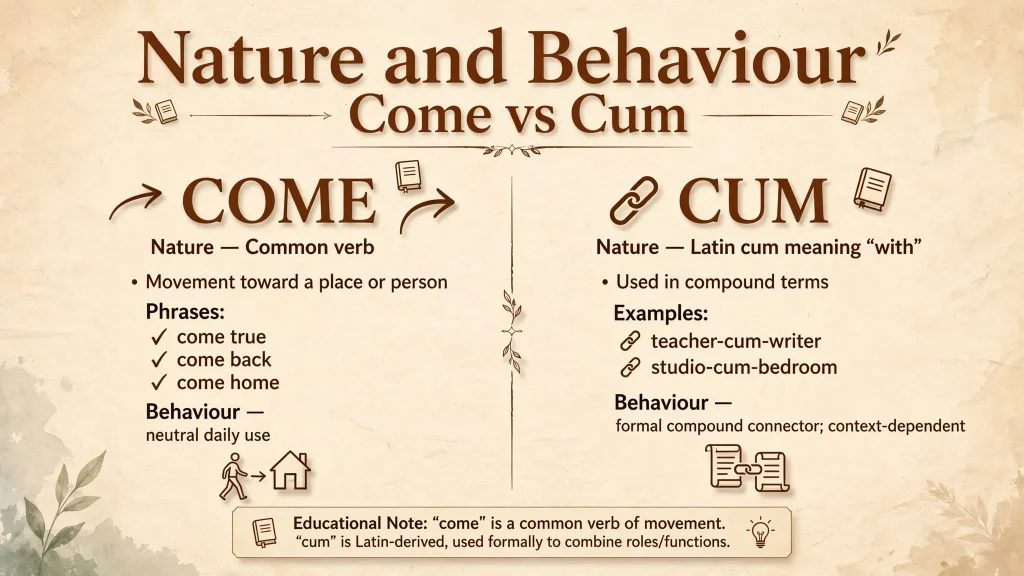
Come is a common verb. It describes movement toward a place or person. It can also appear in phrases such as “come true” and “come back.”
Cum has more limited uses. It is often an adult slang word. In some compound terms, it means that one person or place has two roles or purposes.
Why Do People Get Confused?
People get confused because come and cum sound the same. Their spelling is also very similar.
However, their meanings are different. Come is a normal word for daily life. Cum often has an adult meaning.
The word cum can also appear in compound terms, such as “student-cum-athlete.” This means a person who is both a student and an athlete.
Comparison Table
| Feature | Come | Cum |
| Pronunciation | /kʌm/ | /kʌm/ |
| Main meaning | Move toward a person or place | Adult slang; also used in some compound terms |
| Daily use | Very common | Less common |
| Grammar | Verb | Noun, verb, or part of a compound term |
| Formal use | Common | Limited and context-dependent |
| Suitable for children | Usually yes | Often unsuitable because of its adult meaning |
| Example | Come to my home. | Teacher-cum-writer |
Origin
Come comes from Old English cuman, which meant to move or arrive.
Cum comes from Latin cum, meaning “with.” This Latin use appears in some compound terms that join two roles or purposes.
The adult slang use of cum developed separately in English.
Although the words look and sound alike, their histories and meanings are different.
British vs American English
Come has the same spelling and basic meaning in British and American English.
Cum can also appear in both varieties, but its use depends on the context.
Examples:
- British English: Come to the shop.
- American English: Come to the store.
In both sentences, come means to move toward a place.
Which One Should You Use?
Use come when you mean to arrive or move toward someone or somewhere.
Use cum only when you mean its specific adult slang meaning or when it appears in a compound term.
If you are writing an email, school essay, or work message, come is usually the word you need when talking about movement or arrival.
Common Mistakes
Mistake 1: Using Cum Instead of Come
Incorrect: Please cum to my house.
Correct: Please come to my house.
Mistake 2: Thinking Both Words Mean the Same Thing
They sound the same, but their meanings are different.
Mistake 3: Ignoring the Audience
Cum may be unsuitable in school, work, or public writing because of its adult meaning.
Mistake 4: Missing the Compound Meaning
In “teacher-cum-writer,” cum means that one person has both roles.
Everyday Usage
In Daily Talk
“Come here and help me.”
In Emails
“Please come to the office at ten.”
In School Writing
“Many people come to the library to read.”
In Compound Terms
“She is a singer-cum-actor.”
These examples show that come is useful in everyday English, while cum is used in more limited contexts.
Usage Trends
Come is a very common English word. People use it in speech, books, emails, and online messages.
Cum appears less often in general writing. It may appear in adult content or in compound terms that describe two roles or purposes.
Because the words sound the same, spelling matters. Using the wrong word can change the meaning of a sentence.
Metaphors and Similes
Come appears in many common expressions.
- Come true: When a wish or hope becomes real.
- Come to life: When something becomes active or lively.
- Come rain or shine: No matter what happens.
Examples:
- Her dream came true.
- The old story came to life.
Cum does not have the same range of common everyday expressions.
Connotative Meaning
A word can bring extra ideas or feelings to mind.
Come usually has a neutral meaning. It often describes movement or arrival.
Cum often brings adult ideas to mind because of its common slang use. In compound terms, however, it can simply join two roles or uses.
Idioms and Proverbs
Come appears in many English idioms.
Come rain or shine: No matter what happens.
Example: “I will help you, come rain or shine.”
Dreams come true: Hopes become real.
Example: “She worked hard, and her dreams came true.”
Cum does not have a similar set of common everyday idioms.
Literature and Movies

Come appears often in books, poems, songs, and films because it is a common English verb.
Writers may use phrases such as “come home,” “come back,” or “come to life” to show movement or change.
The word cum may appear in adult writing or in compound terms. Readers should use the context to understand its meaning.
Why Does This Difference Matter?
Knowing the difference between come and cum helps you write clearly.
Using the wrong word may change your sentence or create an unwanted meaning. This can be a problem in emails, schoolwork, and public messages.
Learning the difference also helps you understand English texts when you see either word.
Usefulness in Daily Life
You will often need come in everyday conversations.
For example:
- Come here, please.
- Come with me.
- Please come early.
You are less likely to need cum in everyday writing. If you see it, check the context to understand its meaning.
Situational Preference
Use come in normal conversations, emails, schoolwork, and work messages when you mean to arrive or move toward someone. Cum is used mainly in adult slang or in certain compound terms. Because it may carry an adult meaning, be careful when using it in public or formal writing. If you are not sure which word fits, choose come when talking about movement or arrival.
Fill in the Blanks
Choose come or cum.
- Please ______ to my house.
- I hope you can ______ early.
- A teacher-cum-writer has two ______.
- Please ______ back tomorrow.
- The words have the same ______.
Answers:
- Come
- Come
- Roles
- Come
- Pronunciation
Multiple-Choice Questions
1. Which word means to move toward someone or somewhere?
A) Cum B) Come C) Cameo D) Calm
Answer: B) Come
2. How are come and cum usually pronounced?
A) The same B) Very differently C) One is silent D) They rhyme with “see”
Answer: A) The same
3. What does “teacher-cum-writer” mean?
A) A former teacher B) A teacher who writes only at night C) A person who is both a teacher and a writer D) A student
Answer: C) A person who is both a teacher and a writer
4. Which word is common in everyday English?
A) Cum B) Come C) Both are always interchangeable D) Neither
Answer: B) Come
5. What should you check when choosing between these words?
A) The font B) The sentence and context C) The page size D) The colour
Answer: B) The sentence and context
Possible Questions
1. What is the main difference between come and cum?
Come usually means to move toward a person or place. Cum often has an adult slang meaning, but it can also join two roles in a compound term.
2. Do come and cum sound the same?
Yes. They are usually pronounced the same way.
3. Is come suitable for formal writing?
Yes. Come is a common English verb used in formal and informal writing.
4. What does teacher-cum-writer mean?
It means a person who is both a teacher and a writer.
5. Can I use cum in a school essay?
It is usually better to avoid it unless you need it for a specific meaning. Its adult slang meaning may distract readers.
6. How can I remember the difference?
Remember that come is the normal word for movement or arrival. Cum has a different, context-dependent meaning.
Conclusion
Come and cum look similar and usually sound the same. But they have different meanings. Come is a common English verb. It means to move toward a person or place. You can use it in daily talk, emails, schoolwork, and many other situations. Cum is often used as an adult slang word. It can also appear in compound terms, such as “teacher-cum-writer,” where it joins two roles. The most important thing is to check the context. If you mean to arrive or move toward someone, use come. Do not replace it with cum. Learning this small difference can help you write better English and avoid mistakes.

Mahnoor Afzal is an educator, researcher, and English language content specialist focused on grammar, vocabulary, word differences, and meanings. I combines research, teaching, and SEO expertise to create clear and reliable English learning content at Lengovia.












1 thought on “Come or Cum: Learn the Difference with Easy Examples”