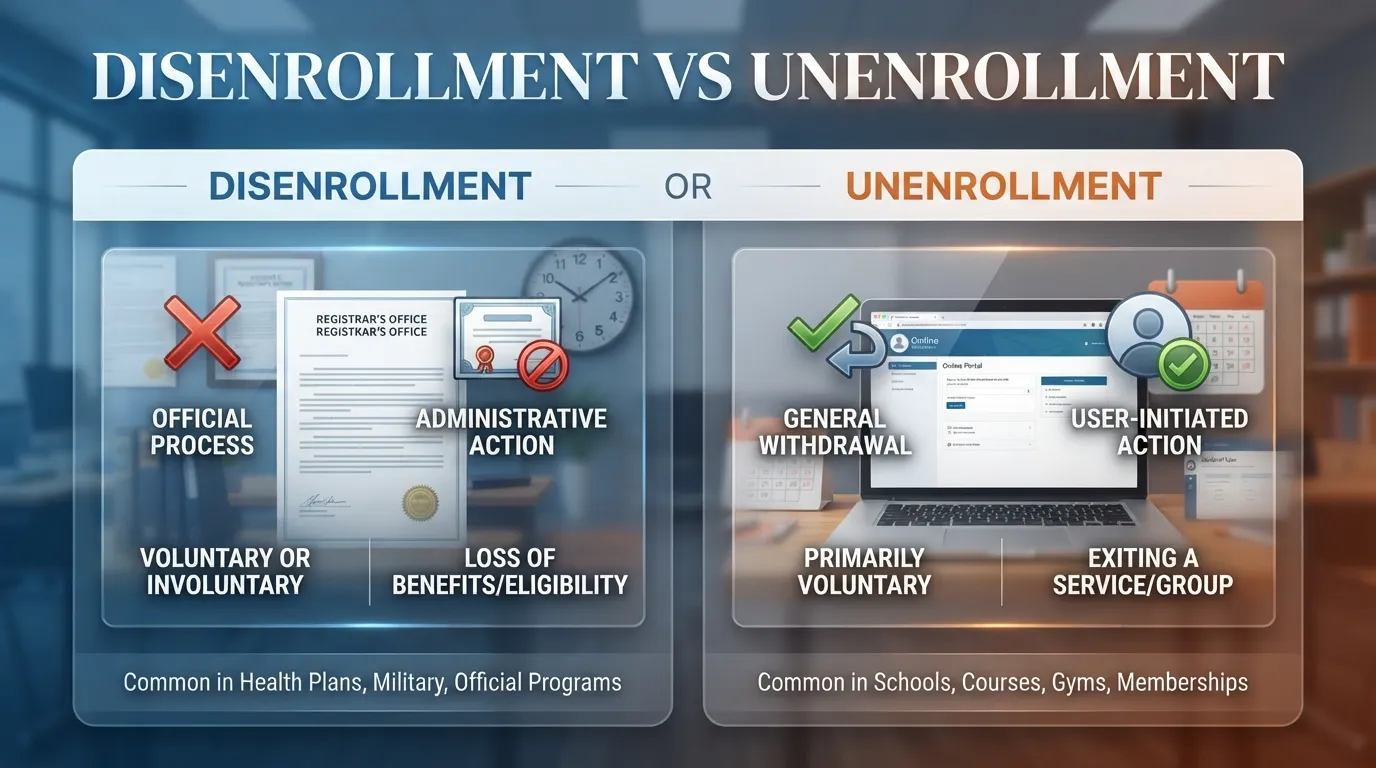
Disenrollment or unenrollment means leaving a class, plan, or program. Both words talk about ending enrollment, but they are not used in the same way everywhere.
Disenrollment is more common in formal writing. It may be used when a student leaves a school program or a person leaves a health plan.
Unenrollment is also used by some websites and groups. It may mean leaving an online class or stopping a sign-up.
For example, a student may leave an online class. The website may call this “unenrollment.” A school may use the word “disenrollment” in its records.
Knowing these words can help you read school letters, website messages, and program rules. The best word depends on the place and the rules. Always check what the word means in that setting.
Pronunciation of Disenrollment and Unenrollment
- Disenrollment: dis-en-ROLL-ment
- Unenrollment: un-en-ROLL-ment
Difference Between Disenrollment and Unenrollment
1. Meaning
- Disenrollment: Ending a place in a class or plan.
- Unenrollment: Stopping or undoing a sign-up.
Examples:
- The school told us about disenrollment.
- I asked for unenrollment from the online class.
2. Common Use
- Disenrollment: Often used in formal papers.
- Unenrollment: Used by some websites and groups.
Examples:
- The plan sent a disenrollment letter.
- The app has an unenrollment button.
3. School Use
- Disenrollment: May mean leaving a school program.
- Unenrollment: May mean leaving an online class.
Examples:
- Her disenrollment ended her place in the program.
- He chose unenrollment from the course.
4. Health Plans
- Disenrollment: Often used when a person leaves a health plan.
- Unenrollment: May be used by some systems.
Examples:
- He asked about disenrollment from his plan.
- The website showed an unenrollment request.
5. Formal Writing
- Disenrollment: Often fits official papers.
- Unenrollment: May fit website steps.
Examples:
- Read the disenrollment rules.
- Click the unenrollment button.
6. Word Parts
- Disenrollment: Starts with “dis-.”
- Unenrollment: Starts with “un-.”
Examples:
- The school explained disenrollment.
- The app explained unenrollment.
7. Leaving a Program
- Disenrollment: Can mean leaving a plan or program.
- Unenrollment: Can mean stopping a sign-up.
Examples:
- His disenrollment ended his place in the program.
- Her unenrollment took her out of the online class.
8. Records
- Disenrollment: May appear in school or plan records.
- Unenrollment: May appear in website records.
Examples:
- The office wrote down his disenrollment.
- The site saved her unenrollment request.
9. Meaning in Use
- Disenrollment: Often sounds formal.
- Unenrollment: May sound like a website action.
Examples:
- The letter explained disenrollment.
- The page showed unenrollment steps.
10. Which One Should You Use?
Use disenrollment in most formal writing. Use unenrollment if a website or group uses that word.
Examples:
- The school explained disenrollment.
- The app uses the word unenrollment.
You can also read :https://lengovia.com/impune-or-impugn/
Nature and Behaviour
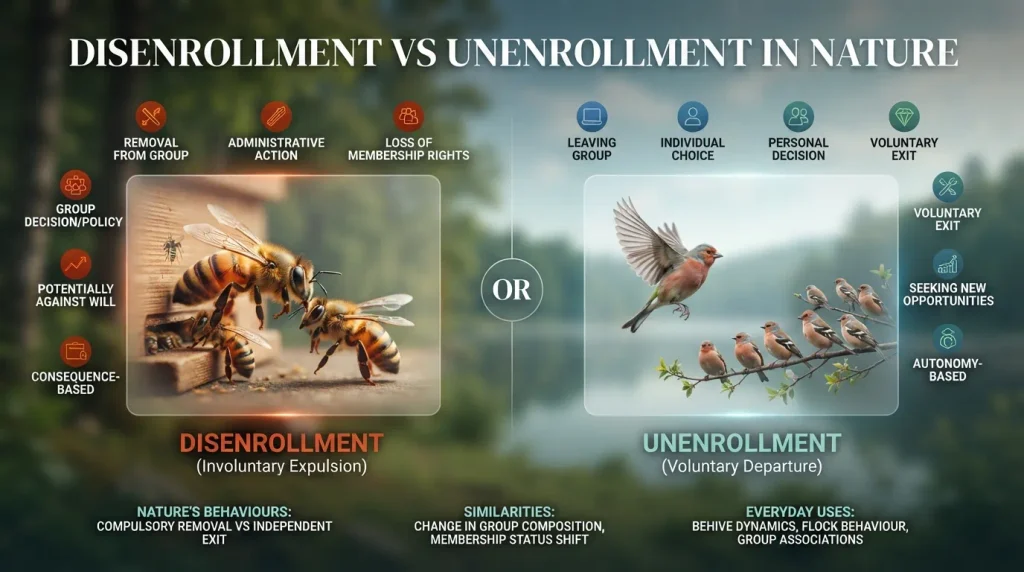
Both words talk about ending a sign-up. You may sign up for a class, a plan, or a program. If you leave it, your enrollment ends.
A school may use disenrollment in its papers. An online class may use unenrollment on its website.
The rules can change from one place to another. Read the message to learn what will happen next.
Why Do People Get Confused?
People get confused because both words look alike. Both have the word “enrollment” in them.
They also have a close meaning. However, schools, plans, and websites may choose different words.
Comparison Table
| Feature | Disenrollment | Unenrollment |
| Meaning | Ending enrollment | Stopping a sign-up |
| Common use | Formal papers | Some websites |
| School use | Yes | Sometimes |
| Health plans | Often used | Depends on the plan |
| Website use | May be used | May be used |
| Best choice | Formal writing | Follow the site’s wording |
Origin of Disenrollment and Unenrollment
Both words come from enrollment. Enrollment means signing up for a class, plan, or program.
The word disenrollment starts with “dis-.” The word unenrollment starts with “un-.” Both parts can show that an action is being stopped or changed.
British vs. American English
American English often uses enrollment. British English often uses enrolment.
The main idea stays the same. The best word also depends on the school, plan, or website.
Which One Should You Use?
Use disenrollment in formal writing about leaving a class, plan, or program.
Use unenrollment when a website or group uses that word. This helps people understand the steps they need to take.
Common Mistakes
| Wrong Statement (❌) | Correct Statement (✅) |
| Both words always mean different things. | Their meanings can be very close. |
| Unenrollment is always wrong. | Some websites use this word. |
| Disenrollment only means leaving school. | It can also mean leaving a plan. |
| Every group uses the same word. | Different groups may use different words. |
| Leaving a program always means the same thing. | Some people leave by choice, while a group may remove others. |
Everyday Usage
You may see these words at school or on a website.
A student may leave an online class. A person may leave a health plan. A worker may stop taking part in a training program.
In daily speech, you can also say “leave the class” or “stop the plan.” These words are often easier to understand.
Usage Trends
Disenrollment is often used in formal papers and rules. Unenrollment is used by some websites and groups.
The words may mean much the same thing, but their use can change from place to place.
Metaphors and Similes
These words do not have many common sayings. Here are two simple ways to think about them:
- Disenrollment is like giving up your place in a class.
- Unenrollment is like undoing a sign-up.
These are simple comparisons, not exact rules.
Connotative Meaning
Disenrollment can sound formal because it often appears in official papers.
Unenrollment may sound like a step on a website.
Neither word tells us if a person left by choice. The full sentence gives us that detail.
Idioms and Proverbs
These sayings are about stopping or changing a plan:
- Call it quits: Stop doing something.
- Back out: Choose not to go ahead with a plan.
- Change your mind: Choose something different.
These sayings do not mean exactly the same as disenrollment or unenrollment.
Literature and Movies
These words are not common in story titles. But a story about school or work may show a person leaving a class or program.
For example, a student may leave a school program. A worker may stop taking part in a training course.
Why Does This Difference Matter?
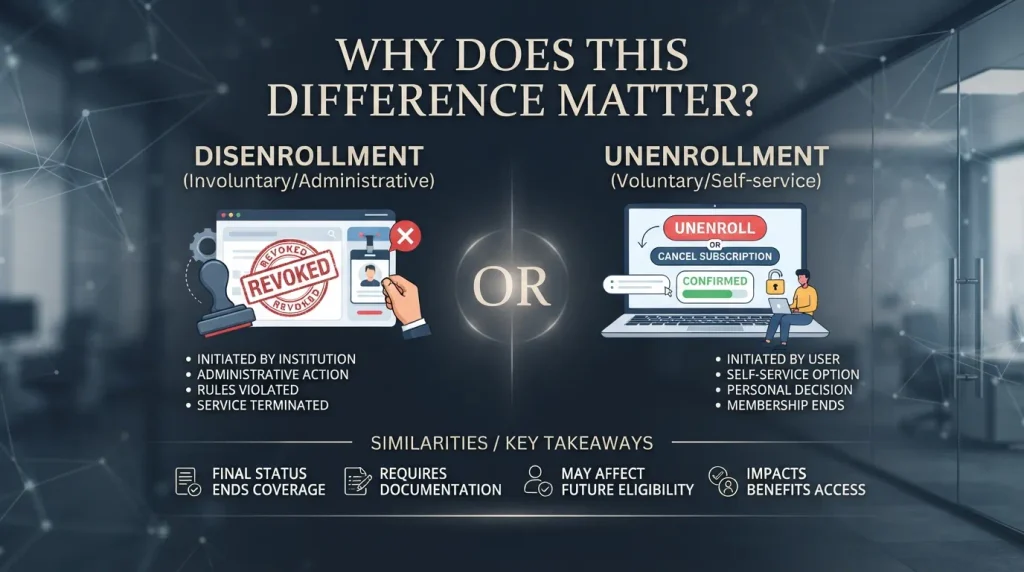
Using the right word helps people understand a letter or website. A school may explain how to leave a program. A website may show a button to stop a class.
Read the rules before you leave. Make sure you know what will happen to your place or account.
Usefulness in Daily Life
You may see these words when you leave a class, plan, or program.
Before you leave, read the rules. Check when your place will end and if you can join again later. Ask for help if you do not understand the message.
Situational Preference
Use disenrollment in formal writing about leaving a plan or program. It is a good choice for school letters and official papers.
Use unenrollment if a website uses that word. For example, an online class may have an “Unenroll” button. Follow the steps shown on the site. Always read the rules so you know what will happen after you leave.
Fill in the Blanks
- Both words relate to ending _____.
- A school may use the word _____ in formal papers.
- Some websites may use the word _____.
- Read the _____ before leaving a program.
- “Leave the class” is a simple way to explain _____.
Answers: 1. enrollment, 2. disenrollment, 3. unenrollment, 4. rules, 5. disenrollment or unenrollment.
Quiz Questions
1. What does enrollment mean? A) Signing up B) Sleeping C) Eating D) Running
2. Which word is often used in formal papers? A) Unhappy B) Disenrollment C) Unkind D) Unclear
3. Where might you see “unenrollment”? A) On some websites B) On a tree C) On a shoe D) On a plate
4. What should you read before leaving a program? A) A song B) A game C) The rules D) A joke
5. Do both words relate to ending enrollment? A) Yes B) No C) Never D) Only at home
Answers: 1. A — Signing up; 2. B — Disenrollment; 3. A — On some websites; 4. C — The rules; 5. A — Yes.
Possible Questions
1. What is disenrollment?
Disenrollment means ending your place in a class, plan, or program.
2. What is unenrollment?
Unenrollment can mean stopping or undoing a sign-up.
3. Are the words the same?
Their meanings are close, but different groups may use them in different ways.
4. Is unenrollment wrong?
No. Some websites and groups use it.
5. Which word should I use?
Use disenrollment in formal writing, unless the group uses another term.
6. Can these words be used for online classes?
Yes. They can describe leaving an online class or course.
7. What is a simpler way to say disenrollment?
You can say “leave a class” or “stop taking part in a program.”
Conclusion
Disenrollment or unenrollment means ending or stopping enrollment in a class, plan, or program. Disenrollment is often used in formal papers. Unenrollment may be used by some websites and groups. The best word depends on the place and its rules. Read the message to understand what will happen when you leave. If you use simple words like “leave a class,” your meaning may be even clearer.

Mahnoor Afzal is an educator, researcher, and English language content specialist focused on grammar, vocabulary, word differences, and meanings. I combines research, teaching, and SEO expertise to create clear and reliable English learning content at Lengovia.











1 thought on “Disenrollment or Unenrollment: What Is the Difference?”