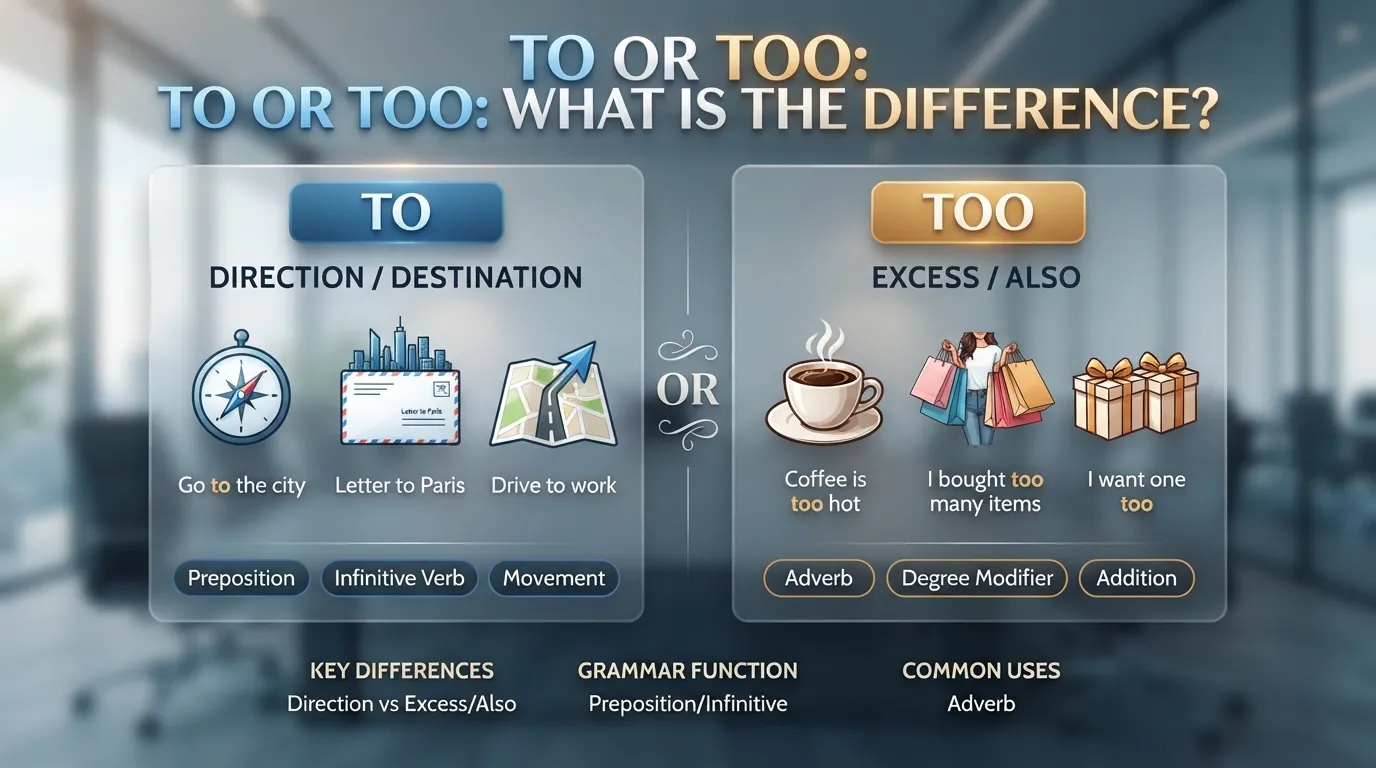
To or too is a common English word comparison. Both words sound the same, but they have different meanings. To often shows direction or comes before an action word. Too means “also” or “more than needed.”
For example, “I go to school” shows where I go. “I want to go too” means I also want to go. In another sentence, “The tea is too hot” means the tea is hotter than I want.
These words are easy to mix up because they sound alike. However, you can learn the difference with a few simple rules. Use to when talking about a place or an action. Use too when you mean “also” or “more than needed.”
Pronunciation of To and Too
- To: Sounds like “too” in many sentences.
- Too: Sounds like “too.”
Both words sound alike, but their meanings are different.
Difference Between To and Too
1. Meaning
- To: Shows direction or an action.
- Too: Means “also” or “more than needed.”
Examples:
- I went to school.
- I want to go too.
2. Direction
- To: Shows where someone goes.
- Too: Does not show direction.
Examples:
- She went to the park.
- He wants to come too.
3. Before an Action Word
- To: Can come before an action word.
- Too: Does not work in the same way.
Examples:
- I want to eat.
- I want to eat too.
4. Meaning “Also”
- To: Does not mean “also.”
- Too: Can mean “also.”
Examples:
- Give the book to Ali.
- Ali wants one too.
5. Meaning “More Than Needed”
- To: Does not show this meaning.
- Too: Shows that something is more than needed.
Examples:
- I went to bed.
- The bag is too heavy.
6. Talking About People
- To: Can show who gets something.
- Too: Can mean another person does the same thing.
Examples:
- I gave a gift to Sara.
- Sara got a gift too.
7. Talking About Food
- To: Can show who gets food.
- Too: Can show that food is hotter than wanted.
Examples:
- Give the apple to me.
- The soup is too hot.
8. Talking About Time
- To: Can come before an action word.
- Too: Can show that something is more than wanted.
Examples:
- I need to sleep.
- It is too late to play.
9. Spelling
- To: Has two letters.
- Too: Has three letters.
Examples:
- I like to read.
- I like reading too.
10. Which One Should You Use?
Use to for direction or an action. Use too when you mean “also” or “more than needed.”
Examples:
- We went to the shop.
- We went too. (This means we also went.)
You may also read :https://lengovia.com/disenrollment-or-unenrollment/
Nature and Behaviour
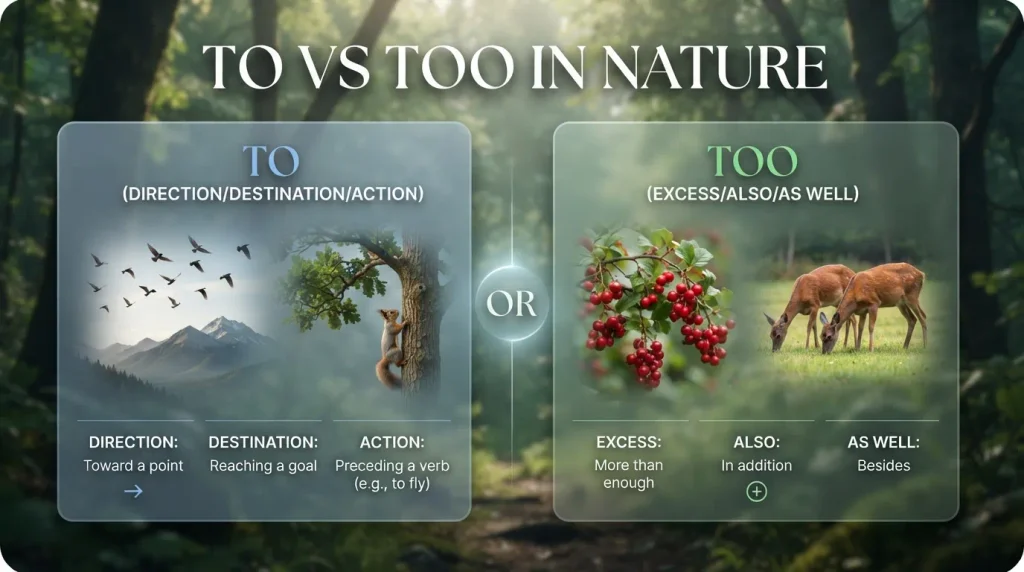
The word to helps connect words in a sentence. It can show where someone goes or what someone wants to do.
The word too adds another meaning. It can tell us that someone else does something as well. It can also show that something is more than needed.
For example, “I want to play” tells us what you want to do. “I want to play too” means you also want to play.
Why Do People Get Confused?
People get confused because to and too sound alike. When people speak, it can be hard to know which word they mean.
However, the words have different spellings and meanings. Reading the full sentence can help you choose the right one.
Comparison Table
| Feature | To | Too |
| Meaning | Direction or action | Also or more than needed |
| Shows a place | Yes | No |
| Comes before an action | Yes | Not in the same way |
| Means “also” | No | Yes |
| Means “more than needed” | No | Yes |
| Example | Go to school | I want to go too |
Origin of To and Too
To is an old English word. People have used it for a long time to show direction and connect words.
Too also comes from Old English. Over time, it came to mean “also” and “more than needed.”
Today, both words are used every day.
British vs. American English
There is no spelling difference between to and too in British and American English. Both forms use these words in the same way.
Examples:
- British English: I want to play too.
- American English: I want to play too.
Which One Should You Use?
Use to when talking about a place or an action.
- I went to school.
- I like to draw.
Use too when you mean “also” or “more than needed.”
- I like drawing too.
- The box is too big.
Common Mistakes
| Wrong Statement (❌) | Correct Statement (✅) |
| I am going too school. | I am going to school. |
| I want to come to. | I want to come too. |
| The water is to hot. | The water is too hot. |
| She wants too eat. | She wants to eat. |
Everyday Usage
You can use to and too in schoolwork, emails, text messages, and daily talks.
For example, you may write, “I need to go to school.” If your friend is going with you, you can say, “I want to go too.”
When you write, read the sentence again. Ask yourself if you mean a place, an action, “also,” or “more than needed.”
Usage Trends
Both words are very common in English. People use them in books, school lessons, messages, and online posts.
Because they sound alike, people sometimes spell them incorrectly when writing quickly. Learning their meanings can help you avoid these mistakes.
Metaphors and Similes
These words do not have many common sayings of their own. However, simple comparisons can help you remember them.
- To is like a road that takes you to a place.
- Too is like adding one more thing or having more than you need.
These are easy ways to remember how the words work.
Connotative Meaning
To is a simple word that helps show a link, place, or action.
Too can mean something positive, such as joining a friend. It can also show a problem, such as food that is too hot.
The meaning depends on the sentence.
Idioms and Proverbs
These phrases use to or too:
- Too good to be true: Something seems so good that it may not be real.
- To each their own: Each person can have their own likes.
- Too little, too late: Something happens too late to help much.
Literature and Movies
Writers use to and too in stories, poems, and movie scripts.
A story may say, “She went to the forest.” Another line may say, “I want to come too.” Both words help readers understand what the characters do and feel.
Why Does This Difference Matter?
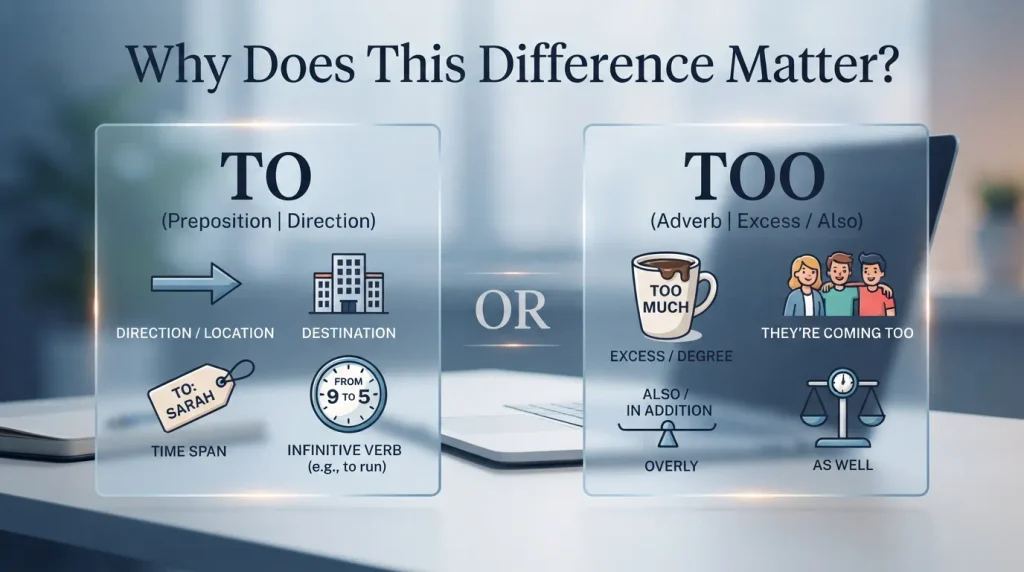
Using the right word makes your writing easy to read. A small mistake can change the meaning of a sentence.
For example, “I want to go” tells us what you want to do. “I want to go too” means you also want to go.
Learning this difference helps you write better sentences at school and at home.
Usefulness in Daily Life
You use these words often, even if you do not notice them.
You may say, “I need to eat,” “Give this to me,” or “I want some too.” Remembering the simple rules can help you write clear messages and do well in English lessons.
Situational Preference
Choose to when talking about a place or an action. For example, “I need to go to the shop.”
Choose too when you mean “also” or “more than needed.” For example, “I want to go too” means you also want to go. “The shoes are too small” means the shoes are smaller than needed.
Read your sentence before you finish writing. This simple habit can help you choose the right word.
Fill in the Blanks
Fill each blank with to or too.
- I want _____ play.
- She came _____.
- We went _____ the park.
- The milk is _____ hot.
- I want _____ eat _____.
Answers: 1. to, 2. too, 3. to, 4. too, 5. to, too.
Quiz Questions
1. Which word means “also”? A) To B) Too C) Two D) Do
2. Choose the right word: I want _____ sleep. A) Too B) To C) Two D) Do
3. Choose the right word: The bag is _____ heavy. A) To B) Too C) Two D) Go
4. Choose the right word: We went _____ school. A) Too B) To C) Two D) So
5. Which sentence is correct? A) I want too eat. B) I went too school. C) I want to eat. D) The tea is to hot.
Expected Questions
1. What is the difference between to and too?
To shows direction or comes before an action word. Too means “also” or “more than needed.”
2. Do to and too sound the same?
Yes. They sound the same in most common uses.
3. When should I use to?
Use to in sentences like “Go to school” and “I want to play.”
4. When should I use too?
Use too in sentences like “I want to come too” or “The room is too hot.”
5. Is “I want too go” correct?
No. The correct sentence is “I want to go.”
6. Is “Me too” correct?
Yes. “Me too” means “I also feel or want the same thing.”
7. Are to and too spelled the same in British and American English?
Yes. Both use the same spelling.
Conclusion
To or too is a common word choice that is easy to learn. Use to for direction or before an action word. Use too when you mean “also” or “more than needed.” Remember these examples: “I want to play” and “I want to play too.” With practice, you can choose the right word and make your writing clear and natural.

Mahnoor Afzal is an educator, researcher, and English language content specialist focused on grammar, vocabulary, word differences, and meanings. I combines research, teaching, and SEO expertise to create clear and reliable English learning content at Lengovia.