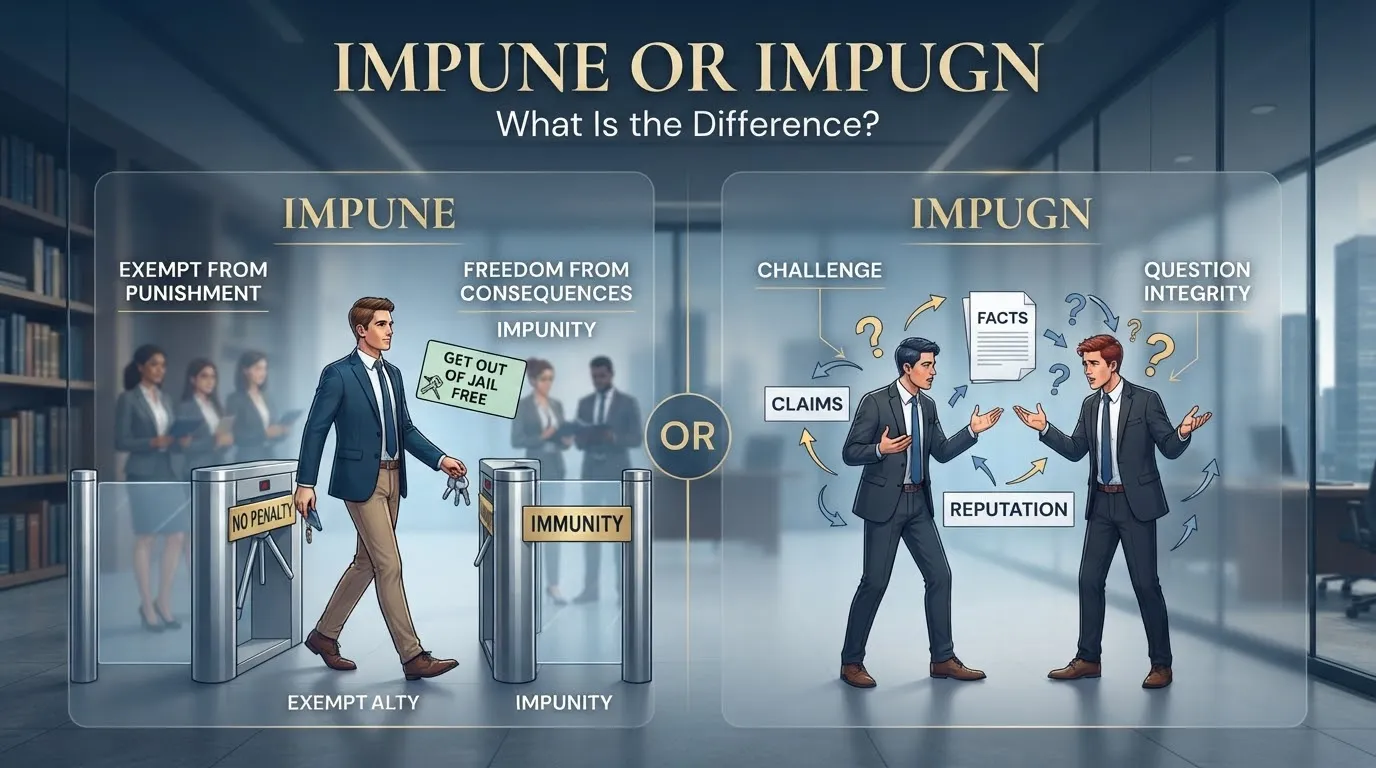
Impugn is the correct and common English word. It means to question someone’s honesty, actions, or ideas. Impune is not a standard English word with the same meaning. It is often a spelling mistake for impugn.
- Impugn — to challenge or question something, especially someone’s honesty or good name.
- Impune — usually an incorrect spelling of impugn when this meaning is intended.
Examples:
- Correct: She did not want to impugn his honesty.
- Incorrect: She did not want to impune his honesty.
Pronunciation of Impune and Impugn
- Impugn: im-PYOON
- Impune: It has no common standard pronunciation because it is not a standard word in modern English.
Difference Between Impune and Impugn
1. Meaning
- Impugn: To question someone’s honesty or actions.
- Impune: Not a standard word with this meaning.
Examples:
- The report may impugn his honesty.
- She wrote “impune” by mistake.
2. Correct Spelling
- Impugn: Correct spelling for the word meaning to question or challenge.
- Impune: Usually a spelling error when used in place of impugn.
Examples:
- Please do not impugn her good name.
- Please check the spelling of “impune.”
3. Grammar
- Impugn: A verb.
- Impune: Not commonly used as a standard modern English word.
Examples:
- They may impugn his claim.
- He meant to write impugn.
4. Use in Writing
- Impugn: Used in formal writing and speech.
- Impune: Usually appears because of a spelling mistake.
Examples:
- The lawyer did not impugn the witness.
- The student corrected “impune” to “impugn.”
5. Meaning in Court
- Impugn: To challenge a person’s honesty or the truth of a statement.
- Impune: Does not carry this standard meaning.
Examples:
- The lawyer tried to impugn the witness’s statement.
- The lawyer used impugn, not “impune.”
6. Meaning in Daily Life
- Impugn: To cast doubt on someone’s honesty or actions.
- Impune: Not normally used in everyday English.
Examples:
- Do not impugn my good name.
- He made a spelling error with “impune.”
7. Tone
- Impugn: A formal word.
- Impune: May look like a mistake to most readers.
Examples:
- The article seemed to impugn the leader’s honesty.
- The editor changed “impune” to “impugn.”
8. Word Form
- Impugn: Can be used in forms such as impugns, impugned, and impugning.
- Impune: Does not normally follow these forms in standard modern English.
Examples:
- She impugned his claim.
- She was impugning his motives.
9. Common Use
- Impugn: Found in formal reports, debates, and legal writing.
- Impune: Rare and not normally used for this meaning.
Examples:
- The report did not impugn his character.
- The writer corrected “impune” in the report.
10. Which One Should You Use?
Use impugn when you mean to question someone’s honesty, motives, or claims. Do not use impune as its replacement.
Examples:
- Correct: I do not impugn your motives.
- Incorrect: I do not impune your motives.
Nature and Behaviour
The word impugn often appears when people disagree or question someone’s good name. It can suggest that a person doubts another person’s honesty or reasons.
For example, a news writer may question a leader’s claim. A lawyer may challenge what a witness says. In both cases, impugn can describe the act of casting doubt.
Impune is not the usual word for this action. Using the correct spelling makes your writing clear and natural.
You can also explore :https://lengovia.com/sds-or-msds/
Why Do People Get Confused?
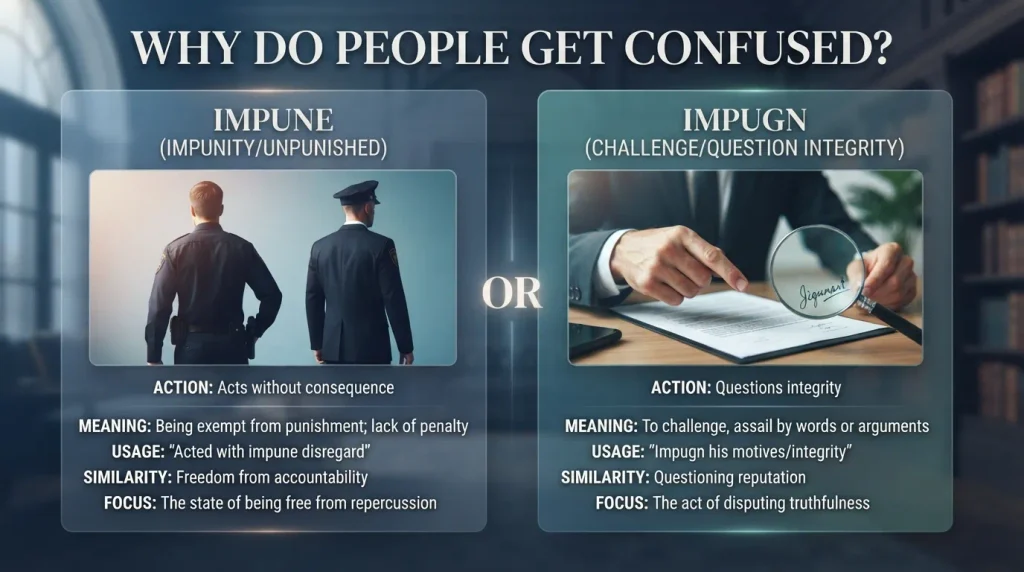
People may confuse these words because they look and sound similar. Both begin with “impun,” but their endings are different.
The correct word is impugn. Its final letters are g-n, and the “g” is not pronounced as a hard sound. This can make the spelling harder to remember.
Comparison Table
| Feature | Impune | Impugn |
| Standard modern word | Not for this meaning | Yes |
| Meaning | No common meaning as a modern word | To question or challenge |
| Part of speech | Not normally used | Verb |
| Formal writing | Usually avoid | Common in formal contexts |
| Legal writing | Not the usual term | May be used |
| Example | Often a spelling error | “They impugn his claim.” |
| Best choice | Avoid for this meaning | Use it |
Origin of Impune and Impugn
Impugn comes from the Latin word impugnare, which means to attack or fight against. Over time, it came to mean questioning or challenging a person’s words, actions, or honesty.
Impune is not the standard modern English spelling for this meaning. If you see it in a sentence, check whether the writer intended to use impugn.
British vs. American English
There is no major British and American spelling difference between these words. In both forms of English, impugn is the standard word for questioning someone’s honesty or claim.
For example:
- British English: The report may impugn his character.
- American English: The report may impugn his character.
The spelling stays the same.
Which One Should You Use?
Use impugn in both British and American English. It works in formal writing, legal discussions, reports, and serious debates.
Avoid impune when you mean to question someone’s honesty or claim. If you are unsure, remember this simple rule: impugn is the correct word for this meaning.
Common Mistakes
Wrong Statement (❌)Correct Statement (✅)His words impune her honesty.His words impugn her honesty.I do not want to impune your motives.I do not want to impugn your motives.The lawyer impuned the witness.The lawyer impugned the witness’s honesty.She is impuning his claim.She is impugning his claim.
Everyday Usage
You may see impugn in a news report, a formal letter, a debate, or a legal case. It is not a common word in casual chats because simpler words, such as question or doubt, are often easier to use.
For example, a person may say, “I question his claim” in everyday speech. In formal writing, the same idea might be expressed as “I impugn his claim,” depending on the meaning.
Usage Trends
Impugn remains a valid English word, especially in formal writing. It is less common in everyday conversation than words such as doubt, question, or challenge.
Impune is not commonly used in modern English with the same meaning. When it appears in ordinary writing, it may be a typo or spelling mistake.
Metaphors and Similes
Impugn is not usually part of a common idiom, but it can be explained with simple comparisons.
- To impugn someone’s honesty is like putting a question mark over their good name.
- To impugn a claim is like asking others to look at it more closely.
These examples show how impugn can create doubt about a person or statement.
Connotative Meaning
Impugn can have a negative tone because it suggests doubt about someone’s honesty, motives, or actions. It may sound serious, especially in a legal or public discussion.
Impune has no common modern meaning in this context. Readers may see it as a spelling error.
Idioms and Proverbs
There are no common idioms that use impune as a standard word. However, these familiar phrases relate to questioning or judging others:
- Give someone the benefit of the doubt: Do not assume that someone is wrong without good reason.
- Think before you speak: Choose your words with care.
- Actions speak louder than words: What people do can matter more than what they say.
These phrases are related to the ideas of trust and judgment, but they do not mean the same as impugn.
Literature and Movies
The word impugn may appear in books, news stories, and films about law, politics, or public conflict. A lawyer may impugn a witness’s statement, or a character may challenge another person’s honesty.
Writers may choose this formal word when a simple word such as doubt does not fully express the idea. Impune is not the standard word for this use.
Why Does This Difference Matter?
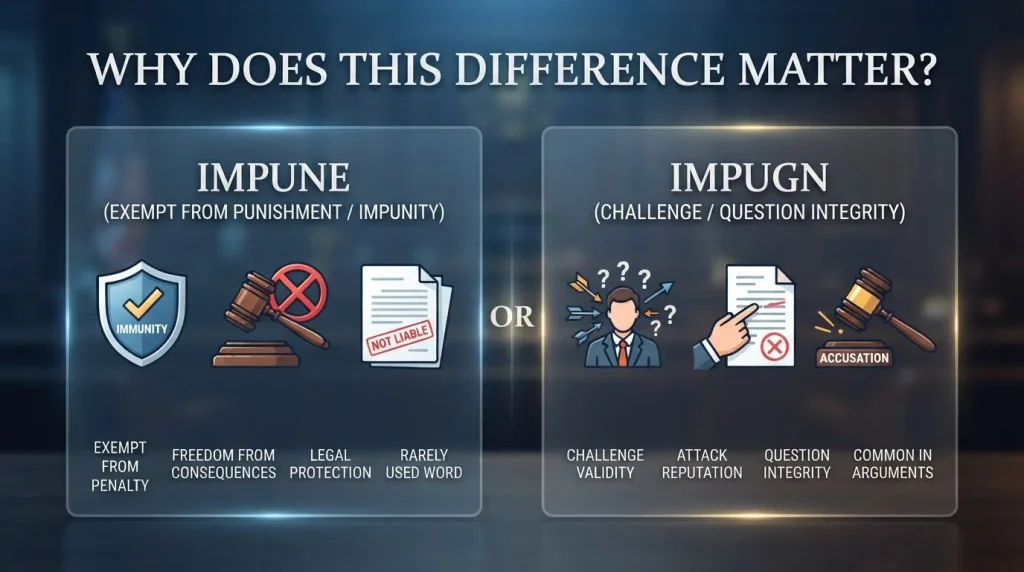
Correct spelling helps readers understand your message. Using impune instead of impugn may confuse readers or make your writing look careless.
This matters in schoolwork, emails, reports, and formal documents. Learning the right word helps you express your ideas with confidence.
Usefulness in Daily Life
You may not need impugn every day, but it can help when you read formal English or write about serious matters.
Remember that impugn means to question or challenge someone’s honesty, actions, or claims. In casual speech, you can often use question or doubt instead.
Situational Preference
Choose impugn for formal writing when you want to say that someone is questioning another person’s honesty or claim. It may suit a legal report, a serious debate, or an article about public trust.
Do not choose impune for this meaning. If you see it in a draft, check the sentence and correct it if the writer meant impugn. For simple everyday writing, words such as question, doubt, or challenge may be easier for readers to understand.
Fill in the Blanks
Complete each sentence with the correct word or form.
- The report may _____ his honesty.
- The correct spelling is _____.
- The lawyer _____ the witness’s claim.
- “Impune” may be a spelling _____.
- They are _____ the truth of his statement.
Answers: 1. impugn, 2. impugn, 3. impugned, 4. mistake, 5. impugning
Quiz Questions
1. Which is the correct word for questioning someone’s honesty? A) Impune B) Impugn C) Impun D) Impoon
2. What does impugn mean? A) To praise B) To sleep C) To question or challenge D) To dance
3. Which sentence is correct? A) I impune his claim. B) I impugn his claim. C) I impun his claim. D) I impuned his claim yesterday, as a present action.
4. Which word is usually the spelling mistake? A) Impugn B) Impugned C) Impugning D) Impune
5. Which word is simpler than impugn in everyday speech? A) Question B) Impune C) Impugning D) Impugned
Answers: 1. B — Impugn; 2. C — To question or challenge; 3. B — I impugn his claim; 4. D — Impune; 5. A — Question.
Expected Questions
1. Is impune a real English word?
It is not a standard modern English word used with the meaning of impugn. In most everyday writing, it is likely to be a spelling mistake.
2. What does impugn mean?
Impugn means to question or challenge someone’s honesty, motives, or claims.
3. How do you spell impugn?
The correct spelling is I-M-P-U-G-N.
4. Is impugn a verb?
Yes. It is a verb. For example: “They impugn his claim.”
5. What is the past tense of impugn?
The past tense is impugned. For example: “She impugned his statement.”
6. Is impugn used in British and American English?
Yes. The spelling is the same in both forms of English.
7. What words can replace impugn?
Depending on the sentence, you may use question, doubt, or challenge.
Conclusion
Impune or impugn can confuse readers because the words look similar. However, impugn is the correct standard word when you mean to question someone’s honesty, actions, or claims. Impune is not normally used with this meaning in modern English. Remember the spelling impugn for schoolwork, formal writing, reports, and serious discussions. If you want a simpler word, you can often use question or doubt. Choosing the right word makes your writing clear and natural.

Mahnoor Afzal is an educator, researcher, and English language content specialist focused on grammar, vocabulary, word differences, and meanings. I combines research, teaching, and SEO expertise to create clear and reliable English learning content at Lengovia.












1 thought on “Impune or Impugn: What Is the Difference?”