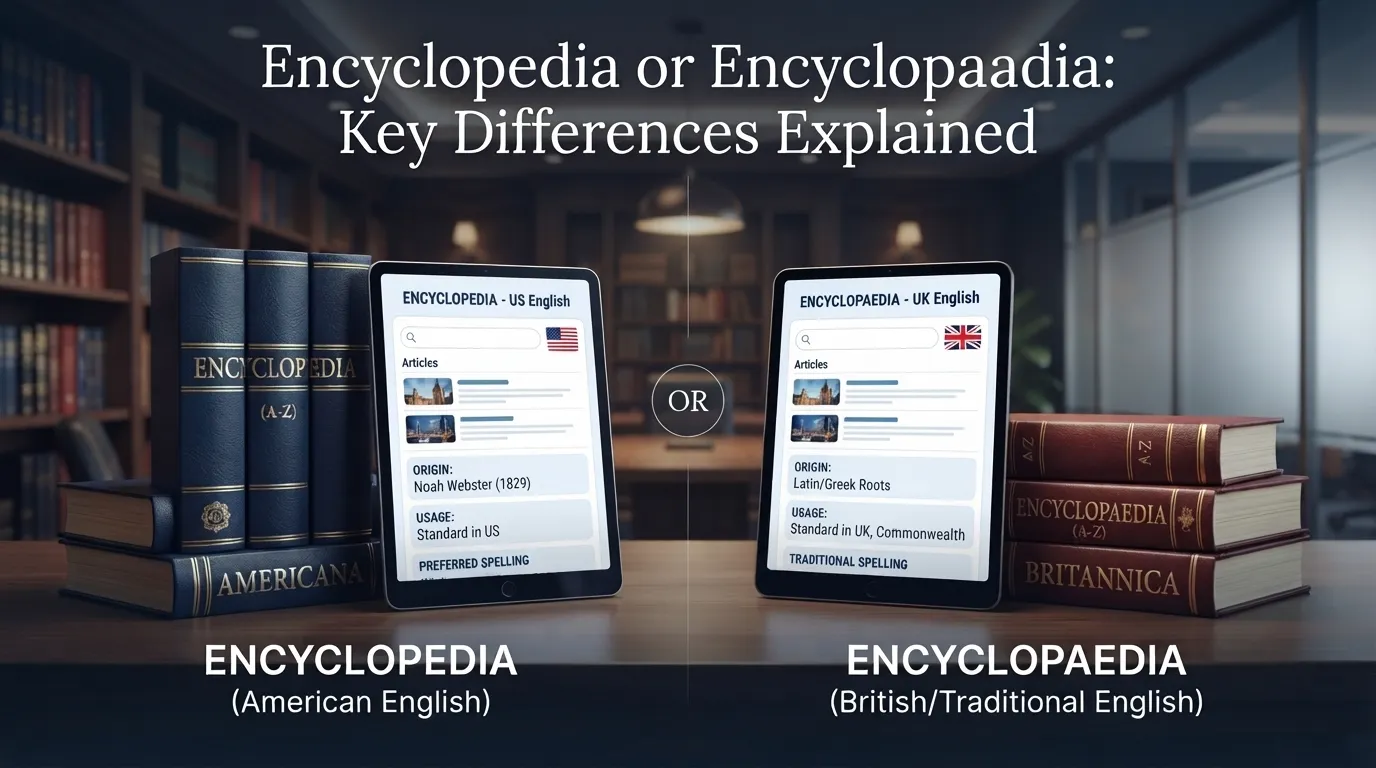
An encyclopedia is a book that helps us learn new things. It has facts about animals, plants, people, places, and many other things. We can read an encyclopedia at home, at school, or in a library. It helps us find answers to our questions.
But have you ever seen the word encyclopaedia? It looks a little different from encyclopedia. You may wonder which word is correct.
The answer is easy. Both encyclopedia and encyclopaedia are correct. They mean the same thing. Only the spelling is different.
People in America usually write encyclopedia. In Britain, people have traditionally used encyclopaedia. Today, people in Britain also use encyclopedia.
For example, you can read an encyclopedia to learn about lions. You can also read an encyclopaedia to learn about birds. Both books can help you learn new facts.
US and UK Pronunciation
Both words are usually said in the same way.
- US English: Encyclopedia — en-sy-klo-pee-dee-uh
- UK English: Encyclopaedia — en-sy-klo-pee-dee-uh
The spelling may look different, but the words sound almost the same.
Difference Between Encyclopedia and Encyclopaedia
The main difference between these words is their spelling. Both words mean a book or other source that gives facts about different things.
1. Spelling
Encyclopedia is the shorter spelling. Encyclopaedia is the longer spelling.
The longer word has an extra “a” after the letters “p” and “a” in the usual spelling pattern.
Examples:
- I have an encyclopedia.
- I have an encyclopaedia.
Both sentences are correct.
2. Meaning
Both words have the same meaning. They tell us about a book or a source of facts.
Examples:
- My encyclopedia tells me about cats.
- My encyclopaedia tells me about dogs.
Both books can help us learn.
3. American English
People in America usually write encyclopedia. This is the common spelling in American books and schoolwork.
Examples:
- I read an encyclopedia.
- My encyclopedia has facts about space.
4. British English
People in Britain have traditionally used encyclopaedia. However, many British writers also use encyclopedia today.
Examples:
- I found an encyclopaedia in the library.
- I read an encyclopedia at school.
Both spellings can be correct in British English.
5. Sound
The two words are usually pronounced in the same way. The extra letter in encyclopaedia does not give it a new meaning.
Examples:
- I can say encyclopedia.
- I can say encyclopaedia.
Both words name the same thing.
6. Use at School
Children can use encyclopedias to learn about new subjects. The spelling they use may depend on their teacher’s instructions.
Examples:
- I used an encyclopedia for my homework.
- I used an encyclopaedia for my school project.
Both examples are correct.
7. Use in Books
Both spellings appear in books. Some books use encyclopedia, while others use encyclopaedia.
Examples:
- This encyclopedia tells us about fish.
- This encyclopaedia tells us about flowers.
Both books give useful facts.
8. Use Online
We can find facts on the internet. Some online sources use encyclopedia, while others may use encyclopaedia.
Examples:
- I found an encyclopedia online.
- I found an encyclopaedia online.
Both spellings refer to the same kind of resource.
9. Number of Letters
The word encyclopedia has 12 letters. The word encyclopaedia has 13 letters.
Examples:
- Encyclopedia is shorter.
- Encyclopaedia is longer.
The longer spelling does not have a different meaning.
10. Correct Use
Both spellings are correct. You can choose the spelling that matches your style of English.
Examples:
- I read an encyclopedia about animals.
- I read an encyclopaedia about animals.
You may also read https://lengovia.com/bengals-or-steelers/
Nature and Behaviour
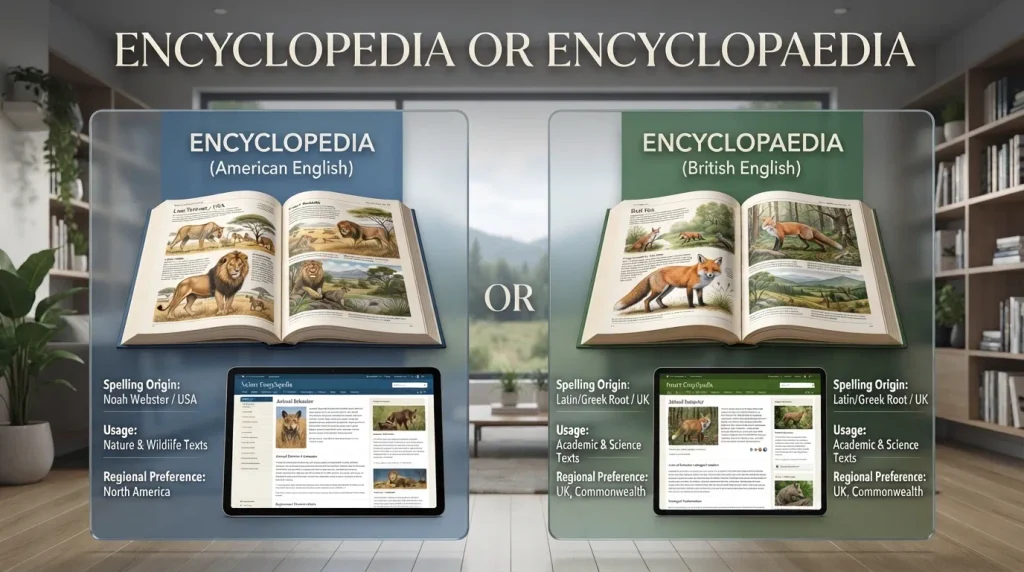
An encyclopedia is a source of facts. It helps us learn about the world around us.
We can read about many things in an encyclopedia, such as:
- Cats, dogs, and other animals
- Trees, flowers, and plants
- The sun, moon, and stars
- People and places
- History and science
For example, a child may want to learn about elephants. The child can look for information in an encyclopedia. Another child may want to learn about the moon and find facts in an encyclopaedia.
Both words describe the same kind of book or reference source. They help us talk about learning and facts.
Why Do People Get Confused?
People get confused because the words look different.
One word is encyclopedia. The other is encyclopaedia. The second word has an extra “a.”
People in different countries may spell some words in different ways. For example, American English uses color, while British English often uses colour.
The same kind of difference appears in encyclopedia and encyclopaedia.
Some children may think that one word is wrong. But both are correct. They have the same meaning.
Remember, you do not need to learn two different meanings. You only need to know that the spelling can change.
Comparison Table
| Feature | Encyclopedia | Encyclopaedia |
| Meaning | A source of facts | A source of facts |
| Spelling | Shorter | Longer |
| American English | Common spelling | Less common |
| British English | Also used | Traditional spelling |
| Pronunciation | Almost the same | Almost the same |
| Correct? | Yes | Yes |
| Example | An encyclopedia about cats | An encyclopaedia about birds |
Origin of the Words
The word encyclopedia comes from old Greek words linked to learning and education. Over time, people began using it for books that collect facts about many subjects.
The spelling encyclopaedia comes from an older spelling style. It became common in traditional British English.
Later, American English mostly used the shorter spelling, encyclopedia. Today, both forms are still used.
The words may look different, but their meaning has stayed the same. Both describe a source that helps people learn about many things.
British English vs American English
British and American English sometimes use different spellings for the same word.
In America, people usually write encyclopedia. In traditional British English, people have often written encyclopaedia. However, the shorter spelling is also used in Britain today.
Here are two examples:
- American English: I read an encyclopedia.
- British English: I read an encyclopaedia.
Both sentences are correct. Neither spelling changes what the sentence means.
If you are writing for an American school, encyclopedia is a good choice. If your teacher wants traditional British spelling, you can use encyclopaedia.
The best rule is to follow your teacher’s instructions and use the same spelling throughout your work.
Which One Should You Use?
You can use either word, but it helps to know who will read your writing.
For American Readers
Use encyclopedia. It is the usual spelling in America.
Example: “I used an encyclopedia to learn about birds.”
For British Readers
You can use encyclopaedia if you are following traditional British spelling. The spelling encyclopedia is also common in modern British English.
Example: “I found an encyclopaedia in the school library.”
For Schoolwork
Always follow your teacher’s instructions. If your teacher asks for American English, use encyclopedia. If your teacher asks for traditional British spelling, use encyclopaedia.
For Everyday Writing
If no one tells you which spelling to use, you can choose either one. Just try to use the same spelling throughout your writing.
Common Mistakes
Here are some mistakes to avoid.
- Do not think encyclopaedia is always wrong.
- Do not think encyclopedia is wrong in British English.
- Do not give the two words different meanings.
- Do not change spellings without a reason.
- Do not confuse an encyclopedia with a dictionary.
An encyclopedia gives facts about subjects, people, places, and ideas. A dictionary mainly tells us what words mean.
Here are some correct sentences:
- I read an encyclopedia about lions.
- My grandfather has an encyclopaedia about history.
- I used an encyclopedia for my schoolwork.
All these sentences use the word correctly.
Everyday Usage
We can use encyclopedias in many parts of daily life. They help us find facts and learn about things we do not know.
At School
Children can use an encyclopedia to help with homework.
Example: “I used an encyclopedia for my science project.”
At Home
Families can read encyclopedias to learn something new.
Example: “My sister read about birds in an encyclopedia.”
In a Library
Libraries may have books that give facts about many subjects.
Example: “I found an encyclopaedia in the library.”
Online
People can also find facts on the internet.
Example: “I searched an online encyclopedia to learn about planets.”
Both spellings are useful when talking about books or sources of facts.
Usage Trends
Today, encyclopedia is a common spelling. It is used in America and in many online resources.
The spelling encyclopaedia is also correct. People may see it in British books or older publications.
You may find either spelling when reading. That is why it is helpful to know both words.
You do not need to worry if you see the longer spelling. It does not mean the word is wrong. Both spellings help us talk about the same kind of resource.
Metaphors and Similes
Sometimes, people use the word encyclopedia to talk about someone who knows many facts.
For example, someone may say:
“My teacher is a walking encyclopedia.”
This means the teacher knows a lot of things. The teacher is not really a book!
Here is another example:
“My dad is a walking encyclopaedia about football.”
This means Dad knows many facts about football.
Both spellings can be used in this expression. The meaning stays the same.
Connotative Meaning
Both words make us think about books, facts, and learning.
The word encyclopedia may look more familiar to people who use American English.
The word encyclopaedia may remind some people of traditional British books.
But both words mean the same thing. Neither spelling is better for learning or finding facts.
Idioms and Proverbs
There is no common proverb that uses one spelling instead of the other. However, people use the phrase “a walking encyclopedia” to describe someone who knows many facts.
Example: “My uncle is a walking encyclopedia about cars.”
This means he knows a lot about cars.
We can also say that a book is “full of facts.”
Example: “This book is full of facts about animals.”
These phrases help us talk about learning and knowledge.
Literature and Movies
Books and movies sometimes show children learning new things. A child in a story may visit a library or read a book to find an answer.
An encyclopedia can help a character learn about animals, planets, or history. It can also help a student solve a problem in a story.
The spelling encyclopedia and the spelling encyclopaedia can both be used when talking about these books.
Neither spelling changes the story or the facts.
Why Does This Difference Matter?
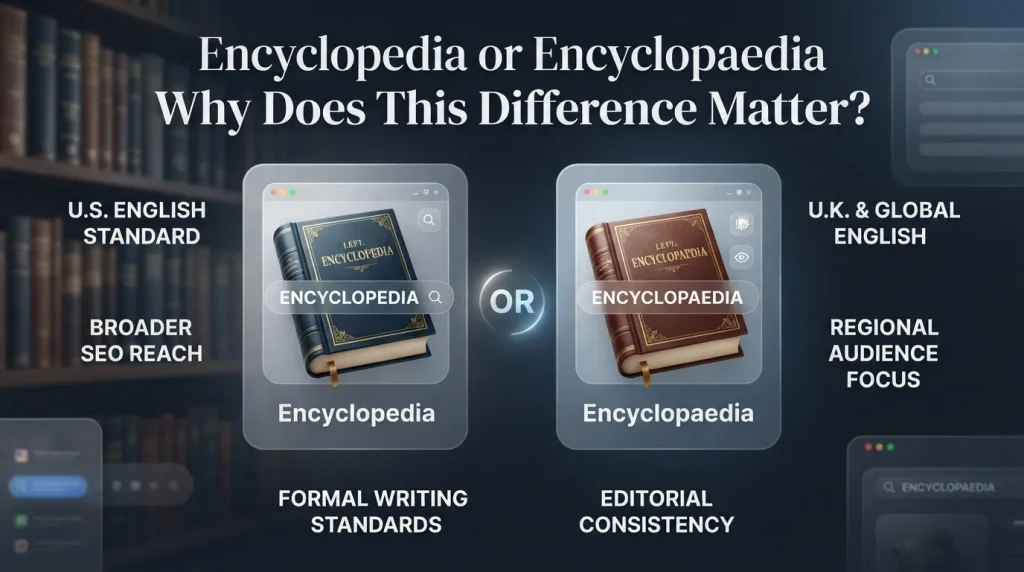
It is helpful to know both spellings because you may see them in different books and websites.
If you see encyclopedia, you will know it is a correct spelling. If you see encyclopaedia, you will know that it is also correct.
This knowledge can help you read better and avoid spelling mistakes.
It can also help you with schoolwork. If your teacher asks you to use a certain style of English, you will know which spelling to choose.
Most importantly, remember that both words have the same meaning.
Usefulness in Daily Life
An encyclopedia can help us learn about many things. We can read about animals, plants, people, places, and space.
For example, you may want to know what a lion eats. You can look for facts in an encyclopedia. If you want to learn about the moon, you can look for information about space.
The spelling encyclopaedia means the same thing. Both words can help us talk about books and sources of facts.
Knowing both spellings makes reading easier. You will not feel confused when you see either word.
Situational Preference
Use encyclopedia when your teacher asks for American English. Use encyclopaedia when your teacher asks for traditional British spelling. If your teacher does not choose a spelling, either word is correct. Both words mean the same thing. You can use an encyclopedia to learn about animals, plants, and many other things. Remember to follow your teacher’s instructions and use one spelling throughout your work.
Fill in the Blanks
Complete each sentence with the correct word.
- An __________ is a book or source of facts.
- Both words have the same __________.
- People in America usually write __________.
- __________ is a traditional British spelling.
- I can learn about animals in an __________.
Answers:
- encyclopedia
- meaning
- encyclopedia
- Encyclopaedia
- encyclopedia
Multiple-Choice Questions
1. What is an encyclopedia?
A. A toy B. A source of facts C. A shoe D. A ball
Answer: B. A source of facts
2. Which spelling is common in American English?
A. Encyclopaedia B. Encyclipedia C. Encyclopedia D. Encyklopedia
Answer: C. Encyclopedia
3. Are both spellings correct?
A. Yes B. No C. Only in America D. Only in Britain
Answer: A. Yes
4. What can we learn from an encyclopedia?
A. Facts B. Nothing C. Only songs D. Only games
Answer: A. Facts
5. What should you do if your teacher asks for one spelling?
A. Ignore the teacher B. Make up a word C. Use both in every sentence D. Follow the teacher’s choice
Answer: D. Follow the teacher’s choice
Possible Questions
1. Is encyclopedia correct?
Yes. Encyclopedia is a correct spelling.
2. Is encyclopaedia correct?
Yes. Encyclopaedia is also correct. It is a traditional British spelling.
3. Do both words mean the same thing?
Yes. Both words mean a book or source that gives facts.
4. Which spelling do people in America use?
People in America usually use encyclopedia.
5. Which spelling is traditional in Britain?
Encyclopaedia is the traditional British spelling.
6. Can I use either spelling?
Yes. You can use either spelling. Follow your teacher’s instructions if you have any.
7. What can an encyclopedia teach us?
It can teach us about animals, plants, people, places, and many other things.
Conclusion
Encyclopedia or encyclopaedia are both correct spellings. They mean the same thing. An encyclopedia is a book or source full of facts. It can help us learn about animals, plants, people, places, and space. People in America usually write encyclopedia. In Britain, people have traditionally used encyclopaedia. Today, both spellings are used. Remember, the words look different, but their meaning is the same. If your teacher asks you to use one spelling, follow that rule. Keep reading, keep learning, and have fun with new words!

Mahnoor Afzal is an educator, researcher, and English language content specialist focused on grammar, vocabulary, word differences, and meanings. I combines research, teaching, and SEO expertise to create clear and reliable English learning content at Lengovia.






1 thought on “Encyclopedia or Encyclopaedia: Key Differences Explained”