
Have you heard the words gemologist and excavator? They mean two different things.
A gemologist is a person who studies gems. Gems are pretty stones, like diamonds and rubies. A gemologist looks at these stones and learns about them.
An excavator is a big machine. It digs the ground and moves dirt and rocks. You may see an excavator at a place where people build houses or roads.
Think about a jewelry shop. A person checks a diamond. This person may be a gemologist. Now think about a big machine digging a hole. That machine is an excavator.
Both are useful, but they do different jobs. A gemologist works with gems. An excavator digs the ground.
What Is a Gemologist?
A gemologist is a person who studies gems. Gems are stones that people use to make rings, necklaces, and other jewelry.
Some gems are very costly. A gemologist can look at a gem and learn more about it.
A gemologist may work in a jewelry shop or a lab. They use special tools to look closely at stones.
Examples:
- The gemologist looked at a diamond.
- The gemologist checked a red ruby.
How to Say Gemologist
The word gemologist sounds like jem-OL-uh-jist.
In American English, people write gemologist. In British English, people may write gemmologist.
What Is an Excavator?
An excavator is a big machine that digs the ground. It has a long arm and a big bucket.
The bucket can dig dirt and pick up rocks. Excavators help people build roads and houses.
A person sits in the machine and controls it. This person is called an excavator operator.
Examples:
- The excavator dug a big hole.
- The excavator moved the dirt.
How to Say Excavator
The word excavator sounds like EKS-kuh-vay-ter.
You may see an excavator at a building site. It helps workers move dirt from one place to another.
10 Differences Between a Gemologist and an Excavator

1. What They Are
A gemologist is a person. An excavator is usually a machine.
Examples:
- The gemologist held a gem.
- The excavator dug the ground.
2. What They Do
A gemologist studies gems. An excavator digs dirt and moves rocks.
Examples:
- The gemologist checked a ruby.
- The excavator dug a hole.
3. Where They Work
A gemologist may work in a shop or a lab. An excavator works at places where people dig the ground.
Examples:
- The gemologist worked in a shop.
- The excavator worked near a road.
4. What They Use
A gemologist uses tools to look at gems. An excavator uses a bucket to dig.
Examples:
- The gemologist used a small tool.
- The excavator used its big bucket.
5. What They Look At
A gemologist looks at stones. An excavator moves dirt and rocks.
Examples:
- The gemologist looked at a diamond.
- The excavator moved some rocks.
6. What They Need to Know
A gemologist needs to know about gems. An excavator operator needs to know how to use the machine safely.
Examples:
- The gemologist learned about rubies.
- The operator learned to use the excavator.
7. What They Help With
A gemologist helps people learn about gems. An excavator helps people dig the ground.
Examples:
- The gemologist helped a buyer.
- The excavator helped build a road.
8. What They Work With
A gemologist works with gems. An excavator works with dirt, sand, and rocks.
Examples:
- The gemologist held a blue gem.
- The excavator moved sand.
9. What They Can Find
A gemologist can help tell what kind of gem a stone is. An excavator can dig up things from the ground.
Examples:
- The gemologist checked a green stone.
- The excavator dug up some old stones.
10. Why They Are Useful
A gemologist helps people learn about gems. An excavator helps people prepare land for building.
Examples:
- The gemologist checked a ring.
- The excavator cleared the land.
You may also read https://lengovia.com/amorcito-or-amorcita/
Gemologist vs. Excavator: Easy Table
| Gemologist | Excavator |
| A person | Usually a machine |
| Studies gems | Digs the ground |
| Looks at stones | Moves dirt and rocks |
| May work in a shop | May work at a building site |
| Uses small tools | Uses a big bucket |
| Knows about gems | Digs and moves earth |
| Helps people learn about stones | Helps people build roads |
| May check a diamond | May dig a hole |
| Works with gems | Works with dirt and rocks |
| Helps in the gem trade | Helps in building work |
Where Do These Words Come From?
The word gemologist comes from the word gem. A gem is a pretty stone that can be used in jewelry.
The word excavator comes from a word that means to dig. An excavator is a machine that digs the ground.
These word meanings can help you remember the difference.
British English and American English
People in the United States often write gemologist.
People in the United Kingdom may write gemmologist.
Both words mean a person who studies gems.
The word excavator is used in both American and British English. It usually means a machine that digs the ground.
Examples:
- The gemologist checked the stone.
- The excavator dug a hole.
Why Do People Mix Up These Words?
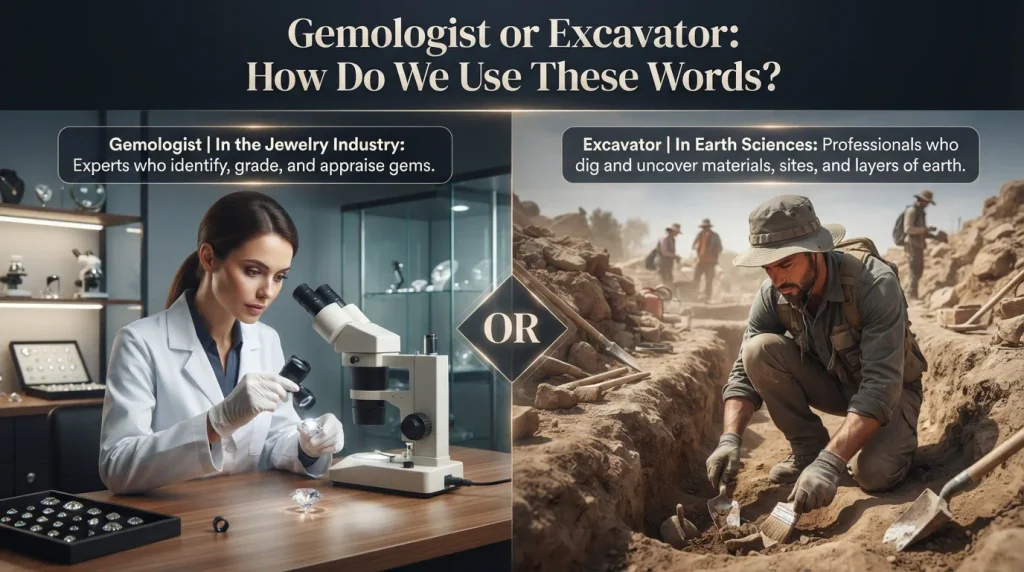
Both words are long. They may look hard to read. But their meanings are not the same.
A gemologist studies gems. An excavator digs the ground.
Sometimes, people may find gems in the ground. A machine may help dig the earth, and a gemologist may study the gems later.
Remember:
- Gemologist = studies gems
- Excavator = digs the ground
Common Mistakes
Mistake 1: Calling an Excavator a Gemologist
An excavator does not study gems. It is usually a machine.
Wrong: The gemologist dug a hole.
Right: The excavator dug a hole.
Mistake 2: Calling a Gemologist an Excavator
A gemologist studies gems. They do not usually drive a digging machine.
Wrong: The excavator checked the diamond.
Right: The gemologist checked the diamond.
Mistake 3: Using the Wrong Spelling
Gemologist is common in American English. Gemmologist is also used in British English.
Both words describe someone who studies gems.
How Do We Use These Words?
We use the word gemologist when we talk about gems and jewelry.
Examples:
- I asked a gemologist about my ring.
- The gemologist looked at the diamond.
We use the word excavator when we talk about digging and building.
Examples:
- The excavator dug a hole.
- We saw an excavator near the road.
Simple Comparisons
We can use easy comparisons to help us remember these words.
A gemologist is like a gem detective. The person looks closely at stones to learn about them.
An excavator is like a big digging arm. It digs dirt and moves rocks.
These are just ways to help us picture their jobs.
Gemologists and Excavators in Stories
Gems and digging machines can appear in books, cartoons, and films.
In some stories, a character finds a shiny stone or a hidden treasure. A gemologist may help explain what the stone is.
In children’s shows, excavators often help build roads and houses. They can teach children about big machines and how they work.
Both can be part of a story, but they do different things.
Why Is It Good to Know the Difference?
Knowing these words helps us speak and write clearly.
If you want to learn about a diamond, you may need a gemologist. If you need to dig a hole for a building, an excavator may help.
Using the right word helps other people understand you.
Remember that a gemologist studies gems, while an excavator usually digs the ground.
Expected Questions
1. What is a gemologist?
A gemologist is a person who studies gems.
2. What is an excavator?
An excavator is usually a big machine that digs the ground.
3. Can a gemologist check a diamond?
Yes. A gemologist can study a diamond and learn about its features.
4. Can an excavator dig a hole?
Yes. An excavator is made to dig and move dirt.
5. Is a gemologist a machine?
No. A gemologist is a person.
6. Is an excavator always a machine?
Most often, the word means a machine. It can also mean a person who digs.
7. How can I remember the difference?
A gemologist studies gems. An excavator digs the ground.
Fill in the Blanks
Fill in each blank with the right word.
- A __________ studies gems.
- An __________ can dig a big hole.
- A diamond is a kind of __________.
- An excavator moves dirt and __________.
- A gemologist may work in a jewelry __________.
Answers: 1) gemologist 2) excavator 3) gem 4) rocks 5) shop
Multiple-Choice Questions
1. Who studies gems?
A) A driver
B) A gemologist
C) A cook
D) A farmer
🟢 Answer: B) A gemologist
2. What does an excavator do?
A) Sings songs
B) Makes food
C) Digs the ground
D) Reads books
🟢 Answer: C) Digs the ground
3. Which one is a gem?
A) Diamond
B) Chair
C) Shoe
D) Spoon
🟢 Answer: A) Diamond
4. Where might you see an excavator?
A) In a school bag
B) On a building site
C) In a lunch box
D) On a bed
🟢 Answer: B) On a building site
5. Which word means a person who studies gems?
A) Excavator
B) Builder
C) Gemologist
D) Driver
🟢 Answer: C) Gemologist
Conclusion
A gemologist or excavator are very different. A gemologist is a person who studies gems. Gems include diamonds and rubies. A gemologist looks at stones and learns about them. An excavator is usually a big machine. It digs the ground and moves dirt and rocks. People use it to help build roads and houses. Both are useful in their own way. A gemologist helps people learn about gems. An excavator helps people dig the ground. It is easy to remember the difference. A gemologist studies gems. An excavator digs the ground. Use these words the right way, and your writing will be clear.

Mahnoor Afzal is an educator, researcher, and English language content specialist focused on grammar, vocabulary, word differences, and meanings. I combines research, teaching, and SEO expertise to create clear and reliable English learning content at Lengovia.












1 thought on “Gemologist or Excavator: What Is the Difference?”